Saia Shares Drop 12% as Q3 Margin Guidance Overshadows Strong Q2 Results
Key Takeaways
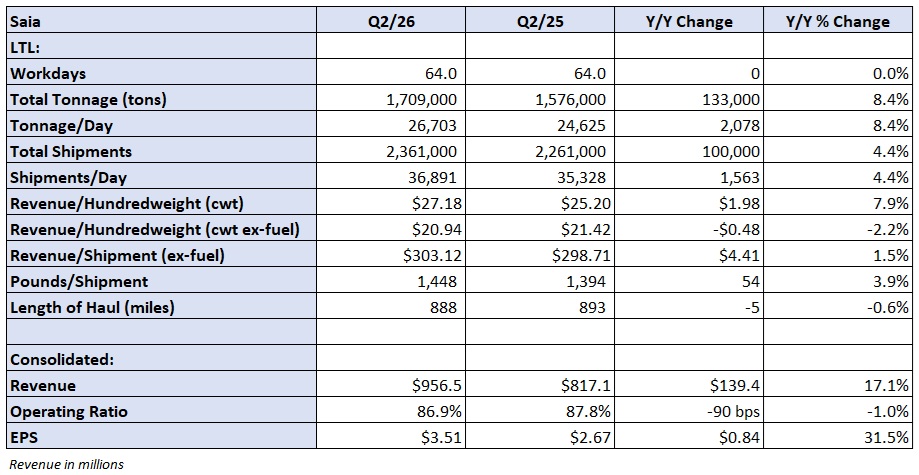
- •Saia reported second-quarter EPS of $3.51, beating the consensus estimate by 12 cents and rising 84 cents year over year, while revenue increased 17% to $957 million.
- •The company narrowed its full-year margin outlook to the lower end of a 100-to-200-basis-point improvement range, projecting a third-quarter operating ratio of 87.9% that would be 30 basis points worse year over year excluding a real estate sale gain.
- •Newer service centers opened since 2022 improved margins by roughly 300 basis points in Q2 but still carry operating ratios in the low-90% range, trailing the established network.
- •Saia implemented a 7.1% general rate increase on July 6, which was 120 basis points larger and three months earlier than the prior year's hike.
- •Contractual renewal pricing averaged 10.7% in the second quarter, significantly outpacing peers, though management acknowledged Saia remains priced below market for the service levels it provides.
Shares of less-than-truckload carrier Saia (NASDAQ: SAIA) fell 12% in midday trading on Thursday after management issued a softer-than-expected third-quarter margin outlook, dampening an otherwise better-than-anticipated second-quarter earnings report.
The Johns Creek, Georgia-based company has invested more than $1 billion in real estate in recent years, expanding its footprint to become a truly national carrier. Saia's expansion took on added urgency following the July 2023 collapse of Yellow Corporation — then the third-largest U.S. LTL carrier — which displaced billions of dollars in annual freight and prompted shippers to redirect volumes to surviving carriers. However, newly opened locations continue to lag the profitability of the legacy network, pressuring near-term margins.
On a Thursday call with analysts, Saia narrowed its full-year margin outlook, saying it now expects to land at the lower end of a previously communicated range calling for 100 to 200 basis points of year-over-year improvement.
"Our strong second quarter results highlight the continued enhancement of our expanded service offering, disciplined execution and the commitment of our team members," said Saia CEO Fritz Holzgrefe. "We achieved record revenue and tonnage, along with a second-quarter record in shipments, reflecting solid growth across our network."
Saia reported second-quarter earnings per share of $3.51 before the market opened on Thursday. The result was 84 cents higher year over year and 12 cents above the consensus estimate. A lower tax rate relative to the prior-year quarter provided a 2-cent tailwind, while a $3 million decline in net interest expense added another 8-cent benefit.
Revenue climbed 17% year over year to $957 million, largely in line with consensus expectations. Both tonnage and yield rose 8% year over year, though yield excluding fuel surcharges declined 2%.
The tonnage increase was driven by 4% growth in both shipment counts and average shipment weights. Monthly tonnage trends showed steady acceleration: up 6.9% year over year in April, 8.4% in May, and 9.9% in June. July tonnage was 7.5% higher year over year.
Saia implemented a 7.1% general rate increase on July 6 — 120 basis points larger and three months earlier than last year's rate hike. Management noted that GRI implementations typically create some near-term volatility in shipment counts as shippers evaluate their options. On a two-year-stacked basis to smooth out prior-year comparisons, Saia's tonnage has remained in a range of plus-8% to plus-9% over the past three months. The company's prior-year comparisons range from mostly negative to slightly positive for the remainder of the year.
Management also addressed the 2% year-over-year yield decline, which stood out somewhat compared to peers. Higher shipment weights and a 1% reduction in length of haul acted as headwinds to revenue per hundredweight. Excluding those factors, as well as the Los Angeles market where shipment counts remain soft — still down 2.5% — management estimated that net yield was likely up 3% year over year.
Contractual renewals averaged 10.7% in the second quarter, or up 15.8% on a two-year-stacked comparison. The result was well ahead of peers, though management acknowledged that Saia's offering remains priced below market relative to the service levels it delivers. The LTL sector's consolidated structure — in which a handful of national carriers dominate after decades of attrition — has generally supported pricing discipline even as the broader trucking industry navigated a prolonged freight downturn that began in 2023.
Saia posted an 86.9% operating ratio — the inverse of operating margin — in the quarter, a 90-basis-point improvement year over year. This marked the carrier's first year-over-year OR improvement since the first quarter of 2024 and came in ahead of management's implied guidance of 87.5%.
The carrier typically experiences 150 to 200 basis points of margin deceleration between the second and third quarters, but this year it expects only 100 basis points of sequential decline. The guidance implies a third-quarter operating ratio of 87.9%, which would be 30 basis points worse year over year, excluding the OR impact from a real estate sale gain recorded in the third quarter of 2025. Management attributed the perceived weakness in the outlook to a pull-forward in the timing of wage increases.
The continued ramp-up of new service centers has also weighed on margins. Since 2022, Saia has opened 33 new locations and expanded or relocated another 25 terminals, increasing its total door count by 25%. Margins at these newer facilities improved by approximately 300 basis points during the second quarter, but their operating ratios remain in the low-90% range, still trailing the company's established network.
Saia reiterated its full-year net capital expenditure guidance of $350 million to $400 million. Net capex totaled $544 million in 2025 and $1.05 billion in 2024.
As of 12:15 p.m. EDT on Thursday, SAIA shares were down 11.7%, while the S&P 500 was up 1.3%.
Saia is one of a limited number of publicly traded LTL carriers, making its quarterly results a valuable barometer for a trucking subsegment where publicly available data remains scarce. With the carrier signaling that new terminal maturation and wage timing will pressure margins in the coming quarter, investors will be watching whether continued tonnage growth and the larger, earlier GRI can offset those headwinds as the year progresses.

