Hyperscaler CDS Hit Record High as Korea's AI Chip Selloff Erases $620 Billion From KOSPI
Key Takeaways
- •Approximately $620 billion was erased from South Korea's KOSPI index as investors aggressively sold semiconductor shares amid a broad reassessment of AI-driven valuations.
- •Credit Default Swaps tied to major hyperscale technology companies rose to record levels, signaling growing market caution about the financial risks associated with massive AI infrastructure spending.
- •Samsung Electronics and SK Hynix control a substantial majority of the global DRAM market and are leading suppliers of HBM chips critical for AI accelerators, making Korean semiconductor stocks a key indicator for global technology markets.
- •The largest cloud providers have collectively committed capital expenditures running into the hundreds of billions of dollars annually, with investors increasingly scrutinizing whether AI revenue growth justifies these investments.
- •Despite the sharp market decline, many industry experts believe the long-term AI investment cycle remains intact as adoption continues expanding across healthcare, finance, manufacturing, and other sectors.
Hyperscaler CDS Hit Record High as Korea's AI Chip Selloff Erases $620 Billion From KOSPI
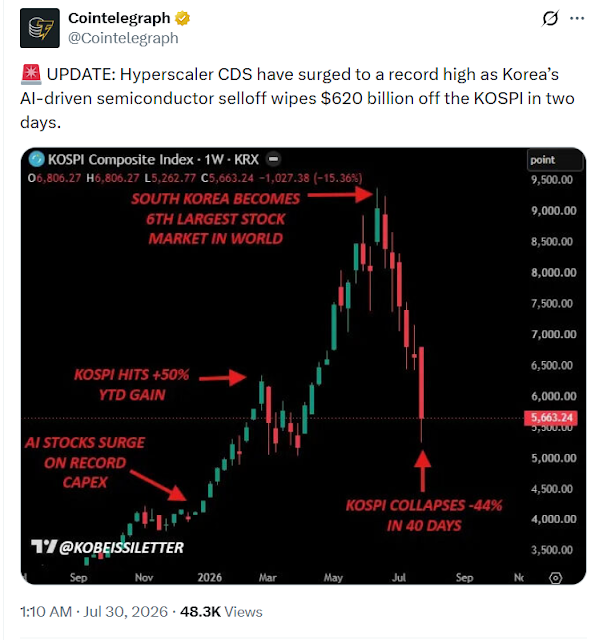
A sweeping selloff in South Korea's semiconductor sector has erased approximately $620 billion from the KOSPI, the country's benchmark stock index dominated by major technology exporters, marking one of the most dramatic declines in the country's technology-heavy equity market. The turmoil follows months of extraordinary investor enthusiasm around artificial intelligence, with market participants now reassessing valuations, capital expenditure expectations, and long-term profitability across the semiconductor and cloud computing industries.
The development was highlighted by the X account of Cointelegraph, which reported the rapid surge in hyperscaler Credit Default Swaps (CDS) alongside the historic decline in South Korea's equity market. The original post can be found at https://x.com/Cointelegraph/status/2082529245725671847.
AI Optimism Gives Way to Risk Repricing
Artificial intelligence has been the primary driver behind global equity market gains over the past several years. Demand for advanced graphics processors, AI accelerators, high-bandwidth memory chips, and cloud infrastructure fueled unprecedented growth among semiconductor manufacturers and hyperscale cloud providers such as Amazon, Microsoft, Google, and Meta.
However, market sentiment shifted abruptly as investors began questioning whether current valuations had moved too far ahead of actual earnings potential. The latest selloff reflects growing uncertainty around several key issues:
- Slowing return on AI infrastructure investments
- Rising financing costs
- Increasing competition among chip manufacturers
- Massive capital spending requirements
- Concerns over future profit margins
These factors combined to trigger widespread selling across South Korea's semiconductor sector, one of the world's most important suppliers of advanced memory chips used in AI servers.
Why South Korea Matters to the Global AI Industry
South Korea plays a critical role in the global semiconductor supply chain. The country is home to some of the world's largest manufacturers of memory chips, advanced packaging technologies, and semiconductor materials that power AI data centers worldwide. Samsung Electronics and SK Hynix together control a substantial majority of the global DRAM market and are leading suppliers of HBM chips critical for AI accelerators, making the KOSPI heavily concentrated in companies whose fortunes are tied directly to global AI hardware demand.
As global AI demand accelerated over the past two years, Korean chipmakers experienced remarkable gains, helping push the KOSPI to record levels. Because of this market concentration, any significant decline in Korean semiconductor stocks often serves as an early warning signal for broader weakness across global technology markets. The latest downturn attracted immediate attention from institutional investors worldwide.
Record High Hyperscaler CDS Raises New Concerns
One of the most closely watched indicators during the selloff was the sharp increase in Credit Default Swaps tied to major hyperscale technology companies. A CDS is essentially an insurance contract that protects investors against the possibility that a borrower may fail to meet its financial obligations. When CDS prices rise sharply, it generally indicates that investors perceive higher credit risk. CDS spreads on major technology companies have historically been low compared to other corporate sectors, reflecting their strong balance sheets and cash generation.
Although major hyperscalers remain financially strong and continue generating billions of dollars in annual cash flow, the rapid increase in CDS spreads suggests markets are becoming increasingly cautious about future risks associated with massive AI spending. The move does not necessarily imply that investors expect defaults. Instead, it reflects a reassessment of financial risk as companies continue investing hundreds of billions of dollars into AI infrastructure.
AI Infrastructure Spending Faces Greater Scrutiny
Large cloud providers have announced enormous investments in AI data centers over the past year. These projects require substantial spending on:
- Advanced GPUs
- High-bandwidth memory
- Networking equipment
- Power infrastructure
- Cooling systems
- Semiconductor manufacturing capacity
Collectively, the largest hyperscalers have committed capital expenditures running into the hundreds of billions of dollars annually, with AI infrastructure representing a growing share of that total. While demand for AI services remains strong, investors are beginning to ask whether current revenue growth will justify the enormous capital expenditures being made across the industry. This changing narrative has become one of the biggest themes influencing global technology markets.
Semiconductor Stocks Lead Market Decline
Technology shares accounted for the majority of losses across South Korea's stock market. Investors aggressively reduced exposure to companies connected with AI memory chips, advanced semiconductor manufacturing, chip packaging, data center equipment, and AI hardware suppliers.
The broad-based selling pressure spread quickly across related sectors as concerns over future earnings intensified. Analysts noted that valuation multiples across several AI-linked companies had reached historically elevated levels following months of relentless gains. As market expectations became increasingly difficult to exceed, even relatively small disappointments triggered significant price declines.
Global Investors Shift Toward Defensive Assets
The selloff also prompted investors to rotate capital into more defensive investments. During periods of elevated uncertainty, portfolio managers often reduce exposure to high-growth technology companies and increase allocations toward government bonds, cash positions, defensive equities, gold, and stable dividend-paying companies.
This shift reflects changing market psychology rather than a collapse in long-term confidence toward artificial intelligence. Many analysts continue viewing AI as one of the most transformative technological developments of the decade, even as valuations undergo a correction.
Could This Become a Broader Technology Correction?
Market participants are now debating whether the recent decline represents a temporary pullback or the beginning of a broader technology correction. The selloff in Korean semiconductor stocks follows similar valuation pressures observed in U.S. technology shares and other global markets, suggesting the risk repricing is not isolated to a single country. Several factors will likely determine the market's next direction.
Future corporate earnings will remain one of the most important catalysts. Strong quarterly results could restore investor confidence, while weaker-than-expected guidance may extend the current volatility. Capital expenditure announcements from major cloud providers will also be closely monitored, as investors increasingly want evidence that massive AI investments are translating into sustainable revenue growth.
Interest rate expectations remain another key variable. Higher borrowing costs generally reduce the present value of future earnings, placing additional pressure on high-growth technology companies. Semiconductor demand trends over the coming quarters will provide important insight into whether AI infrastructure spending remains as strong as previously expected.
AI Investment Boom Remains Intact Despite Market Volatility
Despite the sharp market decline, many industry experts believe the long-term AI investment cycle remains far from over. Artificial intelligence adoption continues expanding across numerous industries, including healthcare, finance, manufacturing, cybersecurity, education, logistics, and software development. Governments and private companies around the world continue announcing new investments in AI infrastructure, suggesting demand for advanced semiconductors is unlikely to disappear.
Instead, the current selloff may represent a period of valuation adjustment following one of the strongest technology rallies in recent history. Historically, rapidly growing sectors often experience periods of heightened volatility as investors reassess expectations against actual financial performance.
What Investors Are Watching Next
Attention is now turning toward upcoming earnings reports from major semiconductor manufacturers and hyperscale cloud providers. Markets will closely analyze revenue growth from AI services, data center expansion plans, capital expenditure forecasts, profit margins, demand for AI chips, enterprise AI adoption, and cloud infrastructure utilization.
These indicators will help determine whether recent concerns are temporary or signal a more meaningful shift in the technology investment landscape.
For now, volatility remains elevated as investors balance extraordinary long-term opportunities in artificial intelligence against short-term valuation risks and macroeconomic uncertainty. The record surge in hyperscaler CDS alongside the massive decline in South Korea's stock market serves as a reminder that even the strongest technology sectors remain vulnerable to rapid sentiment shifts. While the AI revolution continues to reshape the global economy, financial markets are increasingly demanding stronger evidence that unprecedented infrastructure spending will ultimately translate into sustainable profits.
As global investors digest the latest developments, the performance of South Korea's semiconductor industry may continue serving as a critical barometer for the broader AI economy in the months ahead.

