RWA Perpetual Futures Set New $2T Quarterly Volume Record as Q3 Draws to a Close
Key Takeaways
- •Q3 2026 cumulative RWA perpetual futures trading volume exceeded $2 trillion, up from $1.2 trillion in Q2.
- •Hyperliquid's HIP-3 carried over 87% of RWA perpetual futures trading as of August 24, surpassing Binance as the leading venue.
- •RWA market capitalization stands above $45 billion, with 51.9% of the market built on Ethereum.
- •Trading is concentrated in US stocks, gold, oil, and AI-linked Asian companies such as SK Hynix, with the S&P 500 contract among the most active.
- •The RWA sector attracted over $16 billion in liquidity over the past year, while tokenized bonds and money markets remain largely untapped by DEX trading and DeFi lending.
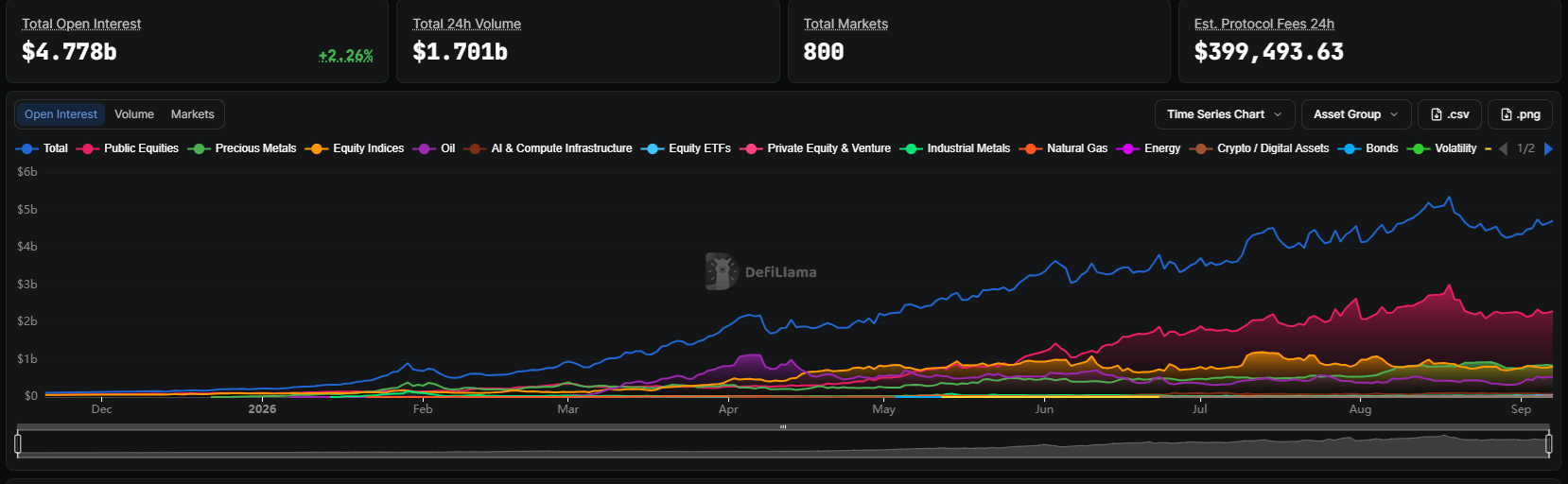
Real-world asset (RWA) perpetual futures have remained one of the strongest trends in the crypto market, with cumulative trading volume for the third quarter breaking above the $2 trillion milestone even before the quarter has ended.
The sector retained its active growth trend through Q3, according to Cryptorank data. Q3 cumulative trading exceeded $2T, up from $1.2T in Q2. Monthly trading volume surpassed $100M in June, while the sector reached peak activity in July.
RWA perpetual futures trading began as a relatively niche corner of the market, with most crypto activity concentrated in BTC, coins, and tokens. The 2026 bear market pushed traders toward new liquidity venues, while technological advances allowed the rapid representation of stocks and commodities on-chain. Unlike direct tokenized ownership of an asset, perpetual futures let traders take leveraged long or short positions on price exposure without holding the underlying asset, which has made them a faster-to-market format for on-chain traditional-finance instruments.
As Cryptopolitan reported, RWA assets are also being added as collateral to DeFi protocols, becoming more influential and widely adopted. RWA market capitalization now stands above $45B, with 51.9% of the market running on Ethereum, according to Token Terminal data. That growth tracks a broader tokenization push, in which traditional asset managers and financial institutions have increasingly experimented with bringing funds, bonds, and commodities onto public blockchains.
RWA has appealed to both whales and retail traders by offering highly liquid markets, minimizing the chance of the rug pulls or crashes to zero that often wipe out crypto tokens.
RWA perpetual futures still focus on hot assets
As of September 2026, RWA perpetual futures generate roughly $400K in daily fees and remain among the most active on-chain applications. Trade XYZ still carries the most active contracts, based on DeFi Llama data. The S&P 500 contract on XYZ was the most active, while oil and gold enjoyed periods of increased demand.
In September, trading has been mostly concentrated in a few selected AI narrative companies, including SK Hynix. Gold and oil also rank among the top contracts, with more fluctuation in single-equity trading. The tilt toward AI-linked equities mirrors the same thematic rotation seen in conventional equity markets this year, where AI supply-chain names have drawn outsized attention.
Most of the cumulative volume for perpetual futures came from the spike in late July, which received a boost from the public sale of SpaceX (Nasdaq: SPCX), as Cryptopolitan previously covered.
For most of 2026, Binance was the leading venue for RWA perpetual futures. In August, however, Hyperliquid's HIP-3 shifted the balance toward DEX activity. As of August 24, HIP-3 carried over 87% of RWA perpetual futures trading and over 73% of all DEX perpetual futures trading, according to Dune data.
Former legacy leaders such as Kraken, Coinbase, and OKX held only a small share of perpetual futures activity. The September balance suggests decentralized markets may be the cutting edge for RWA perpetual futures adoption. The shift also mirrors a wider pattern in crypto this cycle, in which on-chain venues have captured trading activity that previously flowed exclusively through centralized exchanges.
Can RWA boost crypto liquidity?
Hyperliquid's HIP-3 proved to be the leading tool for launching RWA perpetual futures contracts. The platform demonstrated that a contract can be launched quickly, as in the case of SK Hynix or China's CXMT, precisely as those companies drew attention to their stocks. This speed stands in contrast to traditional exchanges and regulated tokenized-equity platforms, where listing new instruments typically involves longer approval processes.
For now, perpetual futures platforms rarely host small or niche shares, focusing mostly on US stocks alongside handpicked Asian companies tied to the RWA narrative. Whether the sector broadens beyond headline names, and whether tokenized bonds and money markets become tradeable collateral on-chain, are the key milestones to watch as Q4 begins.
The rapid growth of RWA trading has also opened new potential for liquidity inflows into crypto. The RWA market remains small compared with previous coin and token trading activity, but growth over the past 18 months has been exponential.
The RWA market is also much smaller than the previous wave of treasury companies. Over the past year, the sector drew in over $16B in liquidity, still relatively modest compared with funds in treasuries.
The main difference is that RWA assets can expand and serve as collateral, offering more secure liquidity on decentralized markets. An active RWA sector could increase lending based on more conservative assets and avoid the risk of crypto-based collateral liquidations.
Beyond stocks and commodities, the biggest share of value remains in tokenized bonds and money markets, which have yet to be tapped by decentralized lending or DEX trading.
