Russia-Linked Shipping Adapts to Ukrainian Drone Threat with Cages, Convoys, and Coastal Routes
Key Takeaways
- •The sanctioned suezmax tanker Caruzo was photographed fitted with anti-drone netting over its accommodation block and cage-like structures along its hull while carrying approximately one million barrels of Russian crude through Istanbul.
- •Russian authorities have discussed placing armed military detachments, heavy machine guns, and anti-drone equipment aboard merchant vessels operating from the Sea of Azov, along with organizing patrol-boat escorts and convoys.
- •Some Russia-linked vessels have adopted coastal routing along Turkey's shoreline to benefit from proximity to NATO territory, while others have suspended Black Sea services or remained in port following Ukrainian drone strikes.
- •Ukraine paused drone strikes on tankers calling at Novorossiysk after US Vice-President JD Vance raised concerns about oil market disruption and damage to vessels carrying non-sanctioned Kazakh crude through the Caspian Pipeline Consortium terminal.
- •Ukraine's Unmanned Systems Forces claims to have struck over 200 vessels since early July, though this figure has not been independently verified.
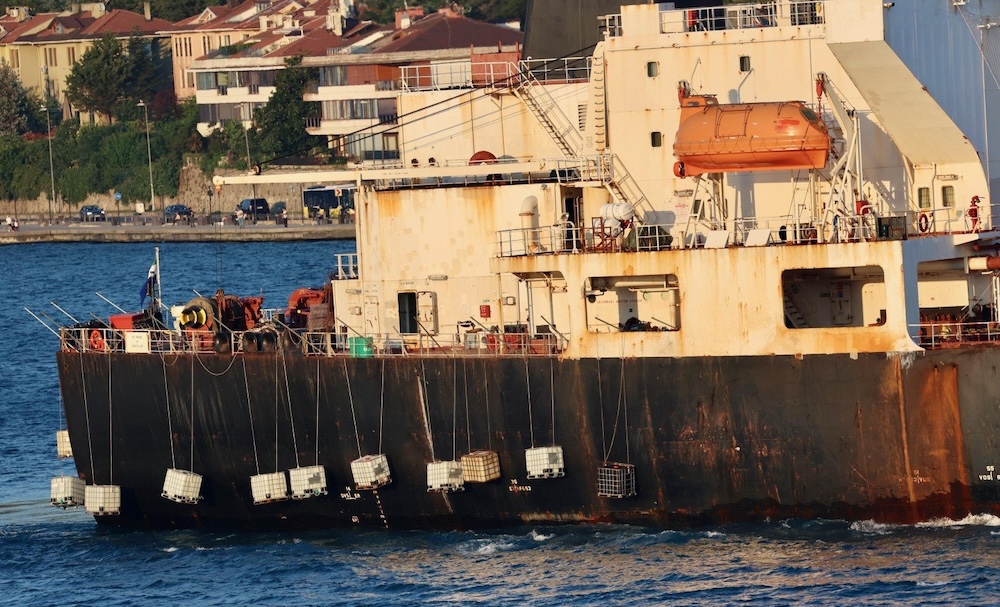
Russia-linked shipping is adopting a range of improvised defensive measures — from anti-drone netting and cage structures to coastal route planning and proposed armed convoys — in response to Ukraine's expanding maritime drone campaign across the Black Sea and Sea of Azov. The campaign marks a significant extension of Kyiv's uncrewed surface vessel operations, which began targeting Russian warships in 2022 and have since expanded to commercial vessels tied to the Russian export economy.
The most striking example documented to date is the 28-year-old suezmax tanker Caruzo, which was photographed by TankerTrackers.com as it transited Istanbul carrying approximately 1 million barrels of Russian crude. The vessel was fitted with netting over its accommodation block and unusual cage-like structures suspended over the aft section of the hull. According to TankerTrackers.com, the netting is designed to shield the superstructure from aerial drones, while the hanging structures appear intended to provide stand-off protection for the engine-room area against uncrewed surface vessels. Caruzo is sanctioned by the UK, the EU, and several other jurisdictions.
These physical modifications represent the most visible sign of the increasingly ad hoc countermeasures being deployed as Ukraine expands its targeting of commercial shipping tied to the Russian economy. The adaptations pair low-tech barriers, armour plating, and sandbags with more fundamental changes to voyage planning and routing.
Coastal routing has emerged as one defensive strategy. Earlier this year, the Russian-flagged tanker Strateg drew attention when tracking data showed it hugging the Turkish coastline instead of taking a more direct route across open Black Sea waters. TankerTrackers.com assessed that the vessel was likely seeking the relative protection afforded by proximity to NATO member Turkey. Other tankers have since adopted similar coastal routing patterns.
Some Russia-linked vessels have also disappeared from public AIS tracking for portions of their voyages, although such AIS gaps have long been associated with sanctions evasion and cannot automatically be attributed to drone avoidance.
Moscow is simultaneously exploring harder defensive measures. Russian military and transport authorities have held discussions with grain traders and shipowners about placing military personnel aboard merchant vessels operating from the Sea of Azov. Proposals under consideration include armed detachments, heavy machine guns, and other anti-drone equipment, along with armour plating, sandbags, and anti-drone mesh. The concept would build upon an existing Russian security presence aboard elements of the shadow fleet operating principally through the Baltic.
Patrol-boat escorts and convoy arrangements have also been discussed, effectively extending military protection to commercial traffic. Such measures raise significant complications, however: deploying weapons and troops aboard civilian vessels creates legal, insurance, and flag-state questions and risks further blurring the line between merchant shipping and military logistics. War risk insurance premiums for Black Sea transits have already been affected by the conflict since 2022, and any militarisation of cargo vessels would compound the underwriting challenges for operators in the region.
For some operators, the simplest protection has been to remain in port. Russia sharply restricted Sea of Azov shipping in July after Ukraine's drone offensive began striking tankers, bulkers, and other commercial vessels. Grain that previously moved through Azov ports has been redirected by road and rail toward deep-sea Black Sea terminals, while Russia is also examining the greater use of Baltic ports as a safer export alternative.
Black Sea operating patterns have shifted as well. Vessel movements at Novorossiysk were banned at night during the height of the attacks, and Russian state shipping company FESCO and Turkish operator Kalyon temporarily suspended Black Sea services following a string of strikes.
Ukraine's Unmanned Systems Forces claims to have struck more than 200 vessels across the Black Sea and Sea of Azov since launching its latest campaign in early July, though this figure has not been independently verified.
Ukraine has paused drone strikes on tankers calling at Russia's Black Sea port of Novorossiysk following a request from US Vice-President JD Vance, the Financial Times reported today, citing Ukrainian officials. The request came amid Washington's concern that the attacks were disrupting oil markets and hitting vessels carrying Kazakh crude to the Caspian Pipeline Consortium terminal. The CPC pipeline, which runs from Kazakhstan through Russia to the Black Sea, handles roughly 1% of global oil supply and is a critical export route for Kazakhstan, a Central Asian energy producer that is not subject to Western sanctions. Kyiv has agreed not to target CPC infrastructure or non-Russian ships, provided they are not sanctioned by Ukraine and are not carrying Russian oil or cargo.
