Farm Bankruptcies Jump 85% as Rural Discontent With Trump Threatens GOP Senate Seats Ahead of Midterms
Key Takeaways
- •Farmer bankruptcy filings have risen approximately 85 percent since Trump's reelection, and the Nebraska Farmers Union's president has characterized conditions as the worst farm economy crisis since the 1980s.
- •Polling indicates Republican Senate candidates face potential losses in Kansas, Iowa, Nebraska, and Texas—states Trump won in 2024—with the Iran war's 70 percent fuel price increase cited as a major factor.
- •Trump's trade wars have shrunk the U.S. share of China's soybean imports from roughly 40 percent to 23 percent, while Brazil now supplies over 60 percent of a market representing about $10 billion annually in U.S. exports.
- •Cuts to food assistance and Medicaid under the 'big, beautiful bill' are projected to leave an estimated 1.8 million rural Americans without health insurance and struggling to afford food.
- •Trump announced an $8 billion emergency aid package known as the Harvest Fuel Relief Program at a Kansas rally, though the speed of delivery and whether it offsets farmers' increased fuel and fertilizer costs remain open questions.
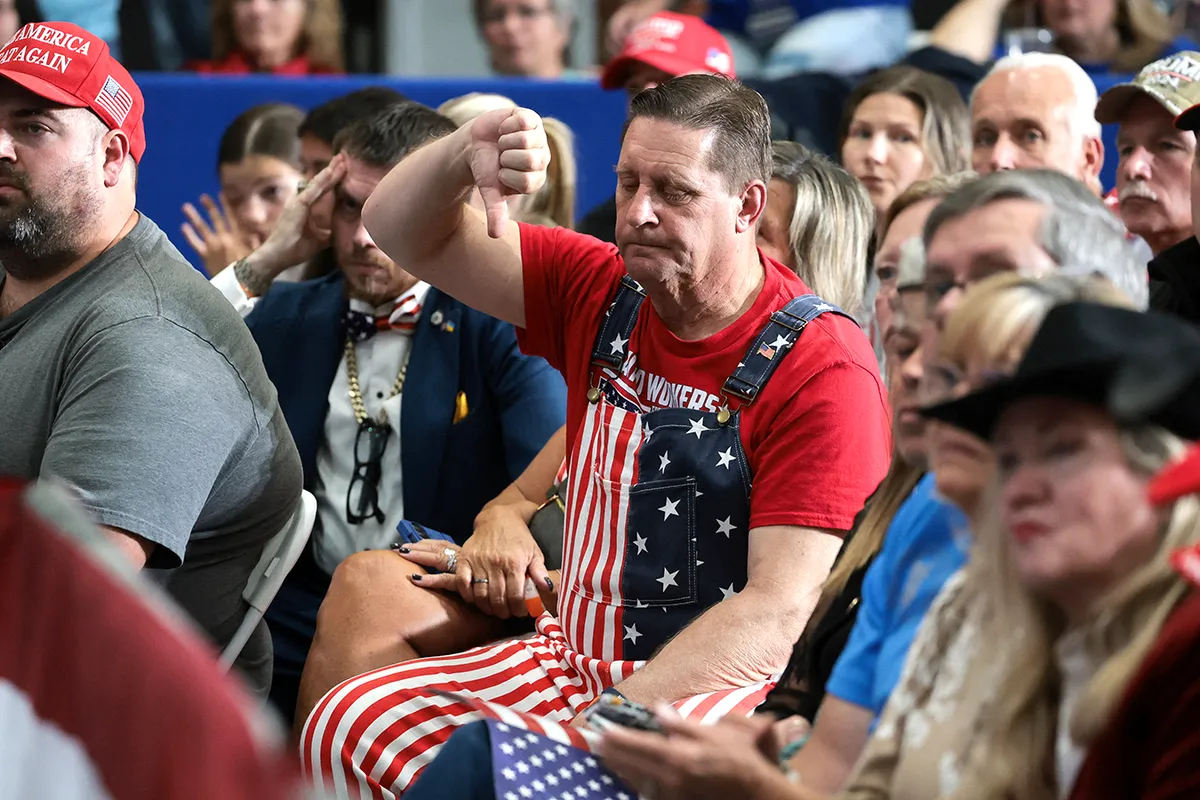
Anger is mounting across rural America as fuel costs, tariffs and trade disruption batter the farm economy, and polling now suggests the political fallout could reach deep into traditionally Republican territory ahead of the November midterm elections.
Bankruptcy filings by farmers have jumped roughly 85 percent since President Donald Trump's reelection. With midterms approaching, Trump is making a last-ditch appeal to voters in the states with the largest number of farms.
John Tsitrian, a South Dakota business executive who writes about rural America, placed the blame squarely on the president. "Farmers are hurting thanks to Trump's apocalyptic screw-up," he titled an article this summer. In it, he wrote: "I believe that today's tough farm economy, in regular need of federal cash infusions, is the result of a disaster that has a specific name attached to it: Donald Trump. Unlike most disasters, this one was utterly foreseeable. Rural voters were nonetheless responsive to his rhetoric and supported him solidly in 2024."
A report from The Guardian reveals that polls suggest Republican Senate candidates stand a good chance of in Kansas, Iowa, Nebraska and Texas — states Trump won in 2024. The shift is attributed largely to Trump's entry of the United States into the Iran war, which increased fuel prices by 70 percent. Fuel is a major input in farming, necessary for on-farm operations such as powering machinery and heating buildings, as well as for external uses such as manufacturing. Tsitrian's article is also referenced in The Guardian's report.
Other administration policies have weighed on rural opinion. Trump's "big, beautiful bill" made major cuts to food assistance and Medicaid, which are expected to cause an estimated 1.8 million rural Americans to lose health insurance and struggle to purchase food for their families.
"He has sold out rural America with his policies," said Jon Tester, a third-generation Montana farmer and former U.S. senator. Rural voters backed Trump based on his promises to lower costs and keep the U.S. out of unnecessary, expensive overseas wars — commitments that, according to the report, were not honored.
John Hansen, president of the Nebraska Farmers Union, said at a recent conference in Washington that farmers "are facing the worst economic and financial crisis since the farm crisis of the 1980s." That comparison carries weight: the 1980s farm crisis — a period of soaring interest rates, falling land values and widespread farm foreclosures that devastated communities across the Midwest and Great Plains — remains a defining reference point in modern American agriculture.
Individual producers have spoken out in recent months. "Compared to last year, our fuel bill is $50,000 higher," Vance Ehmke, a Kansas farmer, told the Hastings (Nebraska) Tribune, explaining that fertilizer had added another $20,000 to $40,000 — increases he attributes to Trump's war in Iran. "I want to tell you that I am a Republican, and I'm p——."
The trade picture is similarly strained. The U.S. and Brazil previously each supplied about 40 percent of China's soybean imports. Following Trump's trade wars with China — and with China preferring to do business with more stable partners — the U.S. now supplies just 23 percent of China's soybeans, while Brazil accounts for more than 60 percent and Argentina 10 percent, representing $10 billion a year in U.S. soybean exports. The stakes for growers are high: China has long been the largest buyer of U.S. soybean exports, and Iowa and Nebraska — two of the states where polls suggest Republican Senate vulnerability — rank among the nation's leading soybean producers.
Trump's response is an $8 billion emergency aid package for U.S. farmers, announced recently at a rally in Kansas and referred to by the president as the Harvest Fuel Relief Program. How quickly that relief reaches producers — and whether it offsets the fuel and fertilizer bills farmers like Ehmke describe — will be part of the economic backdrop as voters across farm country head to the polls.

