Stripe's Privy Brings Embedded Wallets to the XRP Ledger as Every New Wallet Locks 1 XRP
Key Takeaways
- •Ripple partnered with Stripe-owned Privy to embed wallet infrastructure into the XRP Ledger, allowing applications and AI agents to hold funds and authorize payments in XRP, RLUSD, and other assets without anyone managing cryptographic keys.
- •The XRP Ledger has processed more than 14.3 million AI agent payments across 169 registered merchants through the x402 standard, yet the total value moved was roughly $22,000, averaging about a sixth of a cent per transaction.
- •Every new XRP Ledger account must lock 1 XRP as a minimum reserve that is released only upon account deletion, meaning each agent wallet created locks XRP and could become a genuine supply sink against the fixed 100 billion token total supply.
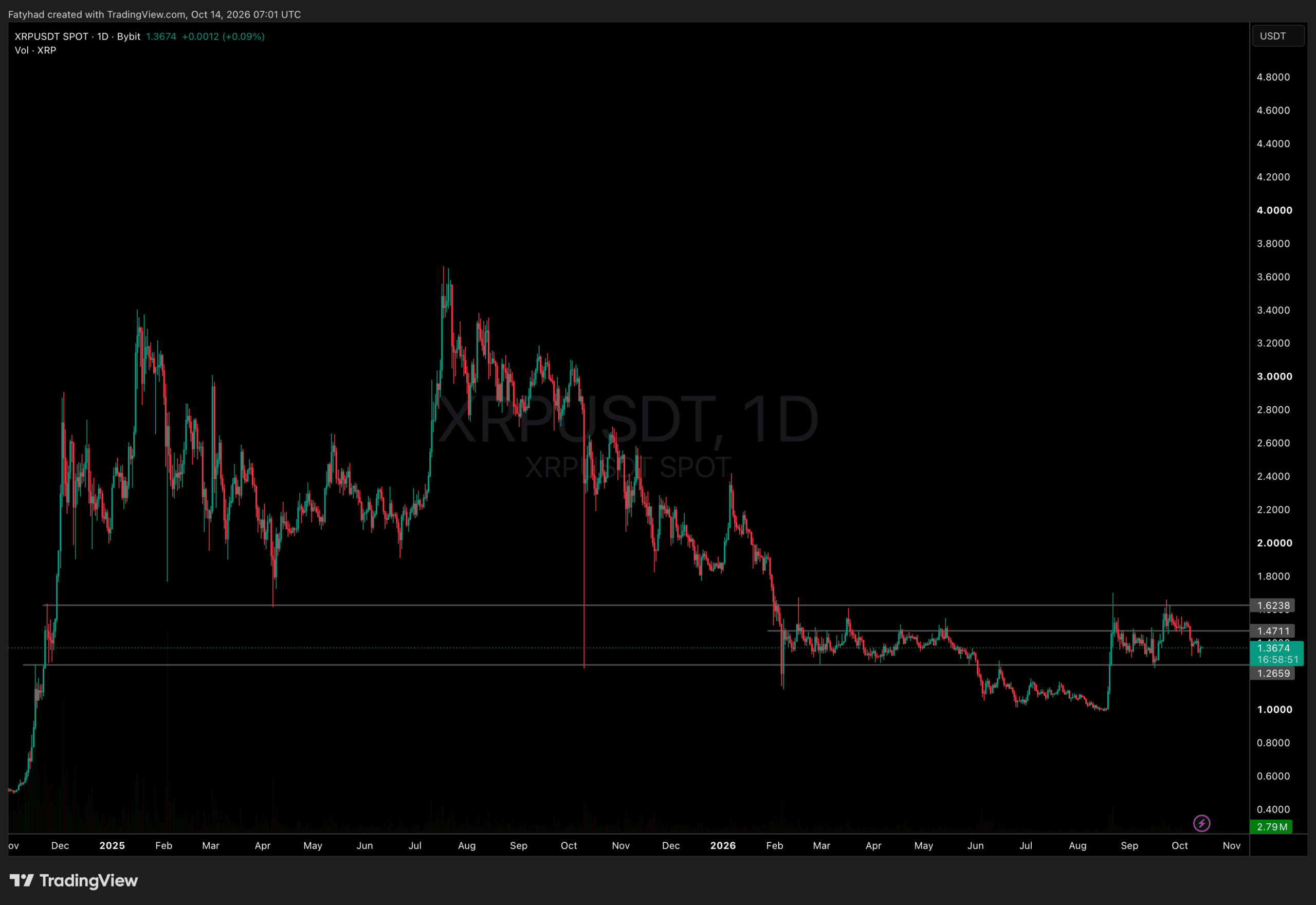
- •XRP trades at $1.3675 with an $86.269 billion market capitalization, consolidating in a narrow $1.35-$1.38 band after last week's selloff bottomed at $1.30, while perpetual open interest of $4.022 billion sits under 5% of market cap, indicating low leverage.
- •Ripple released agent payment tools in June and expanded them in September to support the x402 standard developed by Stripe and Tempo, with policy controls and fee-covering tools still planned per Tuesday's release.
Ripple (XRP) is bringing wallet technology from Stripe-owned Privy to the XRP Ledger, allowing applications and AI agents to hold funds and make payments without anyone managing cryptographic keys. Claude's "AI Predicts XRP" analysis defends its $1.30 base on the development — a call that has nothing to do with the payments themselves, which amount to almost nothing, and everything to do with a reserve mechanic buried in the documentation.
XRP trades at $1.3675, giving it a market capitalization of $86.269 billion. The 24-hour range is unusually narrow at $1.35 to $1.38, a pattern that reads as a market waiting rather than reacting. The tight band follows last week's selloff, which bottomed at $1.30.
JUST IN: Ripple and Stripe-owned Privy partner to bring embedded wallets to $XRP Ledger. pic.twitter.com/mbrY1Ao2AS
— Whale (@WhaleInsider) October 13, 2026
What Ripple and Privy Actually Shipped
Developers can now build wallets directly into their products. Those wallets authorize transfers in XRP, Ripple's dollar-pegged RLUSD stablecoin, and other assets issued on the network. Privy supplies the underlying infrastructure, meaning app builders write far less of it themselves, and users never touch a secret key. Embedded wallets operate inside an application itself rather than through a separate wallet program, shortening the path from sign-up to payment.
The system is not closed. Privy supports exporting keys or a recovery phrase, so a wallet can be moved elsewhere at any time.
The more consequential part is what the technology enables for software. Companies can hand AI agents a set of funded wallets hosted on their own servers, allowing the agents to pay for online services on their own. Those transactions run through x402, a standard for buying access to data: an agent requests paid data, receives a payment request, authorizes it, and gets the data once payment clears. There is no checkout page and no human at the keyboard. The standard takes its name from HTTP status code 402 — "Payment Required" — a code the web's early protocols defined but left unused for decades.
Ripple has been building toward this milestone all year. It released agent payment tools in June, then expanded the kit in September to support the standard developed by Stripe and Tempo. According to Tuesday's release, policy controls and fee-covering tools are still to come.
Stripe's ownership of Privy is the quiet detail in the announcement. Distribution to payment developers is the hard part of this business, and Stripe already has it.
14 Million Agent Payments, Roughly $22,000 in Total
The activity figures look enormous until the amounts are checked. RippleX Head of Engineering J. Ayo Akinyele said the network has processed more than 13 million agent payments through x402, roughly 25% of all ledger activity. The XRPL AI Hub, run by payments developer t54, counts more than 14.3 million cumulative transactions across 169 registered merchants.
The other column tells a different story. Those transactions carried about 6,991 XRP and 12,752 RLUSD in total — roughly $22,000 moved across 14.3 million payments. The average transaction is worth about a sixth of a cent.
That is not a criticism of the technology, because machine payments are designed to be tiny. It does mean transaction counts are the wrong way to value the development.
The metric that matters instead sits in Privy's documentation. A new XRP Ledger account must first receive the network's minimum reserve, currently 1 XRP, before it can transact at all. The threshold is set by the network's validators and has moved before — they cut it from 10 XRP to 1 XRP in late 2024 — and the reserve is not spent, only locked: it sits in the account, unavailable for use, and is released only if the account is deleted. Someone has to supply that XRP even if the customer only ever sends dollar stablecoins. Every agent wallet created therefore locks one XRP, and it stays locked for as long as the account exists.
Payment volume creates no lasting XRP demand. Account creation does.
Where the Range Breaks
Positioning is unusually clean. Perpetual open interest sits at $4.022 billion against an $86.269 billion market capitalization — under 5%. Perpetual futures are derivative contracts with no expiry date, and open interest tracks the total value of positions still open, which makes the ratio a common gauge of how much trading is positioned around an asset. Compared with most mid-cap assets, XRP is carrying very little leverage into this consolidation.
The analysis frames three levels:
- The floor: $1.30. The low from last week's selloff, and the base this consolidation is built on.
- The level to reclaim: $1.47. It capped XRP through early October and has turned back every attempt since.
- The ceiling: $1.62. The barrier that has rejected XRP repeatedly this year.
The $1.47-$1.50 zone comes first. XRP has spent two weeks beneath it, and reclaiming it would turn the current range into a recovery.
Agent wallets are unlikely to move the price this quarter. If the reserve mechanic scales, however, it would become the first genuine supply sink XRP has had — a consideration that carries weight against a fixed total supply of 100 billion tokens.

