Rachel Cruze and George Kamel share the spending 'clues' that reveal if you're broke, average or wealthy
Key Takeaways
- •The Ramsey Show co-hosts Rachel Cruze and George Kamel argue that financial behavior, not income level alone, determines whether a person ends up broke, middle class, or wealthy.
- •Habits the hosts associated with being broke include taking out payday and title loans, relying on rent-to-own purchases and cash advances, and buying lottery tickets.
- •The hosts linked average or middle-class habits to chasing credit card rewards, taking on new car payments, and accumulating consumer debt such as HELOCs and buy now, pay later plans.
- •Wealthy habits cited include earning interest rather than paying it, investing through vehicles like 401(k)s and IRAs, buying used cars, paying off a home early, and living below one's means.
- •Regulatory data cited in the segment shows a typical two-week payday loan carries fees approaching a 400% APR, while U.S. credit card balances have topped $1 trillion with average interest rates above 20%.
Rachel Cruze and George Kamel share the spending 'clues' that reveal if you're broke, average or wealthy
Taking a step back to look at the big picture is helpful in life — and it is no less useful when it comes to your finances. The day-to-day management of money can sometimes cloud what is happening as a whole.
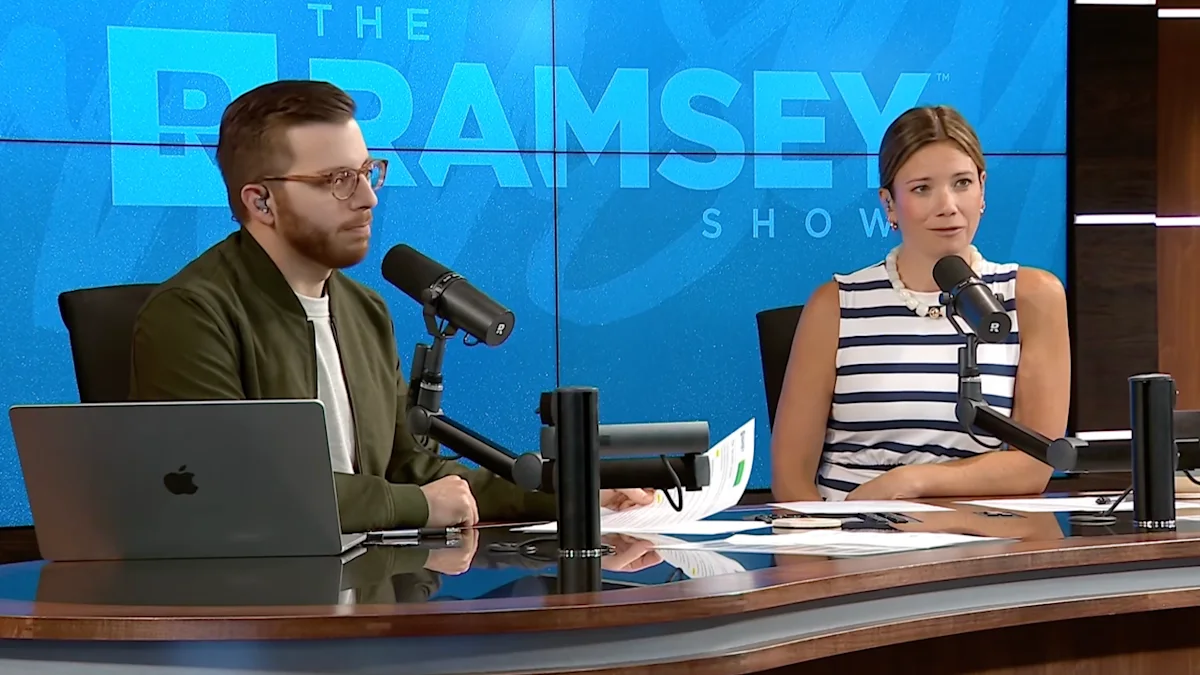
To help people gain perspective on what their spending, saving and investing habits say about their situation, "The Ramsey Show" co-hosts Rachel Cruze and George Kamel offered up "clues" to determine where they stand in terms of financial wellness. The program, part of Ramsey Solutions, the Tennessee-based personal finance company founded by Dave Ramsey, has long been built on the premise that behavior — not income alone — determines financial outcomes, and that premise framed the segment.
"You can make a great income, but you're still broke," Cruze said. "You can make a great income, you could still be middle class. You can make a great income and use that income and build wealth, or you could make an OK income and build wealth, or be broke, right? So much about it is our behavior."
Kamel agreed. "It's habits," he said.
According to the hosts, those habits will land you in one of three categories: broke, average or wealthy.
'Broke people habits'
The hosts first outlined the "clues" of "broke people."
Taking out payday and title loans
Kamel characterized payday and title loans as "probably the saddest [clue] on the list," noting that they are commonly seen in "low-income areas." These types of loans are "high-interest, short-term loans that spiral into a debt cycle" — or end up costing you your vehicle, Kamel said.
Their warning aligns with regulatory findings: the Consumer Financial Protection Bureau has documented that a typical two-week payday loan can carry fees equating to an annual percentage rate approaching 400%, and that most such loans are rolled over or re-borrowed rather than repaid on time.
Cruze added, "When you get stuck in that cycle, you're paying high-interest debt and you just feel like you can't get out of it, and that will keep you broke if you stay in that life."
Leaning on rent-to-own and cash advances
Kamel said rent-to-own can seem "like a smart thing," because "one day I'll own it." Cash advances might not seem that bad either, because "I'll pay it back when I get my paycheck." But the fees and "exorbitant interest" attached to these deals — much like payday loans — can keep people "stuck in this [...] cycle of poverty."
Buying lottery tickets
Cruze flagged that low-income ZIP codes typically account for the higher shares of lottery ticket sales, and said lottery tickets offer "false hope."
"It is sad because it is stealing from people," she said.
Kamel agreed. "And it's statistically impossible odds, but you tell yourself 'someone's got to win,' and when you're that hopeless, you turn to these terrible habits," he added.
'Average person' habits
Kamel noted that "average person" habits — which he characterized as "middle class America" — are "not much better" than the so-called "broke people habits."
Chasing credit-card rewards
Cruze said the idea of all the things rewards will let you do, such as travel, also helps people get stuck in debt. The credit card that "was supposed to be, 'I pay it off every month,'" ends up catching people if they lose a job or face an emergency with no savings, and then "they look up and they're $18,000 in credit card debt."
The stakes of that slide show up in the broader data: Federal Reserve Bank of New York figures show total U.S. credit card balances have topped $1 trillion, while average card interest rates have run above 20% in recent Federal Reserve data.
Kamel and Cruze added that the individuals who pay interest and can't pay their balances "end up subsidizing the rewards."
"Save up and pay for things," Cruze concluded.
Making newer car payments
Kamel explained, "This is where someone goes, 'Well, I want the newer car, and the dealer said he can get the payment down to where I can afford it.'" He described it as yet another cycle people get stuck in.
"You're paying top dollar for a depreciating asset," he said. "So, you paid $50 grand for a car. With interest, you end up paying $60K, and that car is only worth $20K by the time it's paid off. That's bad math."
The gap he describes reflects a well-documented pattern: commonly cited industry estimates put a new car's first-year depreciation at roughly 20% or more of its purchase price.
Cruze called it a "classic example of making someone else rich."
"You're making the credit card companies rich, the car dealers, the banks," she said. "And you're paying interest on something that's going down in value versus actually making interest for yourself."
Piling up consumer debt
The hosts pointed to a broader category that includes HELOCs and buy now, pay later plans.
"These are all really used to fund a lifestyle that people can't afford," Kamel said.
He noted that younger people in particular were "falling for" buy now, pay later, because "it seems better than credit card debt." The category has also grown fast enough to draw regulatory scrutiny, with the CFPB moving in 2024 to extend credit-card-style dispute and refund protections to buy now, pay later loans.
'Wealthy people' habits
Lastly, the hosts outlined what "wealthy people" do.
Earning interest, not paying it
Cruze summed this up as "you have more things invested — you have things that are actually paying you or making you more money — versus debt companies, right? Banks and car dealerships, all of it."
Kamel added, "You're not going backwards here; we're moving forward."
Investing
According to Kamel, "you can't save your way to wealth." He advises investing in stocks and real estate.
"And really, all you need is something like a 401(k), an IRA, mutual funds and your primary home," he said.
The 401(k) became a mainstay of U.S. retirement saving as employers shifted away from traditional pensions in recent decades, which is part of why workplace plans are widely seen as an accessible entry point for households starting to invest.
Buying used cars
Dave Ramsey often tells callers that new cars are a huge money mistake; his rule of thumb is that unless you have a $1-million net worth, buy used.
Cruze offered the same advice.
"That's what wealthy people do," Cruze said. "I'll buy a two-year-old car, and we'll be good to go. I'll pay significantly less because of it.' And they're just smart when it comes to their purchasing."
Living in debt-free housing
Kamel noted that wealthy people will "pay off their home early, which frees up cash for more investing and giving."
Living below your means
The hosts' last observation was that wealthy people budget, have a plan for their money, and "live intentionally."
"They know what their retirement self is going to do, they know what their next goals are," Cruze said.
Cruze wrapped up by adding that wealthy people are "intentional with where [their] money is going."
That's sound advice for anyone, no matter where they fall on the income spectrum.
The co-hosts made their remarks on "The Ramsey Show". This article originally appeared on Moneywise.com under the title: Rachel Cruze and George Kamel share the spending 'clues' that reveal if you're broke, average or wealthy.
This article provides information only and should not be construed as advice.

