Quantinuum Advances Hybrid Quantum Computing with Helios Launch and Global Enterprise Partnerships
Key Takeaways
- •Helios operates with 98 qubits on a trapped-ion architecture and achieves a two-qubit gate fidelity of 99.921%, ranking among the best publicly reported figures in the quantum computing industry.
- •The platform integrates with NVIDIA GB200 processors to support hybrid quantum-classical workflows aimed at generative quantum AI applications.
- •Quantinuum announced early enterprise collaborators including Amgen, BMW Group, JPMorgan Chase, and SoftBank, representing the pharmaceutical, automotive, financial services, and telecommunications sectors respectively.
- •Quantinuum signed an agreement with Singapore's National Quantum Office to install a Helios system by 2026 and establish local research and development operations.
- •Oracle Cloud's quantum-related initiatives, including simulation tools and post-quantum cryptography collaborations, are independent of Quantinuum and the Helios platform.
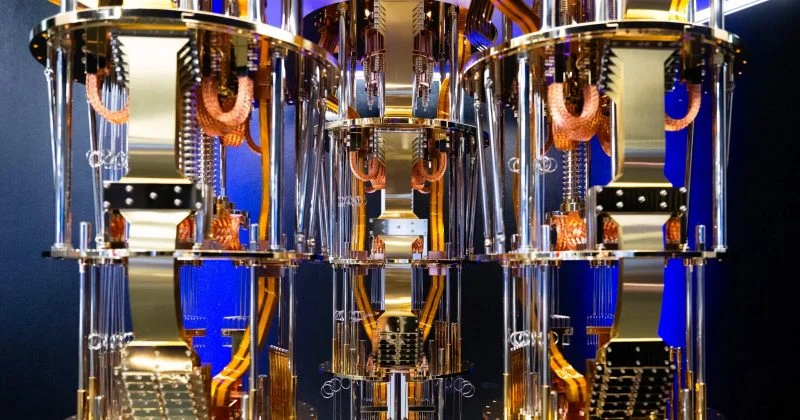
Quantinuum, the quantum computing company formed from the merger of Honeywell Quantum Solutions and Cambridge Quantum, is deepening its push into the enterprise market with the launch of its Helios quantum computing platform.
Helios, officially launched on November 5, 2025, features 98 qubits built on a trapped-ion architecture. The system achieves a two-qubit gate fidelity of 99.921% — a critical benchmark in a field where even minute errors compound rapidly enough to render complex calculations unusable.
Technical Capabilities
Gate fidelity is a decisive metric in quantum computing. Each quantum operation introduces the possibility of error, and when many operations are chained together, even small fidelity gaps accumulate quickly. At 99% fidelity, accuracy degrades by 1% per step; over enough steps, results become unreliable. At Helios's 99.921% fidelity, error rates drop significantly, allowing the system to sustain longer and more complex computations before quantum noise overwhelms the signal.
Helios is specifically designed to support generative quantum AI applications. The platform integrates with NVIDIA GB200 processors to enable hybrid quantum-classical workflows, allowing quantum and conventional computers to collaborate on problems that neither architecture could efficiently solve alone. That hybrid approach is part of the broader effort to make quantum hardware usable in enterprise settings before fully fault-tolerant systems arrive.
Enterprise Collaborations
Quantinuum has assembled a notable group of early collaborators for Helios. Amgen, BMW Group, JPMorgan Chase, and SoftBank were all announced as part of the launch, each representing a distinct enterprise sector: pharmaceuticals, automotive manufacturing, financial services, and telecommunications and venture capital, respectively.
On the same day as the Helios launch, Quantinuum also signed an agreement with Singapore's National Quantum Office. The deal includes plans to install a Helios system in Singapore by 2026 and to establish local research and development operations, extending the platform’s reach beyond U.S.-based enterprise customers.
The Broader Cloud Quantum Landscape
Oracle Cloud has been independently developing its own quantum-related capabilities, including quantum simulation tools and post-quantum cryptography solutions. Oracle has collaborated with companies such as Arqit and American Binary on post-quantum security initiatives and has integrated NVIDIA cuQuantum appliances for quantum AI workloads. These efforts are separate from Quantinuum and the Helios platform.
The cloud delivery model plays a central role in quantum computing's commercial viability. Trapped-ion systems like Helios demand precise laser control and ultra-high vacuum environments, while competing superconducting architectures operate at temperatures colder than deep space. Cloud deployment allows enterprises to access these systems without managing the extreme engineering requirements on-premises, which helps explain why partnerships, remote access, and managed service models remain central to the sector’s near-term commercial strategy.
Quantinuum's competitive differentiation lies in the combination of its trapped-ion architecture and industry-leading fidelity. The 99.921% two-qubit gate fidelity achieved by Helios ranks among the best publicly reported figures in the quantum computing industry, and improvements in fidelity have a disproportionate impact on the practical utility of quantum machines.

