Pony.ai and FutureLink to Deploy 200 Level 4 Robotaxis in Korea by 2028
Key Takeaways
- •Pony.ai and FutureLink agreed in Seoul to deploy 200 Level 4 robotaxis in Korea by 2028, starting with 10 vehicles for certification and adding 190 more afterward.
- •The robotaxis will use BAIC Group vehicles with Pony.ai's seventh-generation autonomy system integrated during production, featuring redundant braking, steering and power systems.
- •FutureLink will handle certification, operations, data and localization, while Pony.ai provides the technology, and the two firms are considering a Korean joint venture.
- •FutureLink has already tested Pony.ai-equipped vehicles in Seoul's Gangnam District, covering about 80,000 kilometers without an accident.
- •The Korea expansion comes as Chinese firms including BYD, Zeekr, XPeng, Chery and Xiaomi deepen their presence in the Korean automotive market.
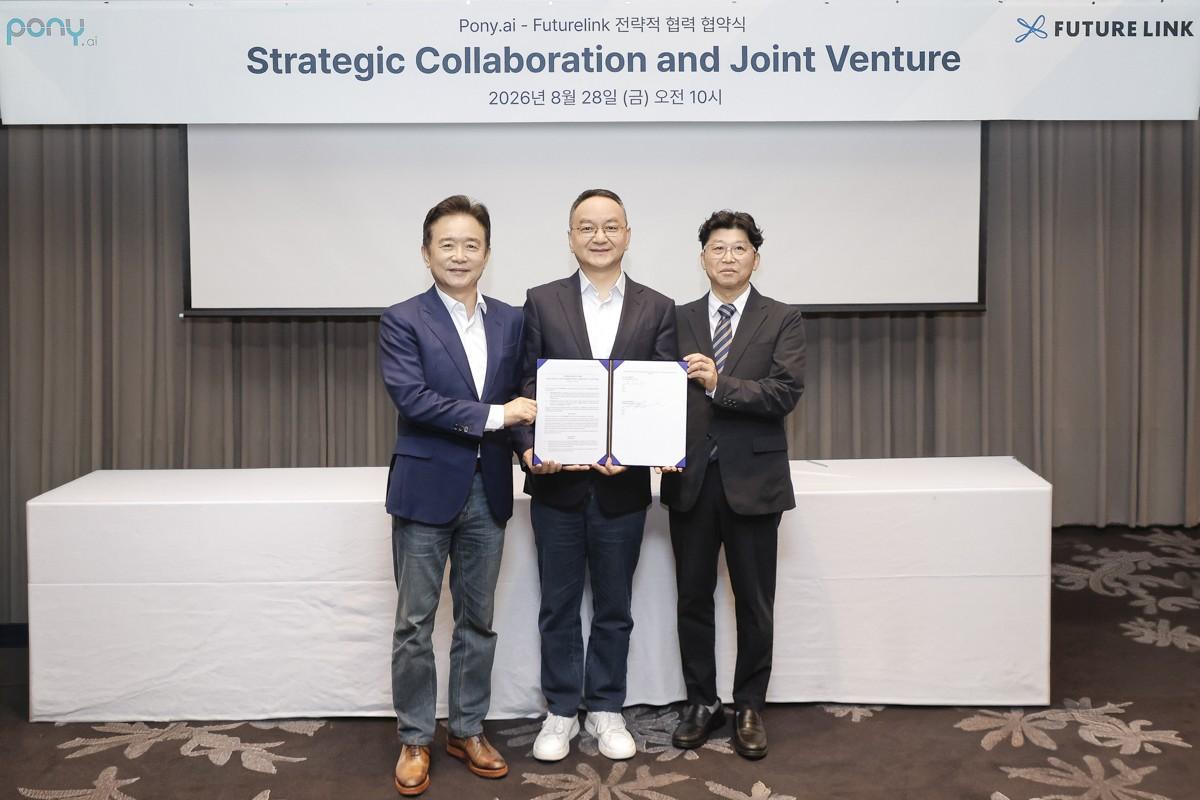
Chinese autonomous driving company Pony.ai is partnering with Korean mobility firm FutureLink to introduce 200 Level 4 self-driving taxis to Korea by 2028, as Chinese automakers and self-driving technology companies continue to expand their presence in the Korean market. Level 4 autonomy, as defined by SAE International's classification system, means a vehicle can operate without a human driver within defined conditions or geographic areas.
FutureLink Chairman Nam Kyung-pil and Pony.ai founder and CEO James Peng signed the strategic partnership agreement in central Seoul on Friday.
Under the agreement, Pony.ai's seventh-generation robotaxis will be introduced to Korea in stages, beginning with 10 vehicles for domestic certification, followed by 190 more once the certification process is completed. The companies plan to launch the robotaxi service initially in Seoul's autonomous driving pilot zone in Gangnam before gradually expanding it across the city, the wider Seoul metropolitan area and other major cities. The timing of the certification and commercial launch has not yet been finalized, and the deployment will depend on Korean regulators approving Level 4 operation on public roads.
The partnership divides responsibilities clearly. FutureLink will handle regulatory certification, market entry, vehicle and service operations, data management, and localization, while Pony.ai will supply its seventh-generation autonomous driving vehicles and technology. The two companies are also considering establishing a joint venture in Korea.
The robotaxis will be based on a model from Chinese automaker BAIC Group, with Pony.ai's seventh-generation autonomous driving system integrated during production rather than retrofitted afterward. According to Pony.ai, the vehicle has redundant systems for critical functions including braking, steering and power, while its autonomous driving kit uses automotive-grade components.
The seventh-generation kit costs 70 percent less to produce than its predecessor, according to the company. Pony.ai plans to cut production costs by a further 20 percent in 2026 and reduce the combined cost of the autonomous driving kit and base vehicle to below 230,000 yuan ($34,000) by mid-2027 in China. Lower hardware costs have been a central challenge for the robotaxi industry, which has spent years working to make driverless services financially viable.
Pony.ai currently operates fully driverless Level 4 robotaxi services in Beijing, Shanghai, Guangzhou and Shenzhen. In Shenzhen, its robotaxis averaged 23 paid orders per vehicle per day in February. The Korea partnership would mark one of the company's major expansions beyond its home market.
FutureLink said it has already conducted day-and-night testing in Seoul's Gangnam District using Kona Electric-based vehicles equipped with Pony.ai's autonomous driving kit. The vehicles have covered about 80,000 kilometers without an accident, according to the company.
The planned Korean deployment comes as Chinese companies expand their footprint in Korea's automotive and mobility sectors, extending their push beyond vehicles into autonomous driving software and services. Chinese electric vehicle (EV) maker BYD has established itself as Korea's fourth-largest imported vehicle brand by sales, while Geely Group's premium EV brand Zeekr is preparing to launch its SUV, the 7X, in the country in September or October. Chinese companies including XPeng Motors, Chery Automobile and Xiaomi Auto are also weighing or pursuing entry into the Korean market.
Meanwhile, Korean automakers are seeking to strengthen their position by combining hardware supply with in-house software development. Hyundai Motor is pursuing a vehicle foundry strategy to supply robotaxi hardware to autonomous driving companies while developing its own advanced autonomous driving technologies, ranging from Level 2+ to Level 4, for future passenger vehicles. The group plans to establish a full-scale software-defined vehicle production system in 2028 and launch vehicles equipped with its Atria artificial intelligence autonomous driving technology in 2029. How quickly regulators clear the certification path for Pony.ai's initial 10 vehicles will be a key signal of how open Korea's market becomes to foreign autonomous driving operators.

