Pi Network tests triangle breakout as RoboPay partnership boosts adoption
Key Takeaways
- •Fabric Foundation announced that Pi Network has joined RoboPay as a payment partner.
- •The integration will let Pi users pay for robot-powered services with PI tokens, including deliveries, security patrols, and inspections.
- •PI futures open interest rose to $8.82 million on Wednesday from $8.51 million the previous day.
- •PI is testing a short-term triangle resistance near $0.085 while still trading inside a broader descending channel.
- •A move above $0.09 could improve the short-term outlook, while failure to break resistance could send PI back toward $0.07.
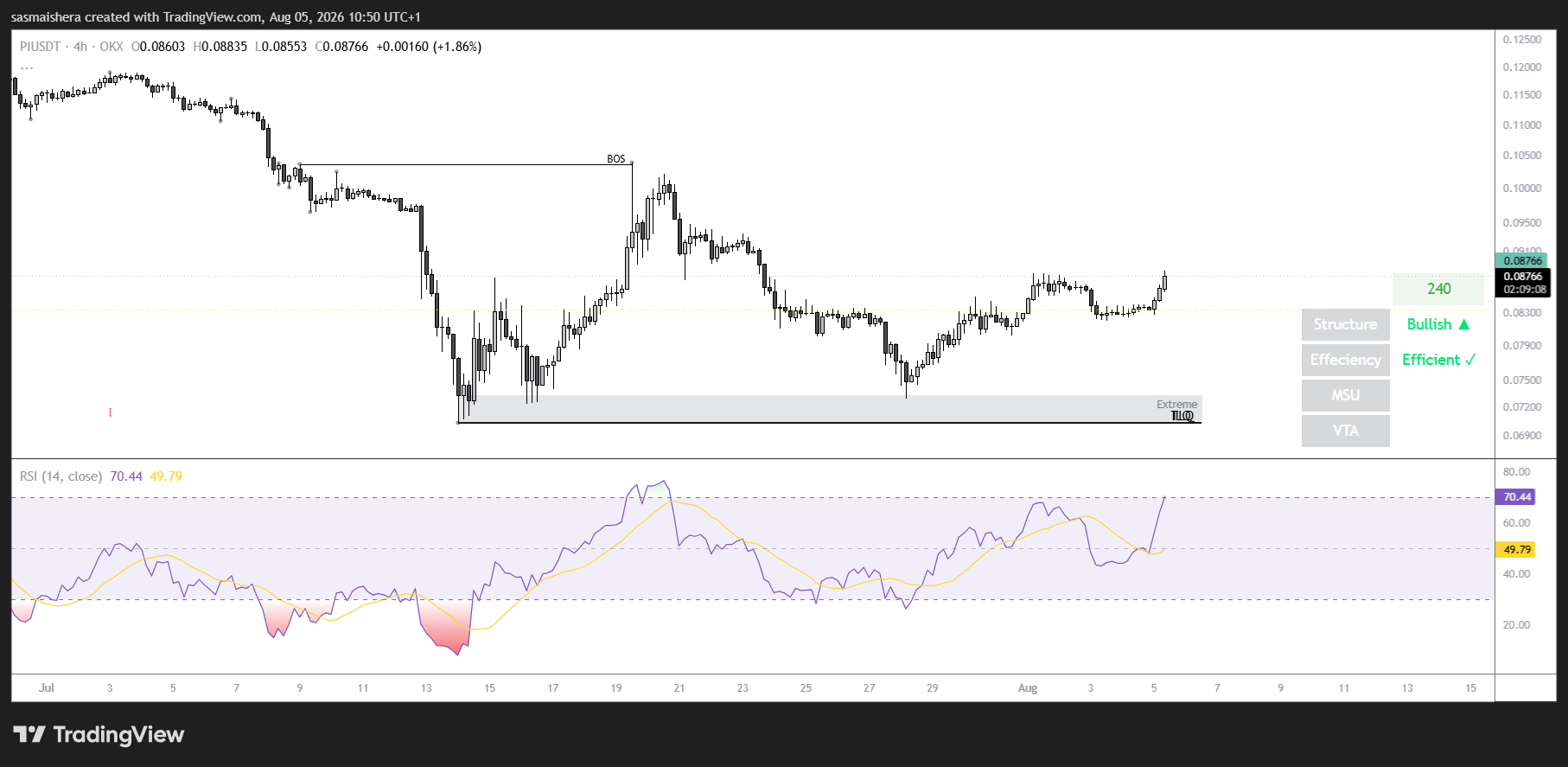
Pi Network (PI) edged higher on Wednesday as the token attempted to break out of a short-term triangle pattern near $0.085.
The recovery comes amid improving momentum indicators, steady derivatives demand, and a new payment partnership with RoboPay. For a token that has often been watched for signs of practical usage as much as price action, the partnership adds a concrete payments angle, although PI still remains confined within a broader falling channel and must overcome resistance near $0.09 to establish a stronger bullish trend.
RoboPay adds Pi Network as payment partner
Fabric Foundation announced on Wednesday that Pi Network had joined RoboPay as a payment partner.
The integration will allow Pi users to pay for robot-powered services using PI tokens. Potential applications include deliveries, security patrols, inspections, and services performed by humanoid robots.
The partnership represents another potential real-world use case for PI and could support adoption if the services gain traction among Pi Network users.
However, the longer-term effect will depend on the scale of RoboPay’s operations, user demand and the availability of supported services.
Speculative demand for Pi Network remained relatively stable this week. CoinAnk data shows that PI futures Open Interest increased to $8.82 million on Wednesday from $8.51 million the previous day.
The increase indicates that the value of active perpetual futures contracts is rising as traders build new positions. While this signals growing market participation, Open Interest alone does not reveal whether those positions are predominantly bullish or bearish.
Pi Network tests triangle resistance
PI is extending its modest recovery and testing the upper resistance trend line of a short-term triangle pattern near $0.085.
The triangle has formed within a larger descending channel, meaning the token remains under pressure from the broader bearish structure. An additional downtrend line near $0.09 strengthens the resistance zone immediately above the current price, so the next move will likely be judged by whether PI can hold any breakout attempt rather than by the initial intraday push itself.
A confirmed breakout from the smaller triangle would improve the near-term outlook, but PI must move above the wider resistance cluster near $0.09 to restore a more convincing bullish trend.
The Moving Average Convergence Divergence and its signal line are trending modestly higher, pointing to early signs of improving upside momentum.
Meanwhile, the Relative Strength Index has recovered to 44. Although it remains below the neutral 50 level, its upward movement indicates that bearish momentum is beginning to fade.
The indicators support a mildly bullish short-term bias but do not yet confirm that buyers have regained full control.
A decisive close above the overhead trend lines around $0.09 could strengthen PI’s recovery and bring the 127.2% Fibonacci extension at $0.0961 into focus.
Clearing that level would provide further evidence that the short-term trend is shifting in favor of buyers.
If PI fails to break above the triangle and descending-channel resistance, the token could retreat toward the record low of $0.07. This support area is reinforced by the 161.8% Fibonacci extension at $0.0679.
A sustained break below that zone would invalidate the developing recovery and signal a continuation of the broader downtrend.

