Pi Network's Tiny Minimum Deposit Raises Questions About Infrastructure Design
Key Takeaways
- •Pi Network's minimum deposit figure of 0.00000001 Pi attracted community attention after being compared to Bitcoin's 0.00003 BTC minimum deposit in an X post by @piman320.
- •High divisibility is a common design choice across major cryptocurrencies, with Bitcoin supporting eight decimal places and Ethereum supporting eighteen.
- •Pi Network uses a consensus mechanism based on the Stellar Consensus Protocol, which differs from Bitcoin's proof-of-work system and influences its transaction precision capabilities.
- •Claims that a small minimum deposit figure signals a specific future price for Pi are speculative, as no direct relationship exists between decimal places and asset value.
- •Pi Network remains in an enclosed mainnet phase, with a transition to open mainnet identified as a key milestone affecting the potential for on-chain activity and external integrations.
In the cryptocurrency space, price movements typically dominate community discussion. When a coin rallies, attention shifts to potential gains; when it declines, questions about the project's future resurface. Occasionally, however, a technical detail captures attention on its own merits.
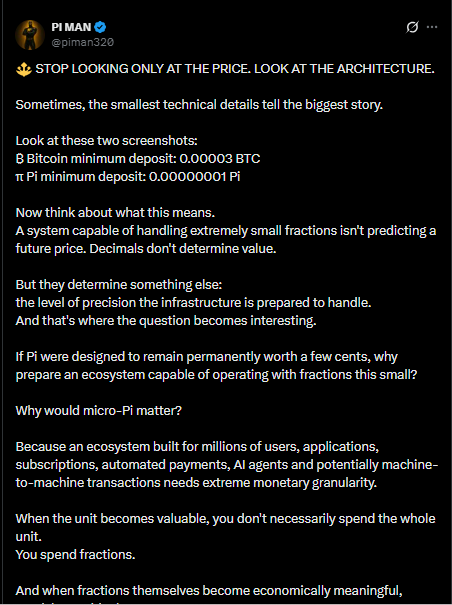
That is what occurred after attention turned to an extremely small Pi Network minimum deposit figure of 0.00000001 Pi, which was compared with a Bitcoin minimum deposit of 0.00003 BTC in material shared by X account @piman320.
The comparison prompted a notable question within the Pi Network community: if a system can process Pi transactions or deposits in such minute fractions, what is its infrastructure being designed to accommodate?
This question does not imply that Pi's price will rise. Decimal places do not determine a cryptocurrency's value. The price of any digital asset depends on market mechanisms including supply, demand, liquidity, utility, sentiment, and numerous other factors. Nevertheless, the detail is noteworthy from an architectural standpoint — particularly because high divisibility is a design choice common across major blockchains. Bitcoin itself is divisible to eight decimal places, with its smallest unit known as a satoshi, and Ethereum supports 18 decimal places through its wei denomination. The presence of fine-grained divisibility in Pi's deposit parameters is therefore consistent with conventions already established across the broader cryptocurrency industry.
Beyond Price: Pi's Infrastructure
Discussions surrounding Pi Network have concentrated largely on price, exchange listings, supply, user numbers, and potential adoption. While all of these factors are relevant, a blockchain network is not built solely to carry a market price. Behind every cryptocurrency lies an infrastructure that governs how the asset can be transferred, used, stored, and integrated into applications.
This is where the concept of precision becomes relevant. A system's ability to handle extremely small fractions of an asset does not mean that the asset holds high value. Rather, it indicates the system can work with very small transaction units.
Within a Web3 ecosystem, such flexibility can be significant. A transaction may not require one full Pi — users could transact using smaller amounts, applications might employ micro-fees, and certain services could apply usage-based payment models. Viewing a figure such as 0.00000001 Pi purely through a price lens narrows the broader context.
Decimal Places Do Not Signal Value
A minimum deposit figure is not a price indicator. If a platform sets an extremely small minimum deposit, it does not necessarily expect the asset to become highly valuable. More decimal places do not automatically create additional value — a cryptocurrency can be divided into very small units without increasing its total economic value.
Accordingly, claims that 0.00000001 Pi proves Pi will reach a particular price should be treated with caution. No direct relationship supports such a conclusion.
A more pertinent question is why the infrastructure needs to handle such a small fraction of Pi. The answer may relate to technical requirements and transaction flexibility, which also opens a broader discussion about how Pi Network could potentially be used as its ecosystem expands.
Source: X post
Bitcoin as a Comparison Point
Bitcoin illustrates why asset divisibility matters. A single Bitcoin need not be owned in its entirety to conduct a transaction — BTC can be divided into much smaller units, allowing users to transact without holding a full coin. This concept is important for any digital asset designed to facilitate value transfer.
The comparison with Pi is notable because the material shared by @piman320 shows a difference between the minimum deposit figures: Bitcoin at 0.00003 BTC and Pi at 0.00000001 Pi. Judged solely by decimal places, the difference appears striking.
However, the two figures cannot be directly compared to determine which asset is more valuable. BTC and Pi have different market prices, different networks, different platform policies, and different liquidity conditions. The comparison is better understood as a starting point for discussing the level of precision an infrastructure can handle, rather than as a price prediction tool.
Pi's Architectural Implications
Pi Network has stated that it uses a consensus mechanism based on the Stellar Consensus Protocol, a Federated Byzantine Agreement model distinct from proof-of-work systems like Bitcoin's. This architectural choice bears on the divisibility question, as the underlying protocol determines how transactions are validated, how units are represented, and what precision the system can natively support. Understanding the protocol layer helps explain why a minimum deposit figure can be set so low — it reflects the system's technical capacity rather than a market valuation.
If Pi Network aims to develop into a Web3 ecosystem with various applications and services, the ability to support transactions of different sizes could become a technical requirement. An application using Pi as a payment method would not necessarily require every transaction to be worth one full Pi — some transactions might require several Pi, others only a fraction. In certain models, micro-payments could become more relevant than large-value transactions.
As an ecosystem broadens, transaction requirements diversify. The ability to handle very small units could provide greater flexibility. Technical capability, however, does not guarantee these scenarios will materialize. Pi Network would still need to demonstrate utility through real-world usage, active applications, economic activity, and adoption. The project has been operating in an enclosed mainnet phase, with a transition to open mainnet identified as a key milestone that would affect whether on-chain activity and external integrations can develop further.
A Shift Toward Utility
The debate over Pi's minimum deposit reflects a broader shift in how some community members view the project. In the past, many discussions centered on a single question: how much will Pi be worth? Increasingly, discussions are also asking how Pi could actually be used.
This shift in perspective is meaningful. A cryptocurrency dependent entirely on price speculation can face challenges in maintaining long-term relevance, whereas an asset with genuine utility within an active ecosystem has more reasons to be used. This is one reason Web3 development matters when discussing Pi Network — if Pi aims to develop as an ecosystem, applications, marketplaces, digital services, peer-to-peer transactions, and other forms of utility could prove far more important than a single minimum deposit figure.
Facts vs. Interpretation
The material shared by @piman320 attracted attention because it encourages the community to examine something usually overlooked: not the price, not the chart, not a prediction, but the architecture. This approach can foster more rational discussion about a blockchain project.
A clear distinction must remain between facts and interpretations, however. The fact is that an extremely small minimum deposit figure appears in the context being discussed. The interpretation is that such capability demonstrates the level of precision an infrastructure can handle. The conclusion that the figure represents a future price signal remains speculation. These three elements should not be conflated — in the cryptocurrency space, failing to distinguish technical facts from speculation can allow a minor detail to evolve into an unsubstantiated claim.
Micro-Transaction Potential
Whether Pi is being prepared for micro-transactions cannot be answered by the minimum deposit figure alone. Conceptually, the ability to handle very small fractions could serve an ecosystem involving micro-transactions. If Pi is eventually adopted for various digital services, small-value payments could become a use case — users might pay small amounts for digital services, tip creators, purchase application features, or conduct transactions that do not require an entire Pi.
All of these scenarios require a flexible system, but whether Pi will actually be used in these ways will be determined by ecosystem development, not by one number. The community should evaluate application development, network activity, integrations, utility, and real-world usage collectively.
The Broader Question
The material that inspired this discussion underscores one idea: look beyond price to how the system is being built. That is what makes the 0.00000001 Pi figure interesting — not as proof of a high price or specific valuation, but as an entry point for discussing how a blockchain ecosystem handles extremely small asset units and how such flexibility could be applied.
Ultimately, Pi Network's future will not be determined by the number of decimal places. It will be shaped by real utility, user adoption, ecosystem quality, economic activity, security, liquidity, and the network's capacity to build sustainable use cases. When the community encounters a figure such as 0.00000001 Pi, the more productive question is not whether the number signals an imminent price surge, but what the infrastructure behind it is being prepared to support.
In blockchain technology, a detail that appears insignificant can sometimes open the door to a much larger conversation — and for Pi Network, the question of architecture may ultimately prove more meaningful than guessing what its price will be next.

