Pi Launchpad Could Redefine Token Launches as Pi Network Eyes a New Web3 Phase
Key Takeaways
- •Community discussions frame Pi Launchpad as a potential hub for launching and distributing utility-based tokens within Pi Network.
- •The proposed model combines Pi DEX and AMM mechanisms to support trading and liquidity pools for newly launched assets.
- •Supporters say the concept could give Web3 developers a more accessible path to build payment tools, games, DeFi services, and community applications.
- •The Pi Core Team has not confirmed final mechanisms, timelines, or features for Pi Launchpad, Pi DEX, or AMM systems.
- •The discussion reflects expectations that Pi Network could grow into a larger digital economy if the infrastructure is implemented successfully.
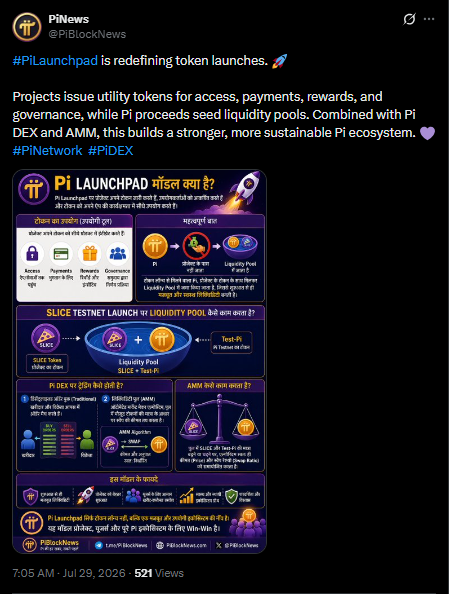
Pi Network has once again become a major topic of discussion within the blockchain community as attention grows around the potential role of Pi Launchpad in building a more structured token ecosystem. Some community members view the concept as a possible key component in Pi Network’s path toward a broader Web3 environment.
The discussion was highlighted by community account @PiBlockNews, which focused on how Pi Launchpad could change the way new projects introduce and distribute tokens within the Pi Network ecosystem.
According to the community analysis, Pi Launchpad would not simply function as a platform for creating new tokens, but could become a complete system connecting projects, users, liquidity, and digital economic activity within one integrated network.
With a combination of utility tokens, Pi DEX, and Automated Market Maker (AMM) mechanisms, the concept is being viewed as a potential foundation for a stronger and more sustainable Pi ecosystem.
Pi Launchpad Could Introduce a New Token Launch Model
In the crypto industry, token launches are one of the most important stages for blockchain projects.
Over the years, many projects have introduced tokens through different methods, including Initial Coin Offerings (ICO), Initial DEX Offerings (IDO), and other distribution models.
One of the biggest challenges, however, has been maintaining long-term value and real usage after launch.
Many tokens experience declining activity because they lack practical functions within their ecosystems.
The Pi Launchpad concept discussed by the community focuses on a different approach by emphasizing utility-based tokens.
This means tokens launched through the platform would not exist only as speculative assets but could serve specific purposes within digital ecosystems, which is one reason the model is drawing attention from developers and users looking for more functional blockchain applications.
Utility Tokens Could Form the Basis of the Ecosystem
One of the main elements behind the Pi Launchpad concept is the use of utility tokens.
Utility tokens are digital assets designed to provide specific functions within a platform.
Unlike tokens that rely mainly on market speculation, utility tokens are created for real usage, including accessing services, making payments, receiving rewards, or participating in governance systems.
Within the Pi Network ecosystem, this approach could create opportunities for various projects to build applications with direct connections to users.
For example, a project could issue a token that allows users to access premium features, receive ecosystem rewards, pay for services, or participate in community decisions.
If implemented effectively, this model could create a more sustainable digital economy than token systems focused only on trading activity.
Pi DEX and AMM Could Become Key Components
Beyond utility tokens, the concept of Pi DEX and Automated Market Maker (AMM) systems represents another important part of the discussion.
A decentralized exchange (DEX) allows users to trade digital assets directly without relying on centralized intermediaries.
Meanwhile, AMM technology enables trading through liquidity pools provided by users and communities.
This model has become one of the most important innovations in the DeFi sector because it allows markets to operate automatically through algorithm-based pricing mechanisms.
By combining Launchpad functionality with DEX and AMM infrastructure, Pi Network could potentially create an integrated environment where digital assets can be created, distributed, and exchanged more efficiently.
Liquidity Could Be Central to Token Growth
One of the biggest challenges facing crypto tokens is liquidity.
A project may have strong technology and an interesting concept, but without sufficient liquidity and active markets, users may struggle to buy, sell, or use the token.
According to the community discussion surrounding Pi Launchpad, Pi could potentially help support liquidity development through liquidity pools.
Stronger liquidity could contribute to healthier markets for newly launched tokens and make it easier for users to participate once projects go live.
In addition, AMM mechanisms allow asset prices to adjust based on market activity without depending entirely on traditional order-book systems.
This approach could help new projects establish stronger economic foundations from the beginning.
Source: Xpost
Potential Opportunities for Web3 Developers
One of the biggest impacts of a system like Pi Launchpad could be the opportunities it creates for Web3 developers.
Developers could gain a more accessible pathway to launch projects within the Pi Network ecosystem.
Potential applications could include digital payment solutions, blockchain games, community platforms, decentralized finance services, and various token-based innovations.
The more projects developed within an ecosystem, the greater the potential for increased user activity and economic growth.
In many successful blockchain networks, developer participation has become one of the most important factors determining long-term success.
Pi Network Could Build a More Complete Digital Economy
If the Pi Launchpad concept becomes a reality, Pi Network could potentially develop a more complete digital economy.
Such an ecosystem could include users, developers, tokens, applications, asset exchanges, and digital financial services.
This approach is similar to strategies used by modern blockchain networks that aim to create self-sustaining digital environments.
Rather than functioning only as a payment network or digital asset system, blockchain platforms are increasingly evolving into complete infrastructures supporting various user needs.
However, the success of such a system would depend heavily on how the technology is implemented and how actively the community participates.
Challenges That Must Be Considered
Although the Pi Launchpad concept has received positive attention from the community, several challenges still need to be addressed.
One of the biggest challenges is ensuring that every launched token provides genuine utility.
Without clear real-world usage, tokens could become purely speculative assets without sustainable economic activity.
Security is another critical factor.
A Launchpad, DEX, and AMM ecosystem must include strong protections against market manipulation, low-quality projects, and activities that could harm users.
Regulatory considerations are also becoming increasingly important as the global crypto industry continues to develop.
Community Awaits Pi Launchpad Development
The discussion surrounding Pi Launchpad reflects the strong expectations many community members have for Pi Network’s future.
Many Pioneers view the concept as an opportunity to expand Pi beyond a digital asset and transform it into part of a larger Web3 ecosystem.
However, information regarding the official implementation of Pi Launchpad, Pi DEX, and AMM systems remains part of community discussion.
The Pi Core Team has not yet provided complete details regarding mechanisms, timelines, or final features.
As a result, the community continues to wait for official announcements before drawing conclusions about the next stage of development.
Pi Network’s Path Toward a Larger Ecosystem
The evolution of the blockchain industry shows that successful networks require more than advanced technology.
They must also create real economic activity, attract developers, and provide useful services for users.
Concepts such as Launchpad platforms, decentralized exchanges, and AMM systems have become essential components in building modern digital ecosystems.
If Pi Network successfully implements such infrastructure, Pi Launchpad could become one of the major elements strengthening the network’s position in the Web3 landscape.
With the support of developers, users, and reliable infrastructure, Pi Network has the potential to continue expanding into a broader blockchain ecosystem.
Conclusion
Pi Launchpad has become one of the most discussed concepts within the Pi Network community because it could introduce a new approach to token launches and digital economic development.
Through the combination of utility tokens, Pi DEX, and AMM liquidity mechanisms, the system could potentially create a more integrated environment for projects, users, and digital assets.
Although official implementation details are still awaited, the growing discussion surrounding Pi Launchpad reflects increasing expectations that Pi Network could evolve into a stronger participant in the global Web3 ecosystem.
