Only 9 Crypto Exchanges Closed in 2026 as Bitcoin Stress Shifts to ETF Flows
Key Takeaways
- •Only nine crypto exchanges and trading platforms have shut down or announced shutdowns in 2026, the lowest yearly count in at least eight years.
- •US spot Bitcoin ETFs posted $11.64 million in net outflows on 27 July, marking a third consecutive negative session.
- •Despite that outflow, the funds still held about $78.71 billion in combined net assets while Bitcoin traded near $64,984.
- •The article says exchange closures are a lagging business statistic and do not reliably indicate a Bitcoin bottom.
- •Broader market assessment should combine ETF flows, spot volume, derivatives, on-chain data, and macro conditions.
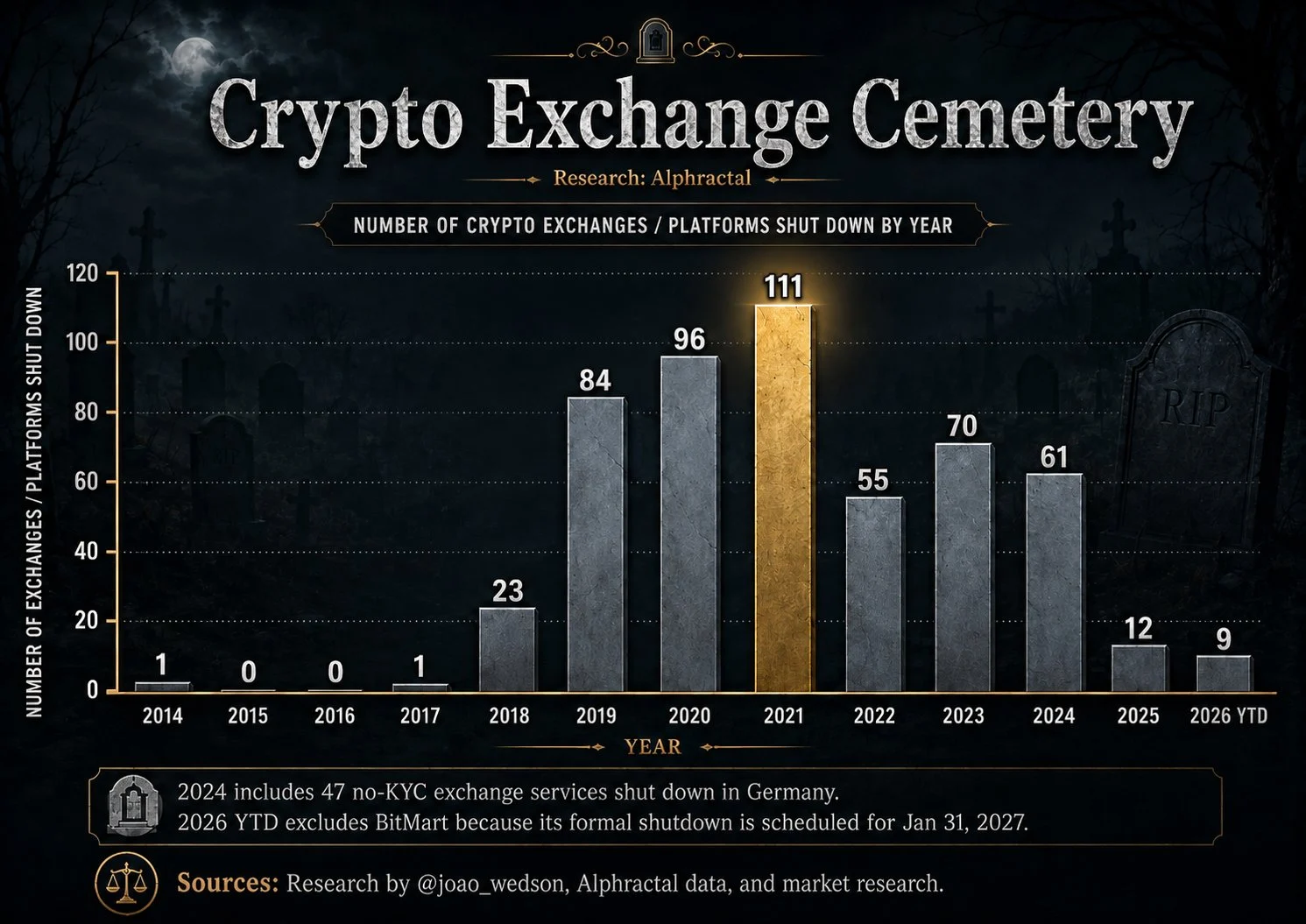
Only 9 crypto exchanges and trading platforms have announced or completed shutdowns in 2026, the lowest annual count in at least eight years. At first glance, that may appear reassuring. Yet Bitcoin’s price near $65,000 suggests a more uneasy backdrop. The pressure has not disappeared; it has shifted into areas that better reflect institutional demand, investor conviction, and available market liquidity.
Why Fewer Crypto Exchanges Are Closing
Exchange failures once tended to cluster near major market lows because prolonged bear markets drained trading volumes and exposed weak business models. Even so, that relationship was never exact. Platforms shut down for many reasons, including poor management, fraud, regulation, security breaches, competition, or a planned commercial exit.
Counting failed venues treats every closure as the same event, even though an insolvent platform and a healthy company leaving one market can signal very different things. The figure of nine therefore says more about business survival than Bitcoin’s next price direction.
ETF Flows Reveal Bitcoin’s Real Pressure
Institutional flows now provide a clearer reading of marginal demand. US spot Bitcoin ETFs recorded $11.64 million in net outflows on 27 July, marking a third straight negative session. Combined net assets still stood near $78.71 billion, while Bitcoin traded around $64,984. The withdrawal was small relative to the funds’ total size, but its direction matters because ETF creations and redemptions show whether fresh regulated capital is entering or leaving the market.
One red day does not prove a deeper downturn. The broader pattern has been mixed. The funds recorded about $33.79 million in net inflows during the week ending 24 July, despite heavy withdrawals late in that period. The pattern resembles a tide that advances, pauses, and then retreats. That points to hesitation, not a full institutional exit.
Key Crypto Indicators Investors Are Watching
No single indicator works in isolation. ETF outflows can reflect portfolio rebalancing rather than fear, while exchange inflows may involve custody transfers rather than planned selling. Analysts get a clearer picture when price, volume, derivatives, on-chain behavior, and macro conditions all point in the same direction.
Crypto Exchanges No Longer Define Market Health
The industry’s center of gravity has changed. In earlier cycles, crypto exchanges were the main gateway for nearly every participant. Spot ETFs, institutional custody, corporate treasuries, and regulated derivatives have since spread activity across more channels.
That makes exchange closures a narrower measure. Bitcoin can face selling pressure while trading businesses remain operational. Platforms can also close during a rising market because of licensing costs or strategy changes. The number of failed crypto exchanges is a lagging business statistic, not a reliable bottom signal.
Macroeconomic conditions now carry more weight as well. Interest-rate expectations, dollar strength, equity risk appetite, and global liquidity can influence Bitcoin alongside crypto-native signals.
What the Nine Closures Actually Mean
The low number is still constructive because crypto exchanges and industry infrastructure appear stronger than during earlier crises.
Resilience, however, is not the same as bullish momentum. Healthy trading platforms can operate through a weak market, just as banks can remain open during an economic slowdown. The more useful question is whether buyers are absorbing supply. ETF flows, spot volume, stablecoin liquidity, and long-term holder behavior help answer that.
Conclusion
Bitcoin’s stress is no longer best measured by counting shuttered platforms. Only nine crypto exchanges have closed or announced closures in 2026, yet institutional demand remains hesitant and price action is vulnerable. The market has matured, and its warning signs have become more subtle. Exchange survival shows infrastructure strength, while ETF flows and on-chain data reveal whether capital has enough confidence to stay.
Frequently Asked Questions
Do exchange closures predict a Bitcoin bottom?
Not reliably. Closures have different causes and often lag market conditions.
Why do Bitcoin ETF outflows matter?
They show whether regulated investment products are gaining or losing net capital.
Is a $11.64 million outflow severe?
Not by itself. Its importance depends on duration, fund size, price action, and wider liquidity.
Which indicator is most useful?
No single measure is best. Strong analysis combines flows, volume, leverage, on-chain data, and macro conditions.
ETF net flow: The difference between capital entering and leaving an exchange-traded fund.
MVRV: A ratio comparing Bitcoin’s market value with value based on the last on-chain movement of each coin.
Open interest: The total value of active futures or options contracts.
Funding rate: A periodic payment between long and short perpetual-futures traders.
Realised loss: A loss recorded when Bitcoin moves or sells below its acquisition price.
This article is for educational and informational purposes only. It does not provide financial, investment, legal, or tax advice.