Philippine Jobless Rate Climbs to Three-Month High in June as Workforce Expands
Key Takeaways
- •The Philippine unemployment rate rose to 4.9% in June 2025, up from 3.7% a year earlier and 4.8% in May, marking the highest level in three months with 2.59 million Filipinos out of work.
- •Approximately 650,000 Filipinos entered the labor force for the first time in June, but only about 310,000 of these new entrants secured employment, contributing to the elevated jobless rate.
- •The youth employment rate for those aged 15 to 24 dropped to 86.5% from 90.6% a year earlier, indicating growing difficulty for young job seekers despite rising labor force participation.
- •Underemployment increased to 12.1% in June from 11.4% a year earlier, with 6.11 million Filipinos seeking additional work hours or second jobs, pointing to weaknesses in job quality.
- •Wholesale and retail trade experienced the steepest annual job losses at 903,000 positions, while accommodation and food services led employment gains with 481,000 new jobs.
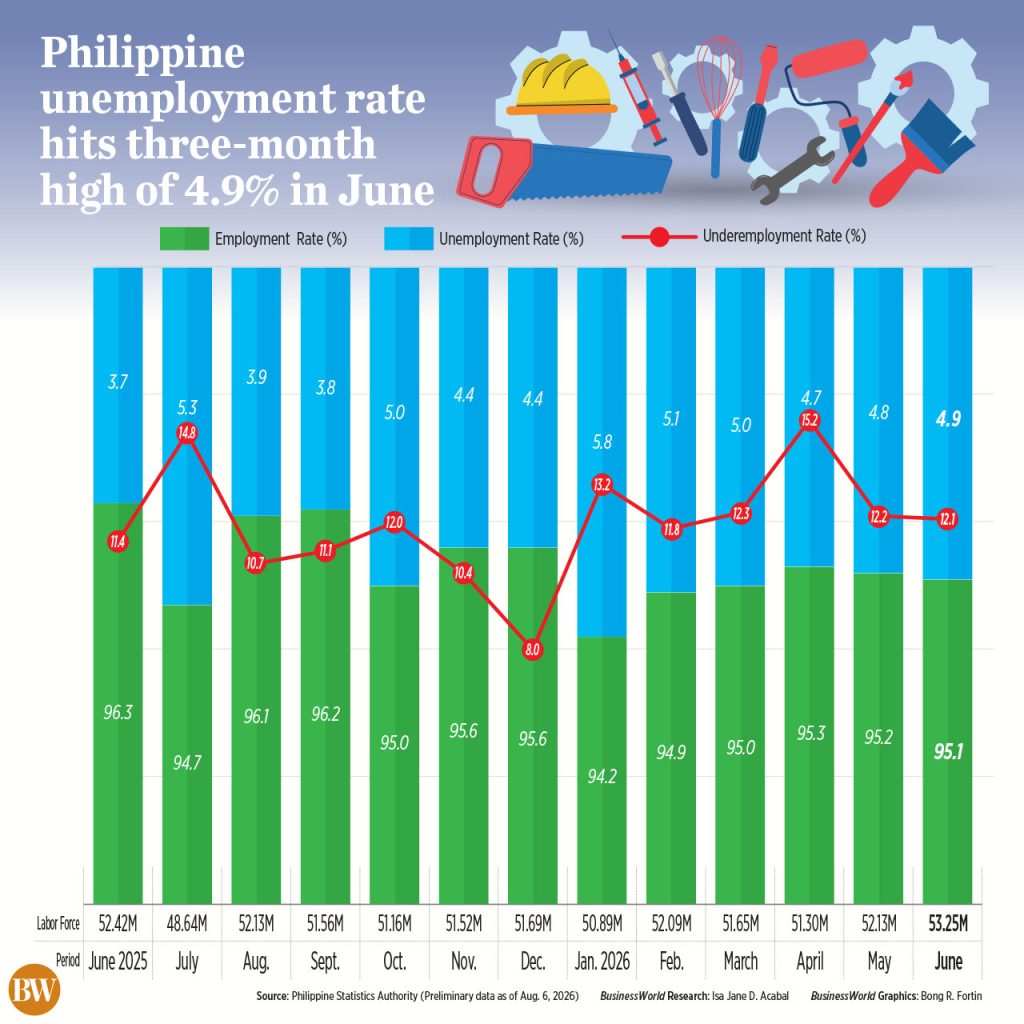
The Philippines' unemployment rate rose to a three-month high in June, the Philippine Statistics Authority (PSA) reported on Thursday, in a signal of potentially softer labor market conditions that could pressure household spending and complicate government efforts to sustain economic growth in one of Southeast Asia's fastest-expanding economies.
The jobless rate climbed to 4.9%, up from 3.7% a year earlier and slightly above the 4.8% recorded in May. It was the highest reading in three months, matching a level last seen when unemployment stood at 5% in March. A total of 2.59 million Filipinos were out of work in June.
National Statistician Claire Dennis S. Mapa attributed the increase primarily to a larger labor force, as fresh graduates entered the job market.
"Our labor force participation increased. Year on year, this increased by around 822,000. Of course, when labor force participation increases, there are employed and unemployed," Mr. Mapa said.
The labor force participation rate (LFPR) stood at 65.1% in June, down slightly from 65.7% in June 2025 but up from 63.8% in May. This brought the total labor force to 53.25 million Filipinos aged 15 years and older.
Approximately 650,000 Filipinos entered the labor force for the first time in June, Mr. Mapa noted. Of these, around 592,000 were aged 15 to 24, indicating that many were new graduates seeking their first jobs. However, only about 310,000 of these first-time entrants secured employment.
Labor Secretary Francis N. Tolentino said the rise in labor force participation reflected growing confidence among Filipinos in seeking employment.
"While year-on-year figures highlight areas that require sustained attention, they likewise reinforce the importance of advancing reforms that raise both the quantity and quality of jobs," Mr. Tolentino said in a statement.
Chinabank Research, in a note, said higher living costs likely pushed more Filipinos to look for work, but job creation failed to keep pace — particularly among those aged 15 to 24 — resulting in the elevated unemployment rate.
PSA data showed the youth labor force participation rate rose to 33.7% in June, up from 33.1% a year earlier and 32.3% in May. However, the youth employment rate dropped to 86.5% from 90.6% a year earlier, meaning a larger number of young Filipinos entered the workforce but a smaller share were able to find jobs.
Underemployment — which measures workers seeking additional work hours or another job — stood at 12.1% in June, up from 11.4% a year earlier but slightly lower than 12.2% in May. The June figure was the lowest underemployment rate since 11.8% in February. The total number of underemployed Filipinos reached 6.11 million.
For the first half of the year, the unemployment rate averaged 5%, while underemployment averaged 12.8%.
Services continued to be the largest employment sector, accounting for 62.7% of total employment, followed by agriculture at 20% and industry at 17.3%.
Accommodation and food services posted the largest annual employment gain in June, adding 481,000 jobs, followed by administrative and support services (including call center positions) at 456,000, and public administration and defense at 440,000. The gains in administrative and support services underscored the continued role of the country's business process outsourcing (BPO) industry — a cornerstone of the services economy and one of the world's largest — as a driver of job creation, even as other service subsectors contracted.
The steepest job losses were in wholesale and retail trade, which shed 903,000 positions year on year. Fishing and aquaculture lost 467,000 jobs, while construction declined by 139,000.
"Rising consumer prices will likely continue to weigh on hiring in the (retail) sector that has been contracting for a 12th straight month," Chinabank Research said, adding: "Employment in the construction sector also declined likely due to high construction material costs."
Jose Ramon G. Albert, a senior research fellow at the Philippine Institute for Development Studies (PIDS), said the latest data indicate the labor market is expanding in headcount but not necessarily in job quality.
"The uptick in underemployment to 12.1% is the more telling signal here. It suggests that a good chunk of those already employed are still looking for additional hours or a second job because their current earnings or work hours are insufficient. Taken together, this points to continued softness in the quality of job creation, with hiring likely concentrated in informal, part-time, or lower-paying segments rather than full-time, higher-value positions," Mr. Albert said.
Benjamin B. Velasco, assistant professor at the University of the Philippines School of Labor and Industrial Relations (SOLAIR), said the latest labor data continued to reflect long-standing structural challenges.
"Beyond the seasonal trend, the latest LFS show the long-term labor market pattern remains challenging. Job creation does not track economic growth. Thus, overseas migration will remain a safety valve, to cite one labor market response," Mr. Velasco said. The Philippines is among the world's top labor-sending nations, with cash remittances from overseas Filipino workers equivalent to roughly 9% of GDP, making migration a critical economic support.
IBON Foundation Executive Director Jose Enrique A. Africa said the figures confirm that the economy is not generating enough employment for its expanding population.
"The year-on-year trends confirm that the economy is unable to generate enough work for the growing population," Mr. Africa said.
He cautioned against attributing weak employment generation solely to recent external shocks, pointing to a sustained deceleration in net employment growth over several years.
"Weak net employment generation cannot be wholly blamed on the recent oil shock because this has been falling even before from 1.3 million in 2023, to 665,000 in 2024, and then just 170,000 in 2025," Mr. Africa said.
He warned that rising unemployment and underemployment, combined with elevated inflation, could erode household purchasing power.
"Growing unemployment and underemployment combined with the most recent report of high inflation especially for the poorest income groups strongly points to weakening family purchasing power and worsening welfare," Mr. Africa said. The Bangko Sentral ng Pilipinas has been monitoring inflation's impact on consumption as it weighs the balance between price stability and supporting growth, making incoming labor data a key input for policymakers. — M.J.M. Sanchez

