Philippine Agricultural Output Growth Eases to 2.9% in Q2 2026
Key Takeaways
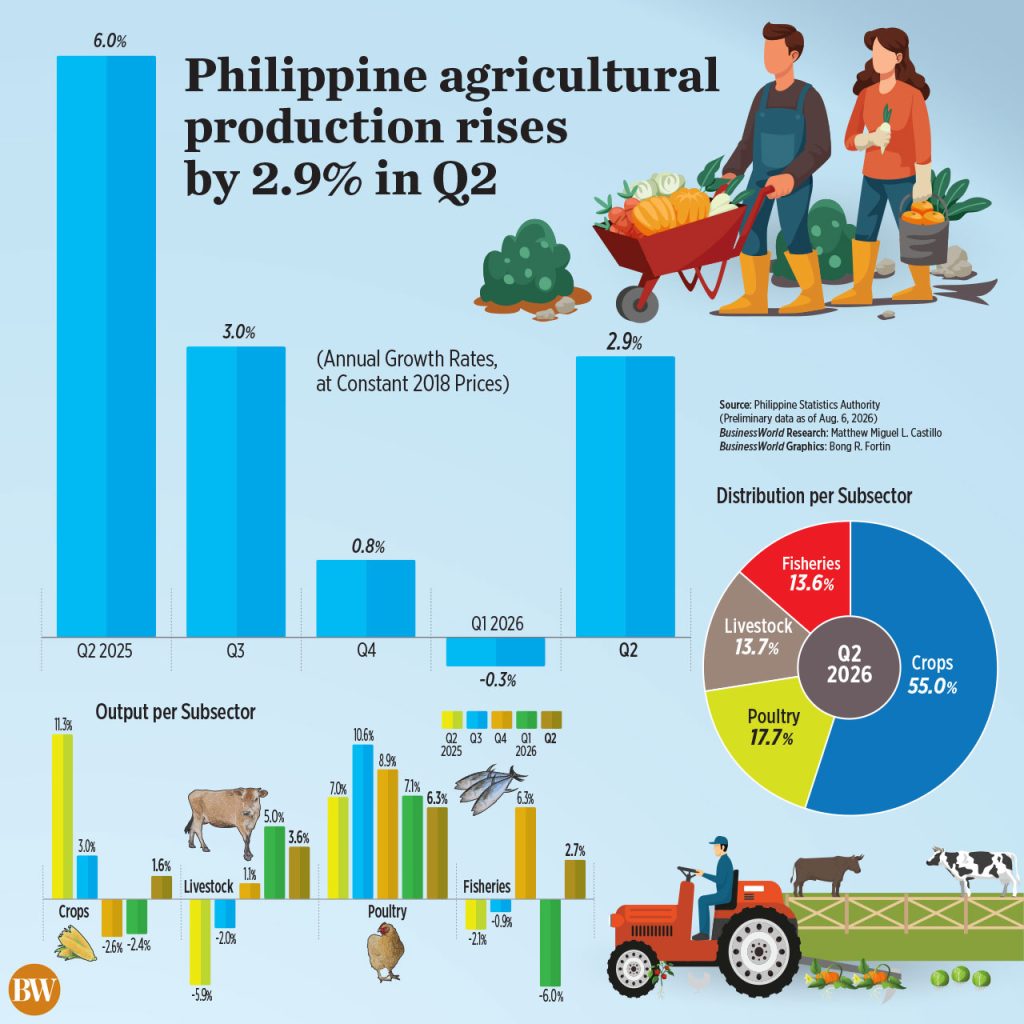
- •The Philippine agricultural sector grew 2.9% year on year in the second quarter of 2026, slowing from 6% in the same period a year earlier but recovering from a 0.3% first-quarter contraction.
- •All four agricultural subsectors—crops, livestock, poultry, and fisheries—registered gains, with poultry leading at 6.3% growth.
- •Former Agriculture Secretary William Dar attributed the slower expansion to geopolitical tensions, high energy and fertilizer prices, rising logistics costs, and delayed government assistance.
- •Livestock production rose 3.6%, reversing a 5.9% decline a year earlier, as hog output recovered 5.6% from the prolonged impact of African Swine Fever.
- •Industry experts warned that a looming Super El Niño could reduce crop yields, stress livestock, and disrupt fisheries in the second half of 2026.
By Marron Joshua F. Mendoza
The Philippines' agricultural sector posted slower growth of 2.9% in the second quarter of 2026, down from 6% a year earlier, even as all four subsectors—crops, livestock, poultry, and fisheries—registered gains, the Philippine Statistics Authority (PSA) reported.
At constant 2018 prices, the value of agriculture and fisheries production rose to P452.22 billion from P439.66 billion in the same period last year. While the expansion marked a deceleration from the 6% growth recorded in the second quarter of 2025, it represented a recovery from the 0.3% contraction seen in the first quarter of 2026. Agriculture accounts for roughly a tenth of Philippine economic output and employs about a quarter of the labor force, making quarterly performance a key gauge of rural incomes and food price stability.
"This expansion was driven by gains across crops, livestock, poultry, and fisheries," the PSA said.
At current prices, the value of production inched up by 0.2% year on year to P610.62 billion from P609.63 billion.
For the first half of the year, the total value of agricultural production reached P889.67 billion, up 1.3%, compared with 4% growth in the same period a year earlier.
Agriculture Secretary Francisco P. Tiu Laurel, Jr. described the second-quarter performance as "strong," saying it demonstrates that the government's farm modernization efforts are yielding results.
"These gains also give us a stronger buffer against the production slowdown we expect from El Niño in the fourth quarter. We cannot control the weather, but we can equip our farmers to overcome it through irrigation, mechanization, climate-smart technologies, quality seeds, modern post-harvest facilities and better market access," Mr. Laurel said in a statement.
Former Agriculture Secretary William D. Dar attributed the slower year-on-year growth to geopolitical tensions and insufficient government intervention.
"There is a convergence of factors why Q2 growth is significantly slower than last year, namely, geopolitical tensions leading to high energy prices, high fertilizer prices and higher logistics costs," Mr. Dar said via Viber.
"You can add the delayed distribution of government assistance of inputs including lack of extension services," he added.
Crops
Crop production, which accounted for 55% of the total agricultural output, rose by 1.6% year on year to P248.9 billion. This was far below the 11.3% increase recorded in the second quarter of 2025, though an improvement from the 2.4% decline posted in the first quarter.
For the first half, crop production contracted by 0.4% to P492.46 billion, reversing the 5.9% growth seen a year earlier.
The value of palay (unmilled rice) production climbed by 5.7% to P93.69 billion in the April-to-June period, decelerating from 13.9% growth a year ago. Rice is the country's staple food, and palay output trends directly affect domestic food inflation and the national rice import bill. In the first semester, palay output dipped by 0.5%, compared with 6.5% growth in the prior-year period.
Corn production value grew by just 0.8% in the second quarter, a sharp slowdown from 27.3% a year earlier. Corn is a key feed ingredient for the livestock and poultry industries, and weaker output can ripple into higher production costs downstream. For the first half, corn output contracted by 3%, reversing 5.4% growth in the same period of 2025.
Coconut output value rose by 2.4%, slightly slower than the 3% posted a year ago but faster than the 1.4% growth in the first quarter. The Philippines is among the world's top coconut exporters. For the first half, coconut production value grew by 1.9%, up from 1.3% a year earlier.
Several crops posted double-digit gains in the second quarter: mongo (14.6%), cabbage (12.3%), cassava (11.4%), tobacco (10.6%), and coffee (10.2%).
Sugarcane production, however, plunged by 22.5%, a stark reversal from the 341% surge recorded in the same quarter of 2025. Other decliners included rubber (-16.4%), tomato (-10.1%), calamansi (-7.7%), onion (-6.1%), banana (-3.5%), sweet potato (-2.7%), and potato (-2.4%).
Mr. Dar partly attributed the weak crop growth to "the problem of irrigation systems that were not functional this time."
Poultry
Poultry, representing 17.7% of total agricultural production, posted the fastest growth among all subsectors at 6.3%, reaching P79.84 billion. However, this was slower than the 7% growth in the second quarter of 2025 and the 7.1% recorded in the first quarter.
Chicken production increased by 4.1% (down from 8.2% a year ago), while chicken eggs surged by 13.2% (up from 4.8%). Duck output fell by 1.3%, worsening from a 1.1% decline a year earlier, and duck eggs dropped by 4% (from -0.7%).
For the January-to-June period, poultry output rose by 6.7% to P160.67 billion, easing from 8.4% last year.
Elias Jose M. Inciong, chairman of the United Broiler Raisers Association, linked the sector's slower growth to a broader economic slowdown.
"Demand was affected by the increase in fuel and fertilizer prices brought about by the Iran-US war. Production was similarly bogged down. Costs went up. Growth will necessarily be a challenge under these circumstances," Mr. Inciong told BusinessWorld via Viber.
He also noted that average farmgate prices had fallen to P105.94 per kilo as of July—the lowest in five years—compared with P119 per kilo in 2025.
Livestock
Livestock production rose by 3.6% to P61.83 billion, accounting for 13.7% of total agricultural output. This marked a turnaround from the 5.9% contraction in the second quarter of 2025, though slower than the 5% growth posted in the first quarter.
Hog production grew by 5.6% in the quarter ending June, recovering from a 7.5% decline a year ago. The hog sector had been battered by African Swine Fever since the disease first surfaced in the country in 2019, causing billions of pesos in losses and shrinking the national herd. Dairy output surged by 37.8%, accelerating from 6% growth in the prior-year period. Declines were recorded for cattle (-5.2%), carabao (-6.6%), and goat (-3.3%).
For the first six months, livestock output expanded by 4.3% to P122.53 billion, a significant improvement from the 4.5% contraction in the same period of 2025.
Alfred Ng, vice chairman of the National Federation of Hog Raisers, said multiple headwinds weighed on the sector.
"Obviously Q2 2026 growth will be slower due to negative effects of US Iran war, inflation due to oil price increases, depressed economic activity, wage freeze resulting to lower disposable income. These all contributed to poor pork demand and depressed liveweight prices," Mr. Ng told BusinessWorld via Viber.
He added that continued growth in pork imports, rising feed prices, and African Swine Fever (ASF) remain persistent challenges for the hog industry.
"ASF continues to be a problem for big pig producing provinces though not completely and accurately reported," he said.
Fisheries
Fisheries production value rose by 2.7% to P61.64 billion, making up 13.6% of total agricultural output.
Notable increases were recorded for squid (42.2%), roundscad or galunggong (38%), fimbriated sardines (33.7%), P. vannamei (23.2%), tilapia (13.1%), grouper (6.7%), and Bali sardinella or tamban (1.4%).
Double-digit declines were seen in mudcrab (-30.2%), cavalla or talakitok (-21.4%), bigeye tuna (-20.1%), big-eyed scad (-11.5%), skipjack (-14%), frigate tuna (-10.6%), and blue crab (-10.1%). Other decliners included yellowfin tuna (-8.5%), slipmouth (-7.4%), milkfish or bangus (-7.1%), threadfin bream (-6.6%), and tiger prawn (-5.6%).
For the January-to-June period, fisheries output contracted by 1.5% to P114.02 billion, reversing the 0.1% growth recorded in the same period last year.
Jayson H. Cainglet, executive director of the Samahang Industriya ng Agrikultura, said the fisheries growth figures primarily reflect gains by commercial fishing operations rather than small-scale fishers. He cited a Supreme Court ruling that permitted commercial fishing vessels to operate within 15-kilometer municipal waters.
"Since last year, a Supreme Court ruling allowed commercial vessels to fish inside the 15-km municipal waters. The 15-km municipal waters should be exclusive to artisanal/small fishers," Mr. Cainglet told BusinessWorld via Viber.
Looming El Niño
Industry experts and officials warned that a looming Super El Niño could significantly affect the agriculture and fishery sectors in the remainder of the year. El Niño typically brings below-normal rainfall and dry spells to the Philippines, reducing crop yields, stressing livestock, and disrupting fisheries.
Mr. Dar said agricultural output, particularly crops, would be badly impacted by the weather phenomenon in the second half.
Mr. Ng cautioned that Super El Niño would drive up prices of locally produced feed ingredients and strain water supplies.
"Super El Niño will put pressure on the local feeds produced like corn, rice bran, coco oil, molasses both on availability and affordability. It will also dampen the growth rate of our animals and may caused higher mortality figures due heat stress," he said. "Water source for drinking of our animals may also be compromised and short."
Mr. Inciong noted that the fourth quarter is traditionally the most challenging period for the broiler industry.
"There is always an expected oversupply because of better production conditions and the very heavy influx of imported chicken meat," he said. "Super El Niño will devastate market demand especially in the rural areas, adding to the oversupply."
Secretary Laurel said the Department of Agriculture's ongoing efforts to open new export markets and expand overseas shipments of Philippine farm products would help drive growth for the agricultural and fisheries sector through the end of the year.

