Philippines' June Trade Deficit Widens to $4.94 Billion as AI Demand Fuels Export and Import Growth
Key Takeaways
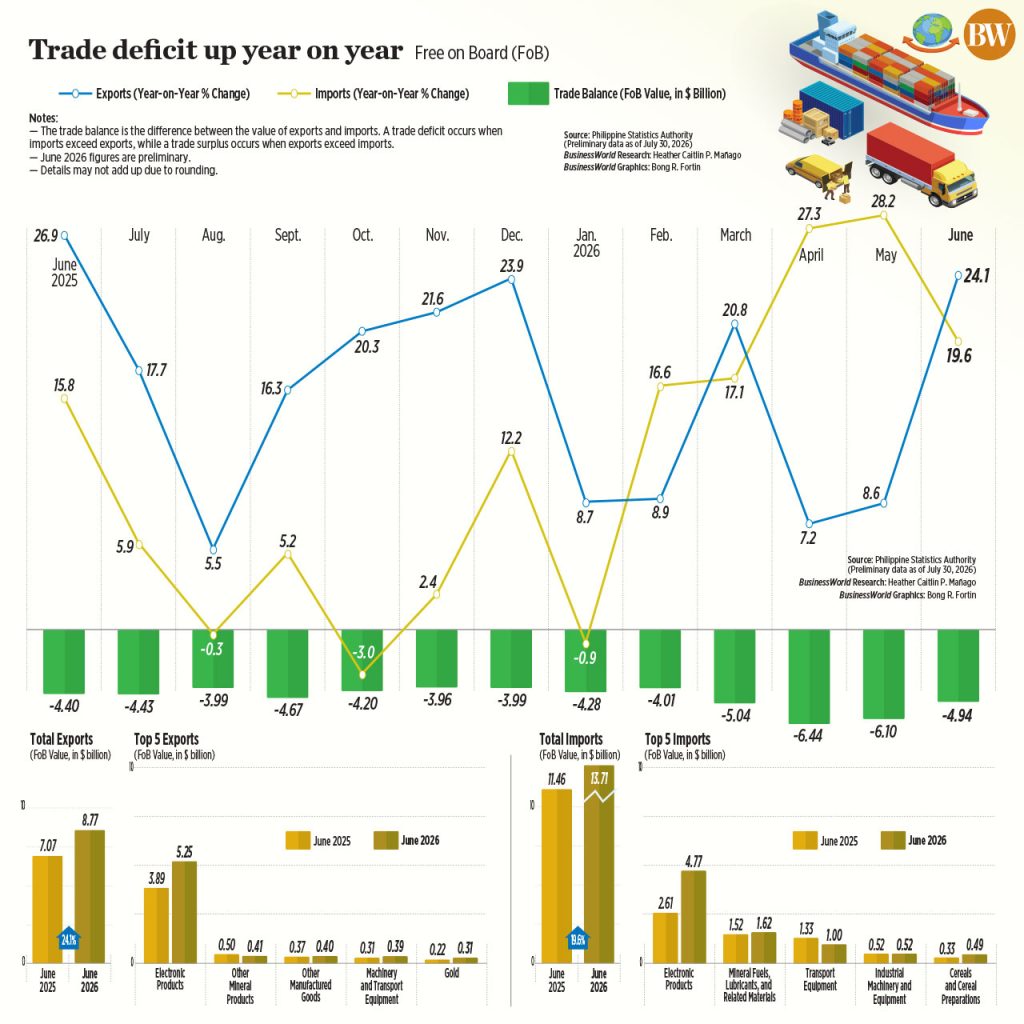
- •The Philippines' merchandise trade deficit widened to $4.94 billion in June, up 12.3% from a year earlier, though it narrowed from May's $6.1 billion shortfall to mark the smallest gap in four months.
- •Merchandise exports reached $8.77 billion in June, the highest level since the data series began in 1991, driven by a 35.2% surge in electronic products to $5.25 billion.
- •Semiconductor imports more than doubled, rising 105.4% to $3.76 billion, reflecting the country's deepening role in midstream AI-related electronics manufacturing and assembly operations.
- •The first-half trade deficit ballooned 25.85% to $30.81 billion, with actual export and import growth rates significantly exceeding the government's full-year targets of 3% and 5%, respectively.
- •The planned Pax Silica AI industrial hub in Tarlac, part of US CHIPS Act efforts to diversify semiconductor supply chains, is expected to boost the Philippines' capacity for higher-value semiconductor exports in the medium term.
By Beatriz Marie D. Cruz, Senior Reporter
The Philippines' merchandise trade deficit expanded to $4.94 billion in June, as surging global demand tied to artificial intelligence (AI) drove double-digit growth in both exports and imports, according to preliminary data from the Philippine Statistics Authority (PSA).
The trade-in-goods balance — the difference between exports and imports — widened by 12.3% from the $4.4-billion deficit recorded in the same month a year earlier. On a month-on-month basis, however, the gap narrowed from the $6.1-billion deficit posted in May. June marked the smallest trade shortfall in four months, dating back to the $4.01-billion gap in February.
The country's trade balance has remained in deficit for more than a decade, since the $64.95-million surplus recorded in May 2015. The structural shortfall reflects the Philippines' position in global electronics supply chains, where components and intermediate goods are imported for assembly, testing, and packaging before being re-exported — a cycle that amplifies both sides of the trade ledger when end-market demand accelerates.
"Rising global demand for semiconductors and other electronics is increasingly shaping the Philippines' trade profile," Chinabank Research said in a commentary.
The Philippines is one of Southeast Asia's key semiconductor assembly and testing hubs, with electronics consistently accounting for the majority of merchandise exports — a profile that makes the country a direct beneficiary of the global AI infrastructure buildout driving demand for chips and data center components.
Export and Import Performance
Merchandise exports climbed 24.1% to $8.77 billion in June — slightly slower than the 26.9% increase recorded a year ago but notably faster than the 8.6% growth seen in May. Total outbound sales of Philippine-made goods reached their highest level since the data series began in 1991.
Imports rose 19.6% to $13.711 billion, outpacing the 15.8% growth in the same month last year but decelerating from the 28.2% surge in May. The June import bill was the lowest since April, when it stood at $13.71 billion.
For the first half of the year, the trade-in-goods deficit ballooned 25.85% to $30.81 billion, up from $24.48 billion in the same period of 2025. Imports from January to June jumped 17.84% to $77.53 billion from $65.79 billion, while merchandise exports rose 13.09% to $46.72 billion from $41.31 billion.
The Development Budget Coordination Committee projects exports and imports to grow by 3% and 5%, respectively, for the full year. The actual first-half growth rates for both far exceed those official targets, underscoring how significantly AI-related demand has outpaced earlier government expectations.
AI-Driven Demand
Electronic products accounted for 59.9% of total exports in June and surged 35.2% to $5.25 billion.
"Rapidly escalating demand for AI, Internet of Things, and investment in hyperscale data centers fueled strong growth of components and semiconductors," the Department of Trade and Industry said in a statement.
Semiconductor exports, which represented the bulk of electronic products, rose 33.4% to $3.85 billion.
"Semiconductors continued to underpin the strong exports performance. The strong growth came despite near-term headwinds such as ongoing warehouse congestion, which disrupted production schedules, raised logistics and storage costs, and put pressure on exporters' delivery commitments," Chinabank Research noted.
Exports of mineral products, which comprised 4.7% of total exports, fell 17.7% to $414.85 million.
By destination, the United States led with $1.76 billion, or 20.1% of total exports. It was followed by Hong Kong with $1.34 billion (15.3%), China with $1 billion (11.4%), Japan with $990.16 million (11.3%), and Singapore with $508.18 million (5.8%). The export destination mix aligns with the geography of AI infrastructure investment, with the US and regional Asian technology hubs absorbing the bulk of Philippine electronics shipments.
Import Composition
Imports of raw materials and intermediate goods jumped 53.4% to $5.89 billion, representing 42.9% of the total import bill. Capital goods imports, however, declined 5.5% to $3.62 billion, accounting for 26.4% of June imports.
Electronic goods recorded the largest import value by commodity group at $4.77 billion, up 82.9% from $2.61 billion a year earlier, and represented 34.8% of total imports. Semiconductor imports — 27.4% of imported electronic goods — more than doubled, rising 105.4% to $3.76 billion.
"Imports of materials for electronic equipment manufacturing soared (+227.9%), raising their share of total imports to 18.3% from 6.7% a year earlier. This underscores the country's growing participation in AI-related and electronics supply chains," Chinabank Research said.
The simultaneous surge in electronic component imports and electronics exports is characteristic of the Philippines' role in midstream semiconductor operations — receiving wafers and components for processing into finished or semi-finished products for global shipment.
Imports of mineral fuels, lubricants, and related materials, which made up 11.8% of June imports, increased 6.3% to $1.62 billion.
"The true engines of the surge in imports were higher global oil prices, transportation costs, and other logistics expenses due to the supply-chain disruptions spawned by the Middle East crisis," said Francisco Cid L. Terosa, a former dean at the University of Asia and the Pacific School of Economics, in an email.
China remained the Philippines' top source of imports at $4.35 billion, or 31.7% of the total. The Republic of Korea followed with $1.78 billion (13%), Japan with $919.13 million (6.7%), Indonesia with $912.63 million (6.7%), and the United States with $706.7 million (5.2%).
Outlook
Chinabank Research said future export growth is expected to be supported by the planned AI hub in Tarlac under the US-led Pax Silica initiative, which is anticipated to enhance the Philippines' capacity to ship higher-value semiconductors.
"In the medium term, we think that the Pax Silica industrial hub could significantly strengthen the Philippines' role in the global technology industry by supporting exports of higher-value semiconductors, advanced manufacturing, and AI-related infrastructure," the research unit noted.
The Pax Silica initiative forms part of broader US efforts under the CHIPS Act framework to diversify semiconductor supply chains across allied and partner nations in the Indo-Pacific, potentially positioning the Philippines for a larger share of value-added semiconductor activity beyond its traditional assembly and testing base.
However, Chinabank Research cautioned that concerns regarding the potential strain of the AI hub on water and energy resources must be addressed to ensure sustainable economic development.

