The resilience dividend: Repositioning Philippine real estate for what’s next
Key Takeaways
- •Metro Manila is expected to become Southeast Asia’s third-fastest-growing major economy by 2035, behind Ho Chi Minh City and Hanoi.
- •The Philippines ranks 90th of 130 countries on a composite resilience index and fifth among six assessed Southeast Asian markets.
- •Renewable energy capacity reached about 8.7 gigawatts in 2025, but renewable generation remained below 25% of the electricity mix.
- •The Philippine data center market is projected to grow from about $0.69 billion in 2025 to $2.48 billion by 2031, with power supply a key constraint.
- •Condominium vacancy reached 24.7% in 2025, while Bay Area Grade A office vacancy was 36% in the second quarter of 2026, contrasting with stronger industrial and REIT activity.
By Cha Carbonell
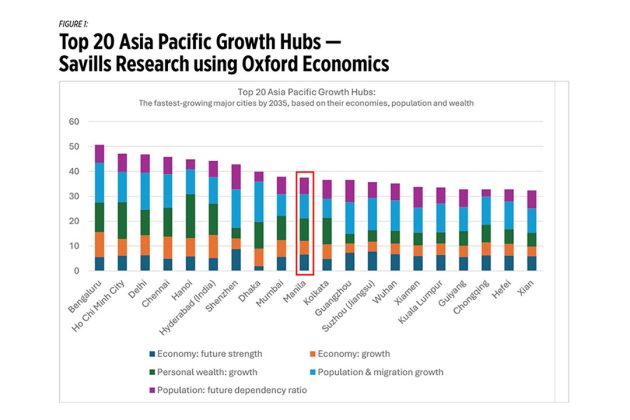
By 2035, Metro Manila is projected to be among the 10 fastest-growing major economies in Asia-Pacific and the third-fastest-growing in Southeast Asia, behind only Ho Chi Minh City and Hanoi, according to Savills Research, using data from Oxford Economics.
The growth story remains intact on paper, supported by a rising population, expanding wealth and an economy on the move. But growth and resilience are not the same thing.
Across a composite resiliency index covering climate, seismic, macroeconomic and governance factors, the Philippines ranks 90th out of 130 countries and fifth among six Southeast Asian markets included in the index. The country is weak on climate, seismic and cybersecurity risks but strong in inflation management.
The gap between where the country is growing and where it is vulnerable defines the real estate industry’s task. Five priorities can help close it.
Infrastructure development
Flood control done right
The World Bank- and JICA-backed Pasig-Marikina River Channel Improvement Project reduced flood inundation by 18% and averted an estimated P14.3 billion in damages in 2024. Marikina’s post-Ondoy reforms resulted in zero deaths during the 2012 Habagat floods, while the P4.3-billion Iloilo Flood Control Project has remained effective for more than a decade.
The pattern is clear: long timelines, multilateral funding and verifiable results. These are precisely the features missing from the so-called ghost projects and should be the standard developers demand before factoring public flood mitigation into a site’s value.
Relieving Manila’s seaport chokepoint
Congestion at Manila Harbor is primarily a yard-utilization problem. The Manila International Container Terminal alone handles roughly 70% of the country’s container traffic, placing it near its rated ceiling.
Batangas is helping relieve the pressure. Its existing terminal added 400,000 twenty-foot equivalent units (TEUs) of capacity in early 2026. International Container Terminal Services, Inc. (ICTSI) also broke ground on the Bauan South Luzon Container Terminal, the largest privately funded marine terminal in Philippine history. Subic’s underused harbor provides additional capacity.
Bulacan and the Region 3 airport and rail network
The New Manila International Airport in Bulacan is intended to ease congestion at Ninoy Aquino International Airport (NAIA). It is connected to Metro Manila, Bulacan and Clark by toll roads and an MRT-7 spur. Clark International Airport is adding a second runway and remains the clearest ready-now alternative.
Davao, Zamboanga, Bohol-Panglao and Kalibo each demonstrate that regional gateways can succeed without routing every visitor through NAIA.
Hospitality and leisure
Every regional gateway upgrade is also a hospitality and leisure opportunity. Bohol-Panglao, Kalibo, Davao, Zamboanga and Dumaguete serve simultaneously as aviation and resort catchments.
Cruise tourism is advancing as well. Arrivals more than doubled from 88,080 in 2023 to 226,247 in 2025, exceeding pre-pandemic levels. The growth is supported by a P5-billion home-port terminal in Manila Bay’s Entertainment City, which is also the country’s most oversupplied office and residential submarket.
Railway and road networks
The rail pipeline, led by the North-South Commuter Railway and the Metro Manila Subway, is expected to cut commute times enough to make satellite cities more livable while shifting commuters to lower-carbon transport.
The Cavite-Laguna Expressway (CALAX), the Cavite-Batangas Expressway and the NLEX-SLEX Connector link these developments into a system that bypasses Manila’s saturated roads.
Sustainability and renewable energy
Renewable energy priority
Renewable energy (RE) capacity continued to rise, reaching about 8.7 thousand megawatts (MW) by 2025, compared with coal capacity of 11.9 thousand MW—a 1.4-times gap.
The disparity is wider in generation: coal produced 72 thousand gigawatt-hours (GWh), compared with 32 thousand GWh for RE, or more than twice as much. The figures show that the Philippines has built substantial RE capacity but is not yet producing a proportional amount of electricity from it. Intermittent renewable sources operate alongside coal, which runs as baseload power nearly around the clock.
The Department of Energy’s (DoE) National Renewable Energy Program targets a 35% share for RE generation by 2030 and 50% by 2040. However, RE generation remained below 25% of the mix in 2025 despite stronger capacity growth.
The Green Energy Auction program is pairing solar and wind projects with battery storage. Without storage, capacity gains appear in MW but not necessarily in GWh. Offshore wind, led by the DoE’s 3.3-GW GEA-5 auction, is the largest potential lever for steadier output.
Reporting standards for sustainable companies
A structural gap remains between landlords and tenants. Mechanisms such as the Green Energy Option Program register the landlord as the utility consumer, leaving tenants without information they can cite in their own environmental, social and governance (ESG) reporting.
Potential solutions include sub-metering at the tenant level, assigning renewable energy certificates to each tenant and writing the cost pass-through into the lease. With Securities and Exchange Commission (SEC) disclosure rules being phased in from fiscal 2026, landlords that address the issue first will be better positioned to retain global capability centers (GCCs) and multinational companies (MNCs).
Artificial intelligence and technology disruption
Data centers emerge as a new asset class
The data center market is valued at roughly $0.69 billion in 2025 and is projected to reach $2.48 billion by 2031.
Power is the principal constraint. The information and communications technology (ICT) sector needs 300-500 MW of baseload capacity through 2026, while the Philippines has the highest commercial electricity price in Southeast Asia. Renewable energy development is therefore a competitiveness issue as well as a climate issue.
BPO and IT services: disruption and reinvention
Artificial intelligence (AI) poses a significant threat to the sector responsible for the largest share of Metro Manila’s office absorption. Research from the International Monetary Fund (IMF) places the risk of customer-service automation as high as 80% by 2025.
At the same time, the Information Technology and Business Process Association of the Philippines (IBPAP) still projects industry revenue to reach $42.3 billion in 2026, because most roles exposed to AI are complementary rather than replaceable.
Global Capability Centers now account for 39% of IT-BPM office demand, reflecting a shift from cost arbitrage toward higher-value activities.
Filipino upskilling and talent
The Philippines continues to have one of Asia’s youngest populations. Some 67.1% of the population is of working age, and labor-force participation is at its highest level since 2005.
The IMF identifies 2025-2035 as the critical window for converting that demographic profile into a genuine dividend. AI exposure is concentrated in clerical and customer-facing roles.
The country’s largest talent pipelines are Business, Administration and Law, and Education. Nearly 2 million enrollees and graduates across these fields combined feed directly into occupations identified by the data as among the most exposed to AI. Lower-exposure fields such as agriculture and trades draw from much smaller pools.
Reskilling should begin with Business, Administration and Law, and Education because these fields combine the largest exposure with the greatest volume. Training should focus on complex judgment and AI-augmentation skills.
The ICT pipeline, which comprises roughly 590,000 people and is undersized given its importance, should be expanded. Trades, agriculture and technical and vocational education and training (TVET) tracks are the smallest pools despite being the most AI-resistant and should be protected as a hedge.
Balancing real estate asset classes
Metro Manila’s residential market shows the clearest overcommitment. Condominium vacancy reached 24.7% in 2025, representing roughly 81,000 unsold units concentrated in Pasay, Parañaque and Muntinlupa. These areas are part of the same Bay Area zone flagged for weak climate and seismic scores.
The office market tells a related story. Bay Area Grade A vacancy stood at 36% as of the second quarter of 2026, compared with less than 8% in Bonifacio Global City (BGC).
Industrial stock, by contrast, has grown consistently since 2015, rising from roughly 9.8 million square meters to a projected 15.9 million sq.m. by 2025—a 63% increase. The expansion reflects a sustained pace of completions across mature and emerging locations as developers continue to serve logistics, manufacturing and distribution demand.
The largest single-year increase came in 2024, when new supply exceeded 1 million sq.m. Batangas and Laguna accounted for most of the additions, reaffirming South Luzon’s dominance as the country’s primary industrial corridor.
Real estate investment trusts (REITs), as a diversified asset class, allow capital to move at scale. Aggregate REIT revenue grew 24% year on year in 2025, with capital rotating out of oversupplied condominiums and into logistics and data centers, retail and hospitality.
A portfolio concentrated in one oversupplied asset class and in the country’s most exposed geography is as fragile as an economy funneled through a single port or airport.
Developers that taper speculative residential construction, focus on industrial and data center demand, hospitality and retail, and incorporate sustainability from the outset are not choosing between resilience and returns. They are building the real estate that the Philippines is becoming.
Cha Carbonell is the Chief Operating Officer of Savills Philippines.

