Peter Thiel puts $118 million into Amazon as Thiel Macro returns to stocks
Key Takeaways
- •Thiel Macro reported a $418.7 million portfolio in its second-quarter filing after having shown no 13F holdings at the end of December 2025 and March 31, 2026.
- •Amazon was the fund’s largest position, with nearly $118 million invested, and every holding in the portfolio was new.
- •AWS revenue rose 37% to $42.2 billion and backlog increased to $496 billion from $364 billion in the prior quarter.
- •Nearly 72% of the portfolio was allocated to energy and power-related stocks, including Vista Energy, Vistra, American Electric Power, DTE Energy, FirstEnergy, CMS Energy, and X-Energy.
- •The energy positions align with AI infrastructure demand, including utility load, grid capacity, and nuclear supply tied to data centers and cloud expansion.
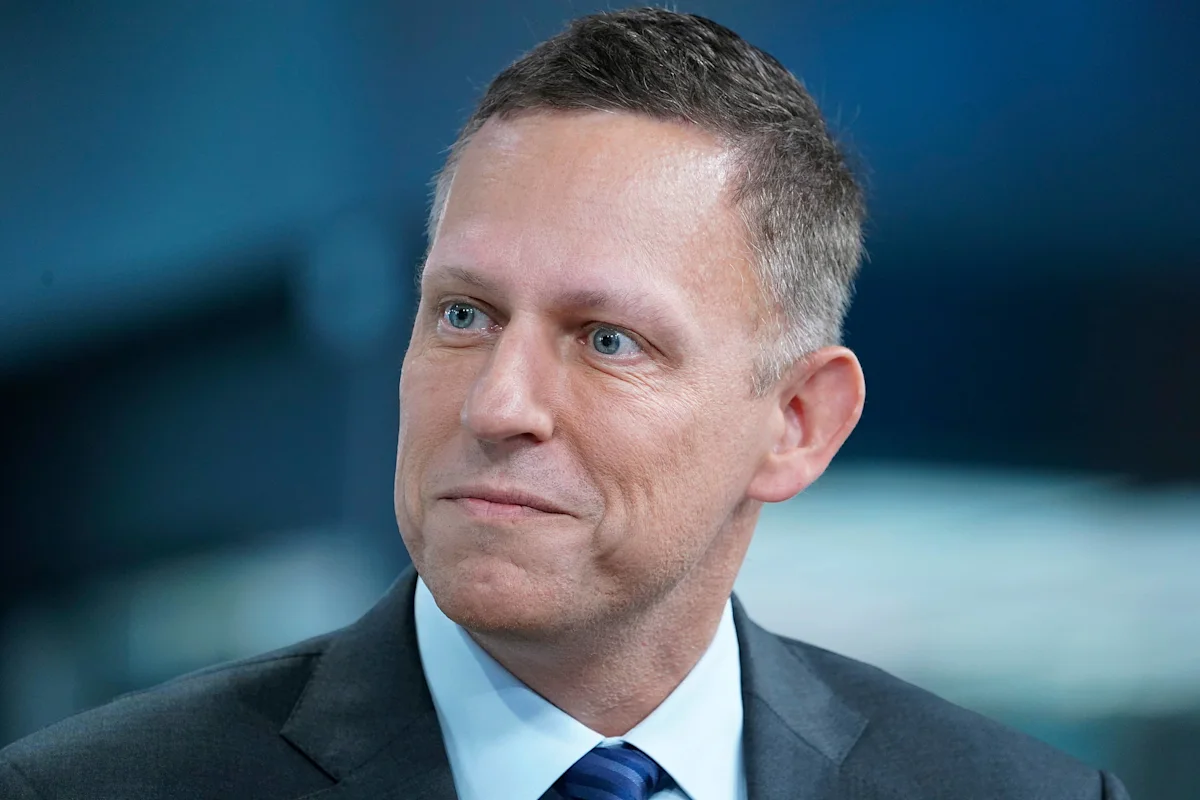
Peter Thiel's Thiel Macro hedge fund had been largely absent from public equity investing for some time.
The fund reported zero 13F holdings at the end of December 2025 and again showed no holdings as of March 31, 2026. That is why Thiel Macro's second-quarter filing drew attention: the fund returned with a $418.7 million portfolio.
Its largest new position was the most notable, because it came as investors were still parsing how much of the AI buildout is showing up in revenues, orders, and spending plans across the cloud and utility sectors.
Peter Thiel makes Amazon his biggest bet
The mystery big tech stock is Amazon (AMZN).
Thiel Macro bought nearly $118 million worth of Amazon shares during the second quarter, making the stock the fund's largest holding at 28% of its $418.7 million 13F portfolio. Every position in the portfolio was new, and the timing stood out.
According to Reuters, Amazon shares jumped about 14% on July 31 after earnings, as investors responded to signs that the company's heavy artificial intelligence spending is beginning to produce visible results. The stock later closed at $278.09 on August 10, about 19% higher for the year at that point.
The clearest reason for the move was Amazon Web Services.
AWS revenue rose 37% to $42.2 billion, its fastest growth in 18 quarters and well above the nearly 31% increase Wall Street had expected. AWS operating income increased to $16.6 billion, accounting for 60% of Amazon's total $27.5 billion in operating profit.
More importantly for the AI thesis, AWS backlog climbed to $496 billion from $364 billion in the prior quarter, a rise of roughly 36%, according to Reuters. Amazon has also said much of its 2027 cloud capacity is already reserved, with some 2028 capacity also spoken for.
That helps explain why investors accepted Amazon's higher 2026 capital spending forecast of $220 billion, even as trailing free cash flow turned to a $7.6 billion outflow. The spending is tied to contracted demand rather than speculative capacity, a distinction that matters for a company whose cloud business often sets the tone for broader sentiment around enterprise AI infrastructure.
Although Thiel has not publicly discussed the latest purchase, his view of Amazon's business model goes back years. In his startup book Zero to One, Thiel wrote, "Amazon shows how it can be done," praising its strategy of dominating a specific market before expanding into adjacent ones.
The new position is therefore less surprising than it may first appear. Thiel is buying into a company whose scale strategy he has long admired, just as AWS appears to be validating the AI expansion cycle.
Peter Thiel's investing strategy
Thiel's investing style is often described through two core traits: patience and concentration.
Based on the second-quarter filing, instead of spreading capital broadly, the fund focused on a small number of related ideas. That approach fits Thiel's broader philosophy.
Founders Fund has long promoted contrarian investing, arguing that consensus opportunities often offer limited upside because much of the optimism is already reflected in valuations. The aim is to find something important enough that the market may still be underestimating it.
Thiel also brings substantial experience to those decisions. He co-founded PayPal, served as chief executive, and took the company public. He later co-founded Palantir (PLTR) and remains chairman of the company. He is also known for making the first outside investment in Facebook and is a partner at Founders Fund, which has backed companies including SpaceX and Airbnb.
Forbes estimated Thiel's real-time net worth at $32 billion as of August 15.
His latest portfolio shift reflects a similar mindset. Rather than simply chasing AI software or chip stocks, Thiel Macro is targeting the bottlenecks behind the boom.
Thiel's larger bet is on AI's power needs
Thiel Macro's other holdings point to the broader AI thesis that the technology requires far more electricity.
Nearly 72% of the $418.7 million portfolio is allocated to energy and power-related stocks. Thiel bought 1.19 million shares of Vista Energy (VIST) worth $75.9 million, reopened 372,755 shares of Vistra (VST) worth $59.1 million, and added 308,617 shares of American Electric Power (AEP) worth $42.2 million, according to 13F.info.
He also invested in 264,450 shares of DTE Energy (DTE) worth $40.3 million, 839,319 shares of FirstEnergy (FE) worth $39.9 million, 517,124 shares of CMS Energy (CMS) worth $39.6 million, and 200,000 shares of X-Energy (XE) worth $3.7 million.
The AI connection is especially clear at Vistra (VST). According to Reuters, the company has a 20-year agreement to supply AWS with 1,200 megawatts of nuclear power from Comanche Peak, along with major nuclear agreements with Meta Platforms (META), the parent of Facebook.
American Electric Power also offers another direct route into the data-center boom. In February, the utility said it had agreements representing 56 gigawatts of data-center load, double its October level, along with another 180 GW of requests.
DTE is positioning similarly. Its agreement for Alphabet's (GOOGL) planned Michigan data center covers 1 gigawatt, while two large data-center contracts could contribute around $9 billion to its electric system through 2045.
X-Energy (XE) is the clearest link back to Amazon. Amazon and X-Energy are targeting more than 5 GW of new nuclear capacity by 2039 to meet rising data-center power needs, according to a press release.
Rather than focusing on a single utility stock, Thiel appears to be positioning for several parts of the AI power buildout, spanning cloud demand, grid capacity, and nuclear supply.
This story was originally published by TheStreet on Aug. 16, 2026, where it first appeared in the Investing section.

