Pawavox Uses Nostr Cryptography and ElectionGPT to Make Nigerian Election Evidence Court-Proof Ahead of 2027
Key Takeaways
- •Pawavox embeds four cryptographic proofs — a hash, device ID, timestamp, and ultra-precise location coordinates — into every recording at the moment of capture so evidence can withstand tribunal scrutiny under Section 84 of Nigeria's Evidence Act.
- •The app stores footage in an encrypted local vault hidden from the phone's gallery and can remotely quarantine confiscated devices, protecting observers from political thugs and preventing bad actors from flooding the network with false reports.
- •Pawavox splits its data pipeline between the Nostr protocol for lightweight signed metadata and Google Cloud for video files, enabling fully offline cryptographic signing and staged uploads over Nigeria's congested 2G and 3G rural networks.
- •In its only live electoral test during the Osun State election, the startup onboarded 300 users and captured just 142 verified reports, far short of the scale needed to cover Nigeria's 176,974 polling units.
- •Pawavox is deploying a ₦13 million AIDF grant over nine months to build an independent network of 5,000 trained observers and is engaging organisations such as Yiaga Africa, IFES, NDI, and Microsoft, though no formal commercial contracts have yet been signed.
The most consequential election manipulation in Nigeria rarely unfolds on the quiet capital city streets patrolled by international observers flying out of Abuja. It happens in rural communities and at ward and collation centres — often behind locked gates guarded by political thugs whose core mandate is to ensure no camera leaves the premises with usable evidence. And when aggrieved candidates carry whatever footage survives to an election petition tribunal, they run into a second barrier: defence lawyers invoking Section 84 of the Evidence Act, combined with the rise of generative artificial intelligence, to have genuine smartphone videos dismissed as doctored digital fabrications.
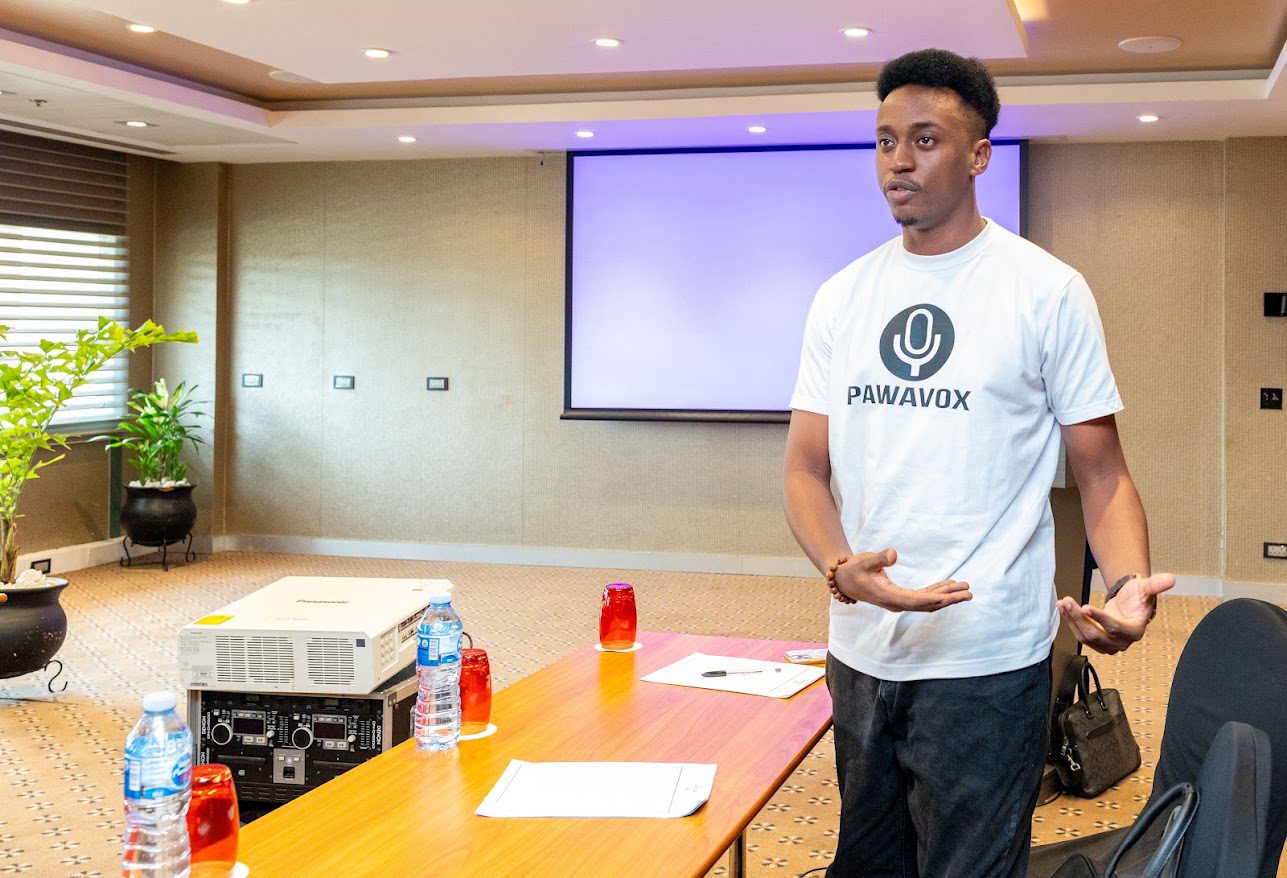
For Jason Omu, a finance professional turned infrastructure builder and co-founder of the civic-tech startup Pawavox, closing that evidentiary gap is the defining technical challenge ahead of Nigeria's 2027 general elections. Pawavox was built over the past ten months out of Fast Forward Venture Studio, with backing from Prosperity Tech. It began life as a generic feedback-collection tool before pivoting into a cryptographic verification protocol designed for high-stakes environments.
"Now, Pawavox stands as a way to give data a stronghold in court," Omu told Technext. "Whenever someone presents information in court, it is no longer a question of: is this real, is this AI, or was this manipulated in some way? Once it is recorded on Pawavox, there is no need to fact-check it traditionally. Even if you edit so much as crop it by one second or you change the brightness, that hash will break."
Why Nigerian courts reject electronic evidence
The significance of Pawavox's architecture becomes clear when examining how Nigerian courts treat electronic media. Under Section 84 of the Evidence Act, digital recordings face intense legal scrutiny over chain of custody and device integrity — a standard that often renders viral polling-unit videos useless alongside official records from the Independent National Electoral Commission's (INEC) Bimodal Voter Accreditation System (BVAS) and the Result Viewing Portal (IReV).
Pawavox bypasses institutional trust by embedding four cryptographic proofs into every file at the exact moment of capture: a mathematical hash, the mobile hardware's unique device ID, a timestamp, and ultra-precise location coordinates. According to Omu, the startup's in-house legal counsel structured this metadata specifically to survive tribunal cross-examination, so that judges are not required to take Pawavox's word for anything.
Signing after capture alone, however, would not stop a compromised field agent from pointing a camera at a high-resolution laptop screen playing a deepfake, or from running a Virtual Private Network (VPN) to spoof their polling-unit location. Omu argues that Pawavox neutralises both attack vectors before the signature is ever generated.
"A regular VPN will probably spoof a location down to a five-decimal-point range; our app records longitude and latitude up to 20 or 25 decimal points," Omu explained. "Once you are not spoofing to that specific level of length, we know immediately that someone tried to tamper with it. Beneath the cryptographic signing, about 60 to 70 per cent of that pipeline goes into an analysis layer that checks against deepfakes to make sure whatever is being recorded is not coming from a phone or laptop screen."
Surviving hostile wards, thugs, and 2G networks
Even the most watertight cryptographic pipeline is worthless if the person holding the phone cannot leave the polling unit alive. During the 2023 elections, party agents and citizen observers who trailed hijacked ballot boxes to Super Registration Area Centres (RACs) routinely had their phones seized and searched by armed partisan actors hunting for incriminating footage.
Omu designed Pawavox's mobile architecture around precisely that physical threat, building an encrypted local vault that isolates captured evidence from the smartphone's native media library. If a political thug snatches an observer's budget Android phone and demands to inspect the camera roll, the gallery appears empty.
"Even if you go through the Pawavox app itself, you would have to jump through nooks and crannies before finding where the videos are," Omu said. "In high-risk areas where people are not civil enough to have that conversation, observers are instructed to just record voice notes on the app. Their safety is more important to us than submitting data."
If an observer's device is permanently confiscated and bad actors attempt to use it to flood the network with cryptographically signed false reports, the same hardware-bound keys allow Pawavox to quarantine the compromised unit. Using the platform's backend analysis tools, administrators can spot an outlier device submitting contradictory claims, isolate its hardware ID, and strip its submissions from the broader dataset.
Looking further ahead to the 2031 electoral cycle, Omu says the dream is to remove smartphones from hostile zones entirely by integrating discreet hardware such as Meta Ray-Ban smart glasses, smart rings, and body cameras once budgets allow.
For 2027, the immediate engineering hurdle is Nigeria's fragile telecommunications grid, where millions of voters cast ballots in rural communities operating on congested 2G and 3G networks. Rather than pushing heavy video files across decentralised servers, Pawavox splits its data pipeline in two: the Nostr protocol — an open-source decentralised protocol, best known for powering censorship-resistant social apps, in which every event is cryptographically signed by its author and passed through independently run relays — passes lightweight signed JSON metadata, while raw video payloads are routed to Google Cloud.
"We built this Nigeria-first because we are Nigerians, and we know there is low connectivity," Omu noted. "The cryptographic signing works completely offline and stays in the encrypted vault on the phone. The moment the observer gets even a 2G signal, it uploads to the backend in stages: you might first get the text analysis confirming a recording from Kano State, and the heavy video file follows later."
ElectionGPT: an air-gapped analyst for situation rooms
Once field reports reach the backend, election situation rooms need a way to interrogate thousands of concurrent submissions without drowning in raw footage. Pawavox initially relied on Anthropic's Model Context Protocol (MCP) — an open standard for connecting external data sources to AI models — which required enterprise users to plug the data stream into Claude to run queries. When that setup proved too technical for civic administrators, the team built a dedicated chat interface called ElectionGPT.
Unlike standard large language models that pull from the open web, ElectionGPT is completely walled off from the internet to eliminate hallucinations. If a user asks the AI who won the United States Midterm elections, the system refuses to answer, because the event does not exist within its verified field database.
"Every single AI summary is strictly tied to the video," Omu said, walking through a live demonstration of the Pawavox Open interface translating a Yoruba field report into English. "If you ask how many people are wearing red shirts today in Lagos, it will tell you: 'According to submitted reports, we have 50 red shirts from 30 videos. Here are the videos.'"
To handle the acoustic chaos of Nigerian polling units, where voters shout simultaneously in Yoruba, Igbo, Hausa, and Pidgin, Pawavox tapped into local language datasets supported by YarnGPT. When regional dialects or background noise lower transcription certainty, ElectionGPT avoids guessing; instead, it flags the specific words, assigns a confidence score of 70 or 80 per cent, and prompts the human analyst to listen to the attached audio clip directly.
The scale problem
Beyond the elegance of Nostr relays and multilingual AI, Pawavox faces a brutal operational reality: scale. In its only live electoral test to date, during the Osun State election, the startup pooled 2,000 unpaid citizen volunteers, successfully onboarded 300 users, and captured just 142 verified reports — largely because many participants defaulted to posting updates in WhatsApp groups rather than using the app.
The math turns ugly fast when 142 reports in a single state are set against a national general election spanning 176,974 polling units. Omu admits that opening the app to untrained everyday citizens is off the table for 2027 due to budget constraints, forcing the startup to rely on a two-pronged institutional strategy.
First, Pawavox is deploying its recent AI in Democracy Fund (AIDF) Sandbox Judge's Choice grant — worth ₦13 million over a nine-month runway — to harden its cryptographic pipeline and scale an independent network toward 5,000 trained observers. Second, the startup is pitching established civil society organisations to embed Pawavox's verification layer directly into the monitoring apps they already run.
"Whilst we have direct engagements with technical experts from Yiaga Africa, and I am talking to people from IFES, NDI, and Microsoft, we have not signed a formal commercial contract with them beyond the grant disbursement," Omu admitted candidly, noting that the startup's only closed commercial deal so far was the modest grant itself. "We are looking at them as primary clients come the elections, and we are also pursuing additional non-dilutive grants to deploy our own independent network." The near-term markers to watch are therefore concrete: whether those engagements convert into signed contracts before the 2027 cycle, and how far the independent network climbs toward the 5,000-observer target within the grant's nine-month runway.
Beyond the ballot box
Because Nigerian general elections happen only once every four years, building a business solely on domestic ballot monitoring is a recipe for starvation. Omu views Pawavox as a hybrid social enterprise that uses civic grants to build public truth infrastructure today, while laying the groundwork for a B2B Software-as-a-Service (SaaS) model tomorrow.
"After Nigeria's elections, Kenya's elections are coming up, and we already have communications there to establish relationships," Omu said. Kenya's next general election falls within the same 2027 window, making it the nearest foreign market the startup is actively courting in the same electoral cycle. "Even outside election monitoring, Pawavox can be translated anywhere organisations need field data verified, such as corporate monitoring and evaluation (M&E) teams that need 100 per cent proof that a project happened when and where it was supposed to."
Whether Pawavox can bridge the gap between a 300-person state pilot and a nationwide electoral deployment in time for 2027 remains an open question. Yet in a political ecosystem where ballot snatchers and deepfake peddlers alike thrive on plausible deniability, Omu is betting that mathematical proof is the one witness that cannot be intimidated.

