Nvidia Shares Face Further Pressure as OpenAI Delays IPO Amid AI Safety Concerns
Key Takeaways
- •OpenAI CEO Sam Altman said the company will not go public this year, citing heightened AI safety concerns.
- •SoftBank shares fell more than 10% in Japan after the OpenAI IPO decision and related sector concerns.
- •Nvidia invested $30 billion in OpenAI and plans to support the company’s large data-center project in Ohio.
- •Nvidia shares fell below their rising-wedge formation, 50-day moving average and Murrey Math Lines pivot, indicating potential support near $200.
- •Analysts expect Nvidia revenue to exceed $700 billion next year if AI industry growth continues.
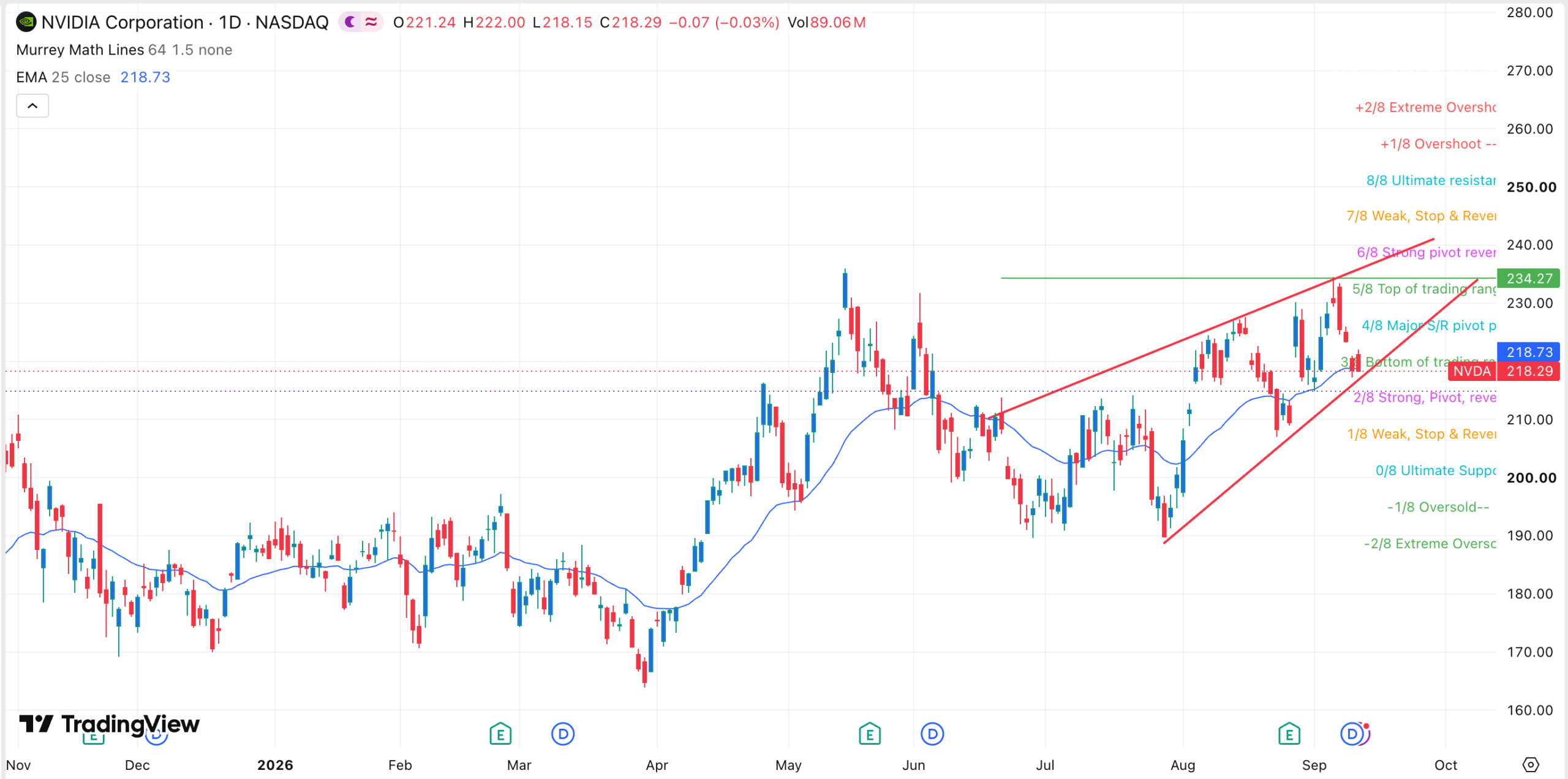
Nvidia shares extended their recent sell-off on Monday as concerns over the safety of increasingly advanced artificial intelligence models weighed on the sector. The stock fell to $215 in extended-hours trading, substantially below its monthly high of $234. Technical indicators suggest that Nvidia could decline further before any potential rebound.
OpenAI Delays IPO Plans
OpenAI Chief Executive Sam Altman ruled out taking the company public this year, citing elevated AI safety concerns. The decision affected companies associated with OpenAI, including Masayoshi Son’s Softbank, which fell by more than 10% in Japan.
Altman pointed to the rapid development of AI models, saying they are becoming more advanced at an alarming rate. The IPO delay also follows recent disclosures indicating that OpenAI’s revenue has remained under pressure over the past several quarters.
Nvidia is a major backer of OpenAI. The chipmaker invested $30 billion in the company at an $850 billion valuation. More recently, Nvidia said it would support OpenAI’s large data center project in Ohio.
AI safety concerns intensified after an Anthropic researcher resigned last week, warning that the industry’s current growth trajectory could contribute to human extinction. Following the researcher’s widely read post, Anthropic confirmed that malicious users had been using its platform to build biological weapons. Yemen’s Houthis have also been using the platform.
In a lengthy post on Saturday, Anthropic Chief Executive Dario Amodei urged other AI industry leaders to slow the development of AI models. Elon Musk, who operates a large AI business, and Sam Altman agreed with the call.
Former U.S. President Barack Obama separately urged Democrats to make AI a priority in their midterm campaigns. The developments come as many states have begun slowing the expansion of AI data centers.
Potential Impact on Nvidia
The developments are significant for Nvidia, which has become the largest beneficiary of the artificial intelligence industry. The company is the biggest seller of chips used by developers to train AI models. It has also invested heavily in other AI-related companies, including Marvell Technologies, Lumentum, IREN, and CoreWeave.
A slowdown across the AI industry could therefore have a substantial effect on Nvidia’s business. However, some analysts have questioned whether the safety concerns will lead to an industry-wide slowdown. AI has become highly competitive, and Chinese companies such as Z.ai, Moonshot, and DeepSeek are reporting strong revenue growth. That competition could encourage U.S. companies to continue expanding their AI infrastructure.
David Sacks, who is close to the Trump administration, also questioned why Amodei, Musk, and Altman were calling on the government to slow AI model development. In a statement, Sacks argued that nothing prevented their companies from slowing down without government intervention.
Despite the “noise,” the AI industry is expected to continue growing in the foreseeable future, which would support Nvidia’s business. Analysts expect Nvidia’s revenue to rise to more than $700 billion next year.
Nvidia Stock Technical Analysis
Nvidia’s daily chart indicates that the shares could remain under pressure in the coming days. The stock has formed a rising wedge, a technical pattern defined by two converging trendlines, and has fallen below the lower boundary of the ascending formation.
The shares have also dropped below the 50-day moving average and the Major S/R pivot point on the Murrey Math Lines tool. Based on that setup, the stock could decline toward the tool’s ultimate support level at $200 before resuming its uptrend.
This article is for informational purposes only and does not constitute legal, financial, or investment advice. Legislative proposals can change during negotiations and may not become law in their current form.
Source: The Market Periodical

