Nvidia Shares Near $208 as OpenAI Financing Reports Revive Circular Financing Debate
Key Takeaways
- •Nvidia is reportedly in talks to provide up to $250 billion in financing support for OpenAI’s long-term lease of an AI data-center project in Ohio.
- •The discussions remain ongoing, and no final agreement between Nvidia and OpenAI has been announced.
- •Nvidia has made several major AI-related investments, including commitments involving OpenAI, IREN, Nebius, CoreWeave, Anthropic and Naver.
- •A recent Nvidia-SK Hynix partnership highlights the importance of memory supply and broader data-center infrastructure for advanced AI systems.
- •Investors are watching upcoming earnings from major technology companies for updates on capital expenditure plans that could influence demand for Nvidia chips.
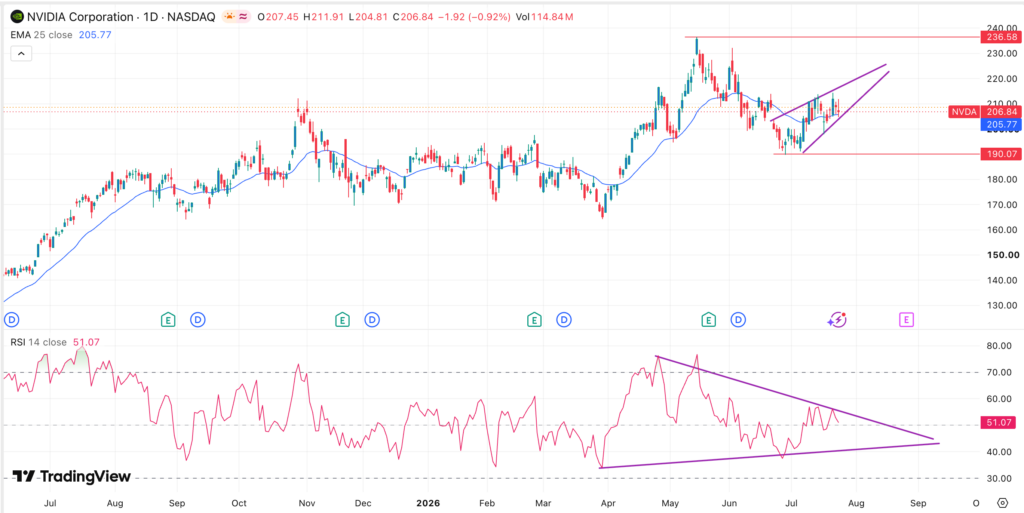
Nvidia shares traded near $208 as investors assessed reports that the company was discussing a possible financing guarantee tied to OpenAI’s planned AI data-center project in Ohio.
According to The Wall Street Journal, Nvidia has been in talks to provide a financial backstop of up to $250 billion to support OpenAI’s long-term lease of a planned 10-gigawatt AI data-center campus being developed by SB Energy in southern Ohio. The discussions remain ongoing, and no final agreement has been announced.
The reported proposal has renewed debate among some market observers over whether Nvidia’s expanding investments in artificial intelligence customers could create perceptions of circular financing. Some analysts use that term for arrangements in which a supplier financially supports customers that later buy its products. Critics say such structures can reinforce future revenue, while supporters view them as a common way to accelerate large infrastructure projects. Nvidia has not described the reported OpenAI proposal as circular financing.
The issue has become more prominent as AI infrastructure projects require unusually large upfront commitments for chips, memory, power, data-center construction and long-term capacity contracts. For Nvidia, whose graphics processors are central to many AI training and inference systems, customer financing arrangements are being watched not only for their size but also for how they may affect the quality and durability of future demand.
Nvidia previously agreed to participate in OpenAI’s latest funding round, reportedly committing about $30 billion at a valuation above $700 billion.
The company has also made several other large investments linked to AI infrastructure. It recently invested $2 billion in IREN, a Bitcoin mining company that is shifting toward AI data centers. The investment was substantial relative to IREN’s valuation of more than $13 billion.
Nvidia also invested $2 billion in Nebius and is now one of its largest shareholders. It owns about 11% of CoreWeave, described in the source article as the largest company in the neocloud business. Nvidia has also committed to invest up to $10 billion in Anthropic, the parent company of Claude. Most recently, it invested $1 billion in Naver, the South Korean company.
Other chipmakers have also entered large AI-linked financing arrangements. Advanced Micro Devices (AMD), for example, reached a major deal with OpenAI under which OpenAI may choose to take a 10% stake in AMD. AMD also recently announced a $5 billion investment in Anthropic.
Nvidia shares were also reacting to a recent agreement with SK Hynix, the South Korean memory company. In an official statement, the companies said they would expand a strategic partnership across AI factories and next-generation memory, with the source article describing the arrangement as a $500 billion partnership.
The SK Hynix agreement is relevant because advanced AI systems depend not only on Nvidia accelerators but also on high-performance memory and broader data-center supply chains. That makes memory capacity, power availability and cloud spending plans important variables for investors tracking the pace of AI infrastructure buildouts.
Investors are also watching upcoming large technology earnings reports for indications about capital spending plans. Meta Platforms and Microsoft are scheduled to report results on Wednesday, followed by Amazon on Thursday. Apple is also expected to publish earnings on Thursday, though the source article noted that Apple is not a major buyer of Nvidia chips.
Those earnings releases are expected to provide more information on capital expenditures across major technology companies. In the previous quarter, these firms indicated that they planned to spend $725 billion on capex this year. Higher commitments would support demand for Nvidia because the company is the largest supplier of chips used by many of these firms, while any reduction in spending would reflect growing investor attention to capital expenditures.
On the technical side, the daily chart showed NVDA stock moving sideways over the past several days and consolidating around the 50-day and 25-day Exponential Moving Averages (EMA). The source article said the stock appeared to be forming a rising wedge pattern, with the two trend lines moving toward a confluence area. A rising wedge is commonly treated in technical analysis as a bearish pattern.
The Relative Strength Index (RSI) was also described as forming a symmetrical triangle pattern, with its two lines close to converging. The technical analysis identified $190 as a key support level if weakness develops.
This article is for informational purposes only and does not constitute financial or investment advice. Stock prices, technical indicators and corporate financing developments do not guarantee future market performance.

