NVIDIA earnings preview: AI capex, Blackwell ramp and 216.40 breakout in focus
Key Takeaways
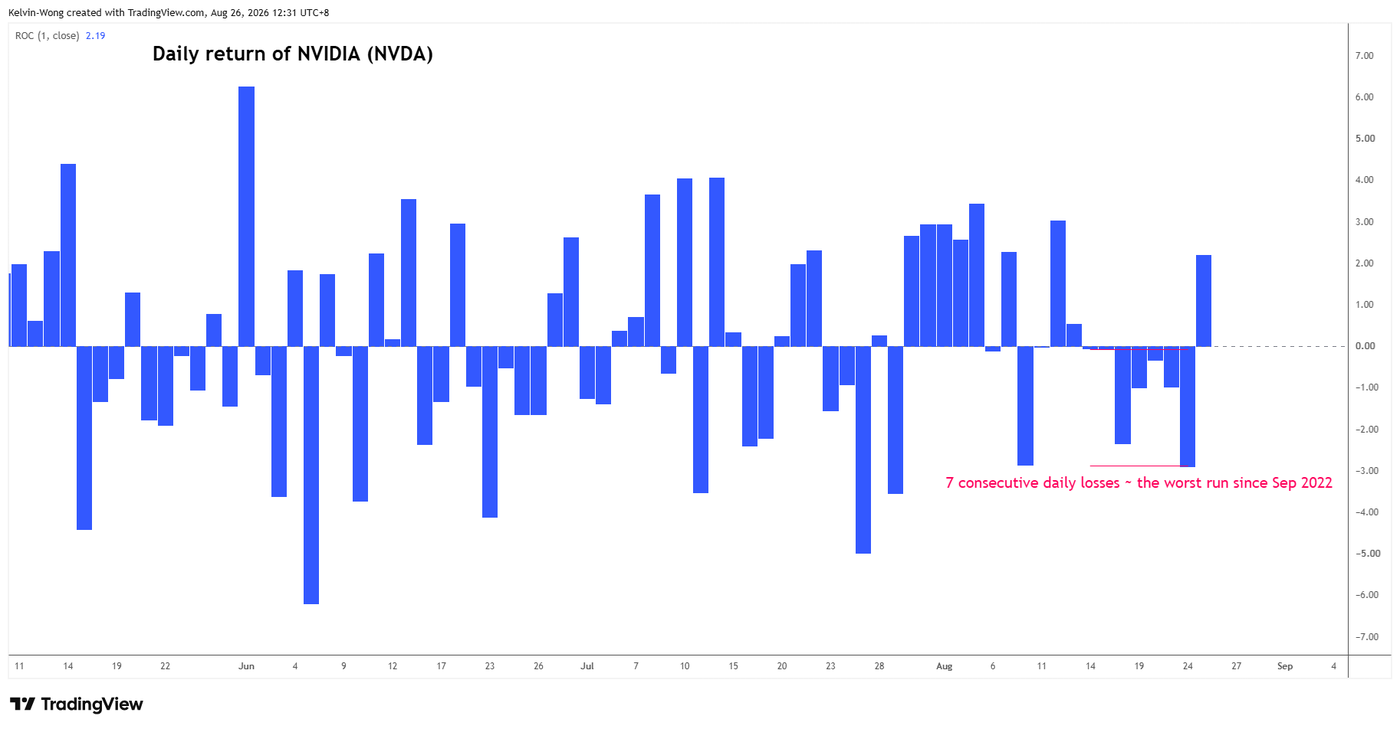
- •NVIDIA shares fell for seven straight sessions before rebounding 2.2% on 25 August 2026, after posting their longest and worst losing streak since September 2022.
- •Consensus expects about US$92 billion in revenue and adjusted EPS of roughly US$2.08 to US$2.09 for Q2 FY2027, compared with NVIDIA’s revenue guidance of US$91 billion plus or minus 2%.
- •Data Centre revenue is the main metric to watch, with consensus around US$85.7 billion, more than double the level from a year earlier.
- •Investors will closely watch Blackwell shipments, B-series revenue, Rubin timing and supply availability for evidence that NVIDIA’s next product cycle is on track.
- •The market sees Q3 guidance as the main catalyst, because a strong outlook would support the AI trade while cautious guidance could trigger a broader de-risking move.
NVIDIA’s Q2 FY2027 earnings report, due after the U.S. close on Wednesday, 26 August 2026, comes at a moment when the stock is being judged on more than just strong artificial intelligence demand. Investors are now asking whether AI infrastructure spending is still accelerating quickly enough to support a market capitalization above US$5 trillion, along with the elevated expectations embedded in the broader AI equity trade.
Over the past week, NVIDIA shares fell for seven straight sessions from 14 August 2026 to 24 August 2026, dropping 7.7% in total and marking the stock’s longest and worst losing streak since September 2022. The shares then rebounded 2.2% on Tuesday, 25 August 2026.
Consensus estimates are centered on about US$92 billion in revenue and roughly US$2.08 to US$2.09 in adjusted earnings per share (EPS). NVIDIA’s own Q2 guide called for revenue of US$91 billion, plus or minus 2%, with non-GAAP gross margin near 75%.
Five fundamental factors to watch
1. Data centre revenue remains the key figure
The main focus is still Data Centre revenue, with consensus pointing to around US$85.7 billion, more than double the level seen a year earlier. This is the clearest indicator of demand from hyperscaler AI capital expenditure, sovereign AI projects, enterprise AI adoption and accelerated computing.
A strong Data Centre beat would reinforce the view that AI demand remains supply-constrained and could support a post-earnings rally. By contrast, a miss or signs that growth is moderating would revive concerns about “peak AI capex” and could pressure NVIDIA as well as the wider semiconductor group.
2. Blackwell and Rubin execution will be closely scrutinized
Traders will be watching for updates on Blackwell shipments, B-series revenue, Rubin timing and supply availability. S&P Global noted that B-series revenue expectations are highly dispersed, with estimates ranging from US$6.3 billion to US$76.3 billion for Q2, highlighting how uncertain the market remains about the ramp profile. Rubin is also expected to start contributing this year.
Because NVIDIA’s valuation has increasingly reflected confidence in its product roadmap, the earnings call is likely to be parsed for evidence that the next-generation cycle is moving from promise to delivery. Clear Blackwell execution and confident commentary on Rubin would keep that story intact. Any delay, supply bottleneck or vague ramp language would likely be viewed negatively, since NVIDIA’s premium valuation depends on continued product-cycle leadership.
3. Gross margin will test pricing power
NVIDIA guided for 74.9% GAAP gross margin and 75.0% non-GAAP gross margin, plus or minus 50 basis points. The market will be looking for signs that higher HBM memory costs, advanced packaging expenses and supply chain pressures are beginning to weigh on profitability.
Margins holding near 75% would confirm that NVIDIA still has strong pricing power. A margin miss would matter more than usual because investors are already questioning whether AI hardware economics can remain this exceptional at scale.
4. Forward guidance is the real catalyst
The reported quarter matters, but Q3 guidance matters more. Wall Street wants evidence that the AI spending cycle remains strong into the next quarter, and some previews suggest Q3 revenue expectations could move above US$108 billion if management delivers another beat-and-raise result.
A strong Q3 guide would be the clearest bullish catalyst. In-line guidance may not be enough after the recent rebound, while cautious guidance could trigger a sharper de-risking move because NVIDIA remains the bellwether for AI earnings momentum.
5. AI capex sustainability is now a market-wide test
NVIDIA’s results are now a stress test for AI capital spending across the market. Reuters reported that traders are focused on revenue, chip demand, margins and cloud-sector capital spending, with the earnings move expected to swing about US$280 billion in market value, or roughly 5.4% in either direction, based on NVIDIA’s market capitalization of around US$5.2 trillion.
That scale helps explain why the report matters well beyond one company: the numbers will feed into views on hyperscaler budgets, semiconductor supply chains and the broader durability of AI-linked earnings. Strong commentary from hyperscalers and enterprise customers would support the broader AI trade. But if management points to slower cloud orders, weaker customer adoption, energy constraints or funding stress, the market could rotate away from AI infrastructure winners.
Medium-term technical picture
From a multi-week perspective, NVIDIA’s recent 9.1% decline from the 17 August 2026 high to low appears to have stalled on Monday, 24 August 2026. The stock then rebounded on Tuesday, 25 August 2026 and formed a “Bullish Harami” candlestick pattern after retesting its 50-day moving average, which is acting as key intermediate support at 208.00.
In addition, the volatility-adjusted relative strength (VARS) of the NVDA/SPY ratio has been trending higher since 18 August 2026. Its latest reading as of Tuesday, 25 August 2026 moved above the centreline, suggesting potential outperformance versus the benchmark S&P 500.
These technical signals point to an increased chance of a medium-term recovery in NVIDIA.
A bullish breakout above 216.40 could signal the start of a new medium-term impulsive uptrend toward the all-time-high zone of 227.40/236.54, with additional medium-term resistance levels at 234.10 and 259.70/260.20, based on Fibonacci extension clusters.
On the other hand, a break and daily close below the key medium-term support at 195.95 would invalidate the bullish reversal scenario and expose a deeper corrective decline toward the next supports at 179.95 and 164.55.
Opinions are those of the authors and do not necessarily reflect those of OANDA Business Information & Services, Inc. or any of its affiliates, subsidiaries, officers or directors. This publication is provided for informational and educational purposes only. For MarketPulse terms of use, see https://www.marketpulse.com/terms-of-use/ . Visit https://www.marketpulse.com/ to find out more about the beat of the global markets. © 2026 OANDA Business Information & Services Inc.

