How NVIDIA’s Gaming Business Affects NVDA: GeForce Demand, PC Cycle and Margins
Key Takeaways
- •NVIDIA reported $96.2 billion in total revenue for Q2 FY27, of which $89.0 billion came from the Data Center segment.
- •Gaming is now reported inside the Edge Computing platform, which posted $7.2 billion in Q2 FY27, up 13% quarter over quarter and 27% year over year.
- •Q2 FY27 GAAP and non-GAAP gross margin both stood at 75.0%, with GAAP operating income of $63.734 billion.
- •NVIDIA guided Q3 FY27 revenue to approximately $108.0 billion, plus or minus 2%, with gross margin of 74.0%, plus or minus 50 basis points.
- •The company returned about $26.0 billion to shareholders in the quarter and had roughly $99.0 billion of repurchase authorization remaining.
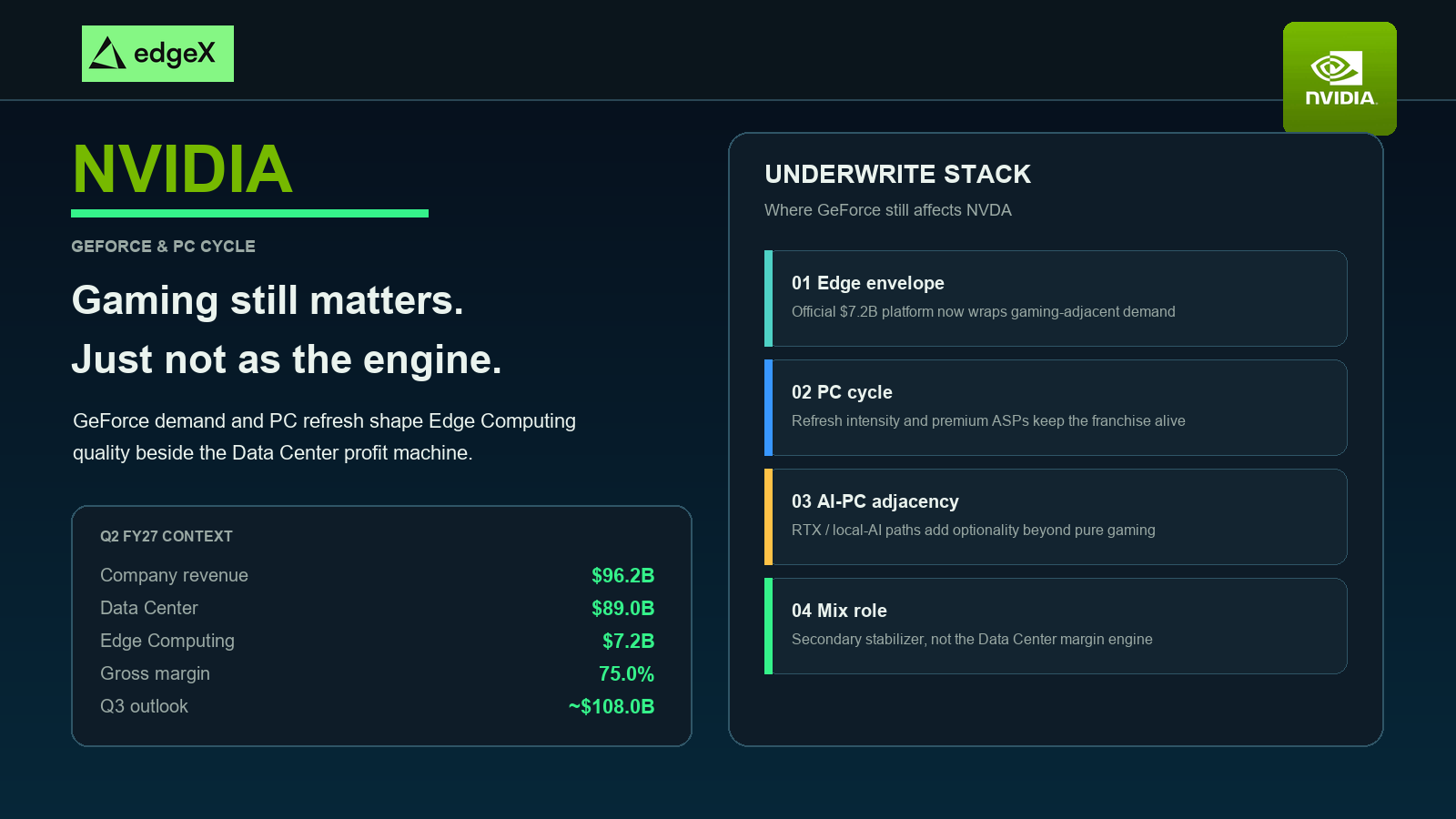
NVIDIA is priced as an AI-infrastructure company. That is correct. It is also incomplete if investors treat GeForce, PC demand, and the broader consumer GPU franchise as irrelevant noise. Gaming no longer drives the NVDA multiple. It still shapes brand, installed base, software habits, and a meaningful piece of the non-Data-Center envelope. In Q2 FY27, NVIDIA printed $96.2 billion in company revenue and $89.0 billion in Data Center sales, while Edge Computing — the market platform that now includes GeForce RTX GPUs, PCs, consoles, workstations, robotics, and automotive — contributed $7.2 billion. The investment question is not whether gaming can replace AI. It is whether the GeForce and PC franchise still matters to mix, durability, and downside quality.
This article explains how NVIDIA’s gaming business affects NVDA after the reporting change that folded Gaming into Edge Computing: what GeForce demand and the PC cycle still contribute, how margins interact with an AI-heavy mix, and which proofs investors should watch next. It is not a Data Center primer and not an earnings walkthrough. For the quarterly scoreboard, see NVIDIA earnings explained. For the AI profit engine, see NVIDIA’s Data Center business.
Quick Answer
NVIDIA’s gaming business still affects NVDA, but not as the main earnings engine. GeForce demand, PC refresh cycles, and related consumer GPU economics now sit inside the Edge Computing platform, which printed $7.2 billion in Q2 FY27 beside $89.0 billion of Data Center revenue. That means gaming can no longer carry the stock on its own. It can still support brand strength, developer mindshare, installed-base leverage, and a second demand pool when AI-infrastructure expectations get noisy. Underwrite GeForce as a quality and diversification factor inside a Data-Center-led franchise, not as a substitute for the AI thesis.
Why Gaming Still Belongs in the NVDA Debate
A common mistake is binary thinking: either gaming is the old NVIDIA or it is irrelevant. Neither view is useful after Q2 FY27. Data Center is the profit engine. Edge Computing, including GeForce, is the consumer and physical-AI adjacency layer. Investors still need that layer because NVDA’s franchise value is not only about hyperscale billings. It is also about whether NVIDIA remains the default accelerated-computing brand across PCs, creators, developers, and emerging on-device AI use cases.
Gaming also remains one of the cleanest ways the public understands NVIDIA. That brand effect is soft, but it is not worthless. A company that owns the high-end PC graphics conversation has an easier time recruiting developers, seeding CUDA habits, and normalizing RTX-class hardware in consumer machines that later become local AI endpoints. The NVIDIA stock guide covers the full business map. This article stays on the GeForce and PC question inside that map.
The reporting change matters for underwriting discipline. Once Gaming stops appearing as a standalone market platform, investors should stop inventing a fake precision Gaming dollar line from old templates. Use the official Edge Computing print, then judge GeForce and PC demand with product, channel, and qualitative evidence rather than false decimal confidence. That discipline also keeps C8 differentiated from earnings and Data Center articles: the subject is franchise quality around GeForce, not another reprint of the AI-factory scoreboard.
An Investor Scorecard for NVIDIA’s Gaming and Edge Envelope
The right scorecard accepts the company’s current disclosure shape. GeForce still matters. The cleanest official dollars around it now live in Edge Computing.
| Investor lens | Latest evidence | What it means for NVDA |
|---|---|---|
| Scale context | Company revenue $96.2B; Data Center $89.0B in Q2 FY27 | Gaming cannot drive the stock alone; AI infrastructure still sets the ceiling |
| Official gaming-adjacent envelope | Edge Computing revenue $7.2B, +13% QoQ, +27% YoY | GeForce/PC and related edge products still contribute a growing non-DC pool |
| Profit quality | GAAP & non-GAAP gross margin 75.0%; GAAP operating income $63.734B | Franchise profitability remains Data-Center-led; consumer mix is secondary |
| Product adjacency | RTX Spark with Microsoft; local-AI optimizations across RTX/DGX platforms | GeForce-class and PC platforms are being pulled into on-device and agentic AI stories |
| Expectation hurdle | Q3 FY27 outlook ~$108.0B ±2%; GM 74.0% ±50 bp | Consumer results matter less to the guide, but narrative shocks can still travel |
The scorecard’s message is blunt. If Edge Computing is healthy, NVDA gets brand support and modest diversification. If Edge Computing softens while Data Center remains strong, the stock can still work, but the consumer franchise needs watching. If both weaken together, the quality story changes fast. In practical terms, investors should ask whether Edge Computing is compounding as a second franchise or merely floating along as a residual category beside the AI machine.
GeForce Demand, PC Cycle and What Actually Moves the Needle
GeForce demand is not one number. It is a stack of refresh behavior, pricing power, game and creator workloads, channel inventory, and now AI-PC adjacency. Investors who still underwrite gaming as “units times ASP” are a generation behind the actual NVDA question.
PC refresh and upgrade intensity
The classic PC cycle still matters because GeForce lives or dies by whether consumers and creators upgrade. Strong game releases, GPU architecture jumps, and better ray-tracing or upscaling experiences can pull demand forward. Weak titles, high system costs, or saturated installed base can push it out. For NVDA, the point is not nostalgia for old gaming multiples. It is whether the consumer GPU engine remains vibrant enough to keep NVIDIA’s end-user franchise premium.
GeForce as a brand and installed-base asset
GeForce is also an installed-base business. Drivers, RTX features, creator tools, and local AI runtimes all benefit when millions of NVIDIA GPUs already sit in PCs. That installed base helps NVIDIA seed software habits that later show up in professional and AI workflows. It will not overtake Data Center economics. It can still reduce the odds that NVIDIA becomes a pure enterprise-only vendor with a thinner consumer surface area.
AI-PC and on-device adjacency
The more interesting evolution is that the PC is no longer only a gaming box. NVIDIA’s Edge Computing highlights around RTX Spark, DGX Station for Windows, and local open-model optimizations show the company pushing GeForce-class and deskside platforms into agentic and local AI use cases. That does not magically turn gaming into AI Data Center. It does mean PC demand can partially re-rate from pure entertainment hardware toward hybrid creator/AI endpoints. Investors should treat that as optionality with proof requirements, not as a finished thesis. The proof standard is simple: recurring product evidence, developer support, and sell-through that looks like a platform shift rather than a one-quarter marketing theme.
How Gaming Interacts With NVDA Margins and Mix
Margins are where gaming bulls and bears often talk past each other. NVIDIA’s 75.0% Q2 FY27 gross margin is not a GeForce story first. It is a Data Center mix and systems-franchise story. That said, consumer GPUs still influence how investors think about the company’s cyclicality and brand power.
A healthy GeForce franchise can support premium consumer ASPs, software attach, and a cleaner perception that NVIDIA monetizes acceleration across both factories and desktops. A weak GeForce franchise does not automatically collapse company margins when Data Center is this large. It can still create narrative drag: channel concerns, discounting fears, or the sense that NVIDIA’s consumer edge is fading while the enterprise story does all the work.
This is why gaming belongs in margin analysis as a secondary factor. Watch whether consumer products remain premium. Watch whether AI-PC positioning supports richer mix. Watch whether any consumer softness starts to spill into broader concerns about demand breadth. Do not pretend GeForce alone explains a mid-70s consolidated margin after an $89.0 billion Data Center print.
There is also a sentiment channel. When GeForce looks strong, investors are more willing to believe NVIDIA can monetize acceleration outside the hyperscale core. When GeForce looks tired, bears gain an easy exhibit for concentration risk even if the Data Center machine is still printing historic dollars. That sentiment effect can move the stock over short windows without rewriting the long-term cash engine.
Cash generation and capital returns sit behind the same hierarchy. In Q2 FY27, NVIDIA returned about $26.0 billion to shareholders with roughly $99.0 billion of repurchase authorization remaining. Those figures are funded by the whole franchise, led by Data Center. Gaming’s job is not to finance the buyback machine by itself. Its job is to remain healthy enough that NVDA is still underwriting a multi-end-market accelerator company rather than a single-customer-cycle semiconductor printer.
Competitive and Cycle Risks Specific to GeForce
Competitive risk in gaming is different from competitive risk in AI factories. In consumer GPUs, rivals can pressure price points, feature narratives, and channel promotions more quickly than they can displace a full CUDA-centered AI cluster. That makes GeForce both more visible and more contestable.
Cycle risk is the other permanent issue. PC demand can cool even when Data Center demand is strong. Inventory swings, weak seasonal sell-through, or delayed upgrades can hit Edge Computing without invalidating the AI-infrastructure thesis. The analytical trap is overreaction in either direction. A soft GeForce quarter is not proof that NVDA’s core thesis is broken. A strong GeForce quarter is not proof that NVIDIA has re-diversified away from AI concentration.
Concentration risk still dominates. Edge Computing’s $7.2 billion contribution is real and growing, yet it remains small beside Data Center. Investors comparing NVIDIA and other GPU or PC names should keep that scale gap explicit. For side-by-side chip-franchise framing, see NVIDIA stock vs AMD stock. The gaming lens matters. It does not reset the hierarchy. A useful habit is to separate three clocks: the AI-factory clock that sets NVDA’s ceiling, the GeForce/PC clock that measures consumer franchise health, and the sentiment clock that can temporarily confuse the first two.
How Investors Should Underwrite Gaming’s Role From Here
A practical GeForce framework uses four proofs. First, Edge Computing continues to grow or at least remain resilient as the official envelope around gaming-adjacent demand. Second, PC and GeForce product evidence stays premium rather than drifting into defensive discounting. Third, AI-PC and local-AI adjacency shows up in real platform launches and software support, not only keynote language. Fourth, consumer-cycle noise does not begin to redefine the NVDA debate away from Data Center execution.
Those proofs connect cleanly to the rest of the cluster. Earnings readers can stay with NVIDIA earnings explained. Segment readers can keep Data Center as the primary engine via NVIDIA’s Data Center business. Comparative readers can continue into the NVIDIA vs AMD frame when consumer and accelerator competition need to be weighed together.
Gaming will not decide whether NVIDIA remains the AI-infrastructure standard. It can still decide whether NVDA looks like a one-tower company or a franchise with a living consumer and edge layer underneath the tower. After Q2 FY27’s $96.2 billion company print, that distinction is about quality and narrative durability more than about headline revenue share. Keep GeForce in the model. Just keep it in the right place. If Edge Computing stays resilient and AI-PC adjacency continues to harden, gaming remains a useful stabilizer in the NVDA underwriting stack. If it fades into a neglected residual, the stock can still rise on Data Center alone while the franchise quietly becomes narrower than bulls prefer to admit.
Trade NVIDIA Perpetuals on edgeX - 24/7, No KYC Required
NVIDIA's story does not pause when markets close. For traders who want continuous exposure to NVDA price action without the constraints of traditional market hours, edgeX offers a decentralized alternative.
Continuous NVDA Market Access
edgeX lists NVDA/USDC perpetual futures with up to 10x leverage and no expiration date. Positions can be held as long as the thesis holds, with transparent on-chain settlement and no KYC requirement.
Institutional-Scale Execution With Self-Custody
edgeX is a decentralized exchange built for active traders who value performance and privacy. Users retain control of their funds and private keys. The platform cites $10 million of depth within a one-basis-point spread, sub-0.1-basis-point slippage on larger trades, and 100% trading-fee rewards through its Trade-to-Earn program.
Know the Risks Before Trading
Leverage can amplify gains and losses, including the risk of liquidation. Traders should verify current funding, fees, liquidity, product availability and contract specifications before opening a position. Explore NVDA/USDC perpetual futures on edgeX to see what decentralized derivatives trading looks like at institutional scale.
Frequently Asked Questions
These questions address the gaming issues investors raise most often after NVIDIA’s latest results: why GeForce still matters, how Edge Computing changed disclosure, and what to monitor next.
Does NVIDIA’s gaming business still matter for NVDA stock?
Yes, but as a secondary quality and diversification factor. Data Center drives the valuation. GeForce and PC demand still support brand, installed base, and the Edge Computing envelope.
Why is there no separate Gaming revenue line in Q2 FY27 materials?
NVIDIA now reports two market platforms: Data Center and Edge Computing. GeForce RTX GPUs and related PC/console/workstation demand sit inside Edge Computing, which printed $7.2 billion in Q2 FY27. Investors should not invent a standalone Gaming figure the company no longer highlights that way.
How should investors read the $7.2 billion Edge Computing print?
Treat it as the official non-Data-Center envelope that includes gaming-adjacent and broader edge demand. It is much smaller than the $89.0 billion Data Center print, but it is large enough to matter for franchise breadth and consumer-health checks.
Can GeForce or AI PCs change NVIDIA’s margin story?
Only at the margin. Consolidated gross margin remains dominated by Data Center mix. GeForce health matters more for brand premium, consumer ASP quality, and narrative durability than for explaining a 75.0% company margin by itself.
What are the cleanest GeForce proofs to watch next?
Edge Computing trajectory, premium versus discounted consumer positioning, AI-PC/local-AI product evidence, and whether PC-cycle swings stay contained or start reshaping the broader NVDA debate.

