Why NVIDIA’s AI Networking Moat Matters: NVLink, InfiniBand and Ethernet
Key Takeaways
- •NVIDIA generated $89.0 billion of Data Center revenue within a total of $96.2 billion in company revenue for the second quarter of fiscal 2027.
- •The company reported 75.0% gross margin on both GAAP and non-GAAP bases, along with GAAP operating income of $63.734 billion.
- •Spectrum-6 switch systems are set to arrive with the Vera Rubin platform, pairing the next compute ramp with next-generation networking rather than a GPU-only refresh.
- •For Q3 FY27, NVIDIA guided revenue to approximately $108.0 billion plus or minus 2%, with gross margin of 74.0% plus or minus 50 basis points and no China Data Center compute assumed.
- •NVIDIA returned about $26.0 billion to shareholders in the quarter and retained roughly $99.0 billion of buyback authorization.
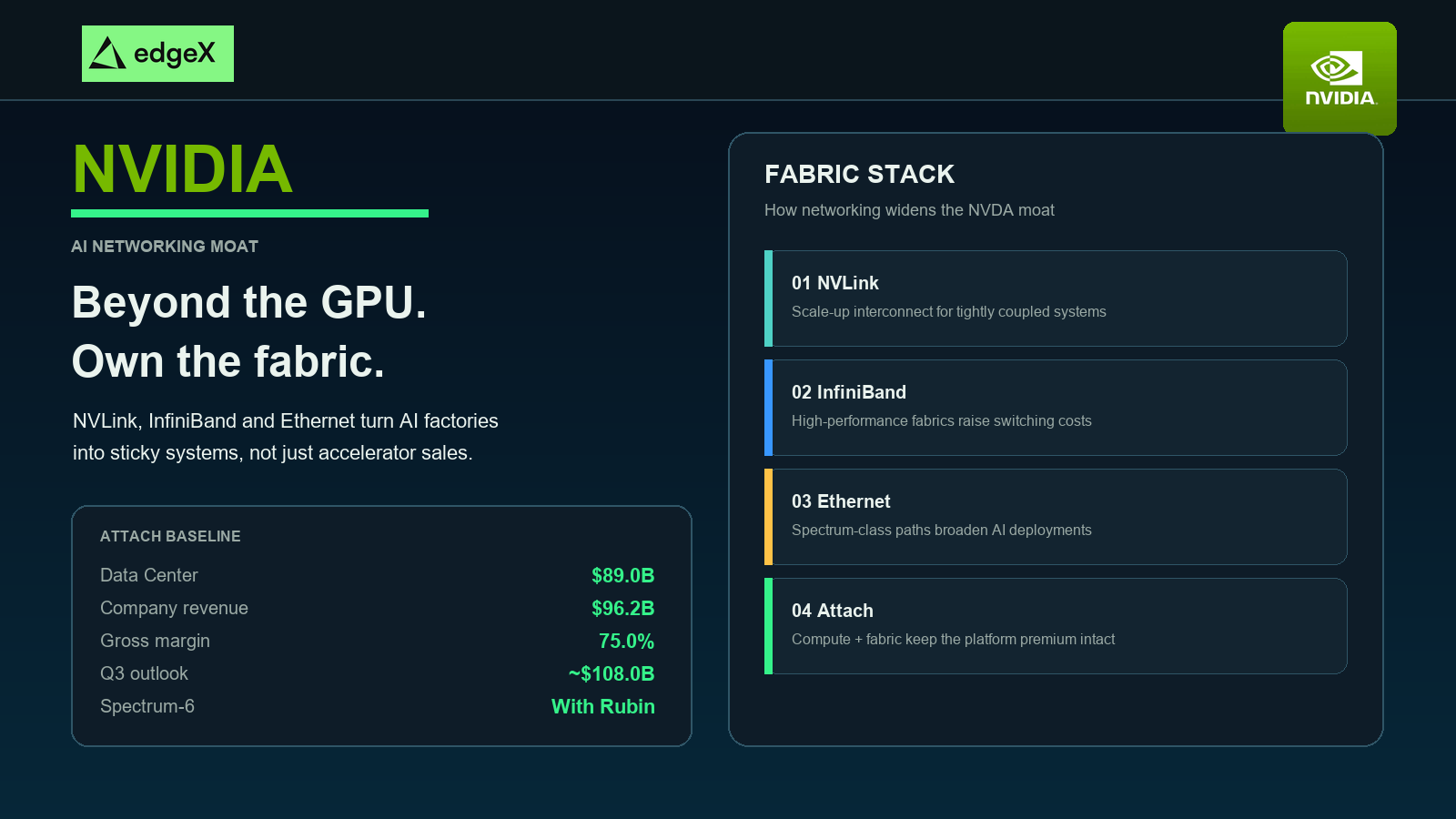
NVIDIA’s AI story is usually told through GPUs. That is the wrong altitude for underwriting NVDA. The more durable question is whether NVIDIA can sell not only scarce accelerators, but the fabrics that make large AI factories usable: NVLink-class interconnects, InfiniBand, Ethernet, and the switching systems that turn racks into clusters. In the second quarter of fiscal 2027, NVIDIA printed $89.0 billion of Data Center revenue inside a $96.2 billion company total while highlighting Spectrum-6 switch systems arriving with the Vera Rubin platform. Networking is no longer a side feature. It is one of the main ways NVIDIA widens the moat beyond the GPU.
This article explains why AI networking matters to the NVDA thesis: how NVLink, InfiniBand, and Ethernet fit the stack, why attach can protect mix through architecture transitions, and what investors should monitor next. It is not a Data Center overview and not a roadmap primer. For segment economics, see NVIDIA’s Data Center business. For Blackwell-to-Rubin cadence, see the NVIDIA platform roadmap.
Quick Answer
NVIDIA’s AI networking moat matters because large-model training and inference are cluster problems, not single-chip problems. NVLink helps scale tightly coupled systems. InfiniBand and Ethernet fabrics help those systems talk at factory scale. When networking attach travels with the GPU roadmap, NVIDIA can monetize more of the AI factory and raise switching costs at the same time. After Q2 FY27’s $96.2 billion company print and $89.0 billion Data Center result, the practical question is whether Spectrum-6 and related fabrics keep that attach alive through the Rubin transition. Treat networking as a duration and mix lever, not as optional plumbing.
Why Networking Belongs in the NVDA Moat Debate
A GPU can create demand. A fabric decides whether that demand becomes a deployable AI factory. At gigascale, bandwidth, latency, topology, optics, and operational software matter as much as peak accelerator specs. That is why networking belongs inside the NVDA underwriting stack rather than in a footnote after the GPU discussion.
Networking also changes competitive math. Custom silicon or rival accelerators can look attractive in isolation. They become harder to adopt if the surrounding cluster design, switching, and software tooling remain centered on NVIDIA. Attach does not make NVIDIA invulnerable. It does raise the cost of leaving and can protect mix when architecture transitions rearrange the bill of materials.
That distinction matters after a quarter as large as Q2 FY27. Absolute Data Center dollars are already extraordinary. The market’s next argument is whether NVIDIA remains a platform vendor or drifts toward a more cyclical component supplier. Networking is one of the clearest tests of that difference. The NVIDIA stock guide covers the wider business. This article stays on the fabric layer that helps keep the franchise premium. If the fabric layer weakens, NVDA can still look busy in accelerator shipments while the quality of the franchise quietly changes.
An Investor Scorecard for NVIDIA’s Networking Moat
NVIDIA’s latest official release does not require investors to invent a separate networking revenue print in order to underwrite the thesis. The cleaner approach is to map networking’s role against the Data Center baseline and the platform evidence around Spectrum-6 and Vera Rubin.
| Moat lens | Latest evidence | What investors should infer |
|---|---|---|
| Demand envelope | Data Center revenue $89.0B; company revenue $96.2B in Q2 FY27 | Networking attach has a historically large AI-factory spend pool to ride |
| Profit quality | GAAP & non-GAAP gross margin 75.0%; GAAP operating income $63.734B | The franchise is still monetizing scarce, high-mix infrastructure rather than pure volume |
| Platform coupling | Spectrum-6 switch systems arriving with Vera Rubin | Next-generation compute ramps are being paired with next-generation networking |
| Continuity hurdle | Q3 FY27 outlook ~$108.0B ±2%; GM 74.0% ±50 bp; no China Data Center compute assumed | Attach and mix still have to clear a higher expectation bar after a historic print |
| Secondary context | Edge Computing $7.2B | Diversification exists, but the networking moat debate still centers on Data Center AI factories |
The scorecard’s point is simple. Networking does not need to be the majority of revenue to matter. It needs to remain attached tightly enough that NVIDIA sells systems and fabrics, not just boards. Investors should therefore judge networking by coupling and continuity, not by whether every release reprints a standalone networking dollar line.
NVLink, InfiniBand and Ethernet: Different Jobs, One Moat
Investors often compress NVIDIA networking into a single slogan. That blurs the underwriting. NVLink, InfiniBand, and Ethernet are related, but they are not interchangeable.
NVLink and scale-up
NVLink-class interconnects matter because many AI systems need extremely tight coupling inside a scale-up domain. When accelerators have to behave more like one giant memory and compute fabric than like loosely connected cards, the interconnect becomes part of the product, not an accessory. That is one reason NVIDIA’s systems pitch is harder to clone than a discrete accelerator pitch.
InfiniBand and high-performance fabrics
InfiniBand remains central to many of the highest-performance AI and HPC clusters. For investors, the point is less brand romance than switching-cost economics: once a customer’s topology, operations, and performance assumptions are built around a fabric, replacing the accelerator alone may not be enough. Fabric lock-in can survive even when customers experiment with alternative compute.
Ethernet and broader AI networking paths
Ethernet-based AI networking widens NVIDIA’s deployment surface. Not every customer wants the same fabric assumptions, and Ethernet options can meet buyers where their data-center standards already live. Spectrum-class systems matter here because they push NVIDIA deeper into the switching layer that turns racks into factories. The more NVIDIA participates in that layer, the more of the AI cluster economics it can influence. That breadth also matters strategically: a moat that works only in one fabric religion is narrower than a moat that can follow multiple deployment standards.
Why Spectrum-6 and Rubin Strengthen the Attach Story
Platform transitions are where networking either proves its value or gets exposed as optional. If a new compute generation ships while fabrics and systems lag, customers can reopen architecture decisions. If compute and networking ramp together, NVIDIA can keep the migration inside its stack.
That is why Spectrum-6 arriving with Vera Rubin is important beyond product marketing. It signals that NVIDIA wants the next manufacturing ramp to include switching systems with both pluggable and co-packaged optics paths for gigascale AI factories. Investors should read that as attach strategy: the company is trying to make the next platform a networked system event, not a GPU-only refresh. The coupling is the story. Compute without fabric continuity reopens architecture debates that NVIDIA would rather keep closed.
Attach as a mix defender
When attach is strong, architecture transitions are less likely to collapse NVIDIA into a pure ASP story about one accelerator SKU. Networking and systems can support mix even as product generations change. That support shows up indirectly in franchise-level profitability. Q2 FY27’s 75.0% gross margins do not prove networking alone. They do show that NVIDIA is still selling a high-quality stack into AI infrastructure demand.
Attach as a switching-cost creator
Networking also changes how hard it is to leave. A customer that has standardized on NVIDIA fabrics, optics choices, and cluster operations faces a larger redesign cost than a customer that only bought boards. That redesign cost is part of the moat. It will not stop every competitive experiment. It can slow share shift and preserve NVIDIA’s ability to monetize successive platforms. In practical underwriting terms, switching costs buy NVIDIA time: time to land the next platform, time to defend mix, and time to keep AI-factory spending inside its stack while rivals try to qualify alternatives.
What Networking Changes in Competitive and Margin Underwriting
Competitive risk looks different once networking is in the model. Rival accelerators and custom silicon can still win sockets. They become more threatening when they also weaken NVIDIA’s ability to sell the surrounding fabric and systems. Conversely, if competitors take some compute share but NVIDIA keeps a large role in cluster networking, the franchise can remain more valuable than a simple GPU share chart implies.
This is why investors should stop treating “share” as a single number. Accelerator share, systems share, and fabric share can diverge. A customer can trial alternative compute while still buying NVIDIA switching, optics paths, or cluster software assumptions. That divergence is exactly where networking either preserves franchise value or fails to do so. If the divergence goes against NVIDIA, the company can remain highly profitable in absolute terms while the market starts questioning how much of the AI factory it still owns.
Margin risk works the same way. A transition that preserves networking attach can support mid-70s profitability even as absolute growth normalizes. A transition that ships compute while attach slips can leave NVIDIA with large revenue and a weaker quality story. That is why the guided Q3 gross-margin band of 74.0% ±50 basis points belongs in networking analysis. Attach is one of the mechanisms that can keep the franchise on the premium side of that band.
Cash and capital-return capacity sit in the background of the same quality debate. A networked systems franchise that continues to convert AI-factory demand into high margins can fund roadmap intensity and still support shareholder returns. In Q2 FY27, NVIDIA returned about $26.0 billion to shareholders with roughly $99.0 billion of buyback authorization remaining. Those figures do not prove the networking thesis by themselves. They do show why mix defense matters: the market is paying for a cash-rich platform engine, not for a thin merchant-silicon cycle.
Expectation risk remains attached to the same Data Center machine. After an $89.0 billion segment print and a company guide toward about $108.0 billion, investors have less patience for ordinary execution. Networking proof helps only if it shows up as real platform continuity, not as slideware. Manufacturing-ramp evidence around Rubin and Spectrum-6 is useful. It still has to survive customer qualification and deployment reality. In a market this large, the penalty for weak attach is not that NVIDIA stops selling chips. The penalty is that the multiple starts treating NVIDIA more like a component cycle.
How Investors Should Underwrite the Networking Moat From Here
A practical networking framework stays close to four proofs. First, Data Center demand remains large enough that attach has a meaningful pool to monetize. Second, next-platform ramps continue to pair compute with fabrics and switching rather than isolating the GPU. Third, mix and margins remain consistent with a high-quality systems franchise near the mid-70s. Fourth, competitive experiments do not visibly strip networking out of NVIDIA’s bill of materials during transition windows.
Those proofs connect cleanly to the rest of the cluster. Segment readers can stay with NVIDIA’s Data Center business. Roadmap readers can watch succession risk in the Blackwell and Rubin roadmap. Software-moat readers can continue into CUDA and the NVIDIA software ecosystem. The shared question is whether NVIDIA remains a full-stack AI-infrastructure vendor. Networking is one of the clearest places that answer shows up.
GPUs open the door. Fabrics help decide who owns the factory floor. If NVLink, InfiniBand, Ethernet, and Spectrum-class systems keep traveling with NVIDIA’s compute roadmap, the NVDA thesis stays broader and stickier than a pure accelerator cycle. If they do not, NVIDIA can still sell a great deal of silicon while the market starts paying less for the duration of that advantage. Keep the underwriting focused on attach, platform coupling, and margin quality, and the networking debate stays concrete instead of dissolving into slogan-level moat talk.
Trade NVIDIA Perpetuals on edgeX - 24/7, No KYC Required
NVIDIA's story does not pause when markets close. For traders who want continuous exposure to NVDA price action without the constraints of traditional market hours, edgeX offers a decentralized alternative.
Continuous NVDA Market Access
edgeX lists NVDA/USDC perpetual futures with up to 10x leverage and no expiration date. Positions can be held as long as the thesis holds, with transparent on-chain settlement and no KYC requirement.
Institutional-Scale Execution With Self-Custody
edgeX is a decentralized exchange built for active traders who value performance and privacy. Users retain control of their funds and private keys. The platform cites $10 million of depth within a one-basis-point spread, sub-0.1-basis-point slippage on larger trades, and 100% trading-fee rewards through its Trade-to-Earn program.
Know the Risks Before Trading
Leverage can amplify gains and losses, including the risk of liquidation. Traders should verify current funding, fees, liquidity, product availability and contract specifications before opening a position. Explore NVDA/USDC perpetual futures on edgeX to see what decentralized derivatives trading looks like at institutional scale.
Frequently Asked Questions
These questions address the networking issues investors raise most often after NVIDIA’s latest results: why fabrics matter, how Spectrum-6 fits, and what proofs to watch next.
Why does AI networking matter as much as the GPU for NVDA?
Because large AI deployments are cluster systems. Networking helps determine performance, deployability, switching costs, and how much of the AI factory NVIDIA can monetize beyond the accelerator.
What is the difference between NVLink, InfiniBand and Ethernet in the NVIDIA stack?
NVLink is central to tightly coupled scale-up designs. InfiniBand remains key for many high-performance fabrics. Ethernet expands NVIDIA’s AI networking path for customers standardized on Ethernet environments. Together they broaden the moat.
Why do Spectrum-6 and Vera Rubin matter together?
Because they pair the next compute manufacturing ramp with next-generation switching. That coupling is evidence NVIDIA wants attach to travel through the platform transition rather than reset to GPU-only sales.
Can networking protect NVIDIA if competitors take some accelerator share?
It can help. If customers still rely on NVIDIA fabrics and systems, share loss at the GPU layer may hurt less than a simple accelerator chart implies. It does not eliminate competitive risk.
What are the cleanest networking proofs to monitor next?
Whether next-platform ramps keep shipping with strong fabric and switching attach, whether margins stay near the mid-70s, and whether Data Center demand remains firm enough for attach to matter after historic prints.

