NVIDIA Blackwell and Rubin Roadmap: What the Next AI Platforms Mean for NVDA Stock
Key Takeaways
- •NVIDIA generated $81.615 billion in revenue during Q1 fiscal 2027, including $75.246 billion from Data Center operations, while maintaining a 74.9% gross margin.
- •Blackwell accounted for the majority of NVIDIA's Data Center compute revenue in Q1 fiscal 2027, serving as the immediate execution test for profitable large-scale system delivery.
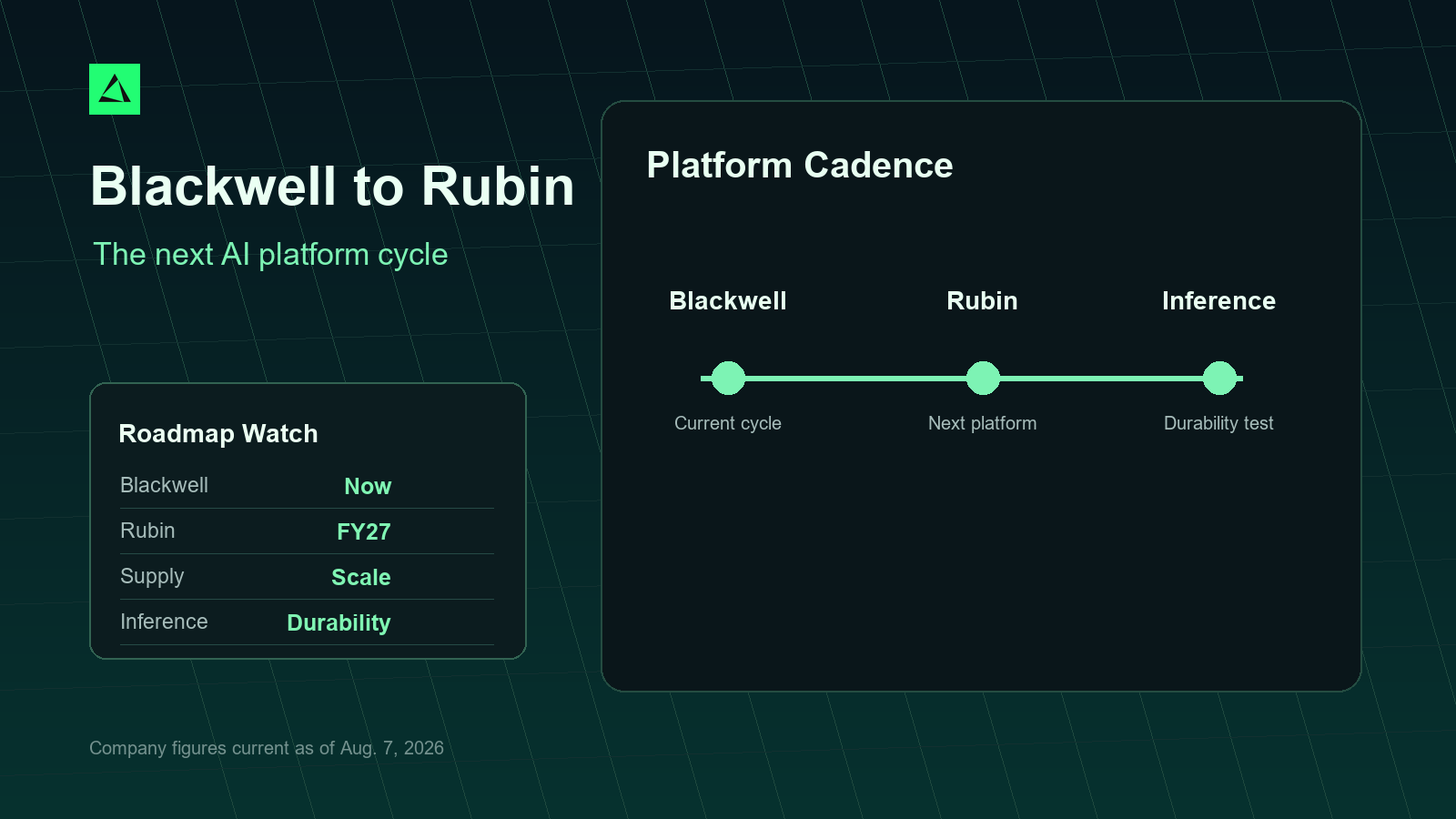
- •Rubin, NVIDIA's next major platform, is expected to begin shipping in the second half of fiscal 2027 and will indicate whether customer upgrade demand extends beyond the current cycle.
- •NVIDIA disclosed $119 billion in manufacturing, supply, and capacity commitments as of April 2026, with $95 billion projected to be spent during the remainder of fiscal 2027.
- •Competitors including AMD, Google, Amazon, and Microsoft are developing alternative AI accelerators that could apply pricing pressure or capture specific workloads from NVIDIA.
Quick Answer
The Blackwell and Rubin roadmap matters for NVDA stock because it turns the valuation debate into a timing question. Blackwell has to prove that current demand can be shipped profitably. Rubin has to prove that customers still want the next architecture after absorbing today's systems. A smooth handoff would make NVIDIA look like a multi-generation AI platform supplier. A rough handoff would raise different concerns: order pauses, qualification delays, margin pressure, supply friction and weaker upgrade urgency.
Information and cited company figures are current as of August 7, 2026. NVIDIA's next earnings release, official filings, product updates, policy changes and market price can change the investment setup.
Why Product Roadmap Matters for NVIDIA Stock
NVIDIA's valuation depends on more than one great product generation. AI infrastructure customers plan capacity years ahead, and investors want to know whether demand can persist through multiple upgrades. That makes the product roadmap one of the most important inputs for NVDA stock.
Blackwell and Rubin are not just names on a launch calendar. They are markers for whether NVIDIA can keep raising performance, improving efficiency, widening the platform stack and giving customers a reason to keep building. If each generation creates meaningful deployment advantages, the company can extend the AI cycle. If transitions become difficult, the stock can face margin and timing questions even while demand remains large.
The operating backdrop is strong. NVIDIA's latest official quarter produced $81.615 billion of revenue, including $75.246 billion from Data Center. That momentum gives investors a financial scorecard for judging whether the roadmap is already translating into demand.
Blackwell Is the Current Execution Test
Blackwell is central to NVIDIA's current AI platform cycle. The company said Blackwell was the majority of Data Center compute revenue in Q1 fiscal 2027. That matters because investors are not only watching demand; they are watching whether NVIDIA can ramp a complex system platform while preserving profitability.
Blackwell demand supports the bull case because it shows customers are still willing to buy high-performance AI systems at scale. It also reinforces NVIDIA's ability to sell complete platforms that include compute, networking, systems and software. A successful Blackwell cycle suggests customers are not merely buying chips. They are standardizing around NVIDIA's AI infrastructure roadmap.
| Roadmap Element | Investor Question | Stock-Market Implication |
|---|---|---|
| Blackwell ramp | Can NVIDIA convert demand into shipped systems at strong margins? | Supports near-term Data Center revenue and earnings quality |
| Networking integration | Can clusters scale efficiently as workloads grow? | Expands NVIDIA's system-level role beyond GPUs |
| Rubin transition | Can the next platform sustain customer upgrade demand? | Tests whether AI spending is a multi-generation cycle |
| Supply chain | Can packaging, memory and manufacturing keep pace? | Affects revenue timing, margins and guidance credibility |
| Software ecosystem | Can customers keep workloads on NVIDIA platforms? | Supports switching costs and platform durability |
Blackwell Is a System Story
Investors should resist treating Blackwell as a single-chip story. Large AI deployments require compute, networking, memory, software and system design to work together. If NVIDIA can deliver a platform that reduces deployment friction, the company can capture more value per customer.
That platform angle matters because Data Center growth depends on how well NVIDIA turns product generations into deployable infrastructure.
Margins Are the Blackwell Scorecard
NVIDIA's 74.9% gross margin in Q1 fiscal 2027 suggests strong economics. The market will watch whether those economics persist as Blackwell systems scale. Advanced systems can carry higher value, but they also require complicated supply chains, advanced packaging and high-bandwidth memory.
A smooth Blackwell ramp with stable margins would support the idea that NVIDIA has pricing power and execution control. A ramp with margin pressure would not necessarily break the thesis, but it would change how investors value future growth.
Rubin Is the Next Durability Test
Rubin is the next major platform marker. NVIDIA has described Rubin as expected to begin shipping in the second half of fiscal 2027. That timeline matters because it gives investors a concrete way to judge whether the AI roadmap is moving fast enough to support continued customer investment.
Rubin's importance is not only technical. It is financial. If customers see Rubin as a meaningful upgrade, NVIDIA can extend the product cycle. If customers pause to digest existing Blackwell capacity or wait for clearer AI returns, the transition could create more uneven revenue timing.
Product cadence matters because AI infrastructure is not a one-quarter purchase. Customers building AI factories need roadmaps, supply visibility and confidence that their software investments will carry forward. NVIDIA's ecosystem gives it an advantage, but each new platform still has to earn adoption.
Training, Inference and the Upgrade Cycle
The roadmap is tied to the shift from training to inference. Training large models can create intense bursts of demand. Inference can create recurring demand if AI products are used at scale. A successful platform roadmap should support both.
Blackwell can support today's training and inference expansion. Rubin will be judged on whether it improves performance and efficiency enough for customers to refresh and expand. If inference workloads become more common, customers may need systems that are not only powerful but efficient at high utilization.
This is why product cadence affects valuation. A company selling into one training surge deserves one kind of multiple. A company selling into a recurring AI compute layer deserves another. That difference changes how investors think about growth duration, margins and downside risk.
Platform Continuity Matters as Much as Performance
Raw performance improvements are important, but continuity is just as valuable for large customers. A cloud platform or enterprise buyer does not want each new generation to require a complete rethink of software, networking, operations and deployment planning. The stronger the continuity between Blackwell and Rubin, the easier it is for customers to treat NVIDIA's roadmap as a long-term infrastructure standard.
This is where NVIDIA's ecosystem can matter financially. If customers believe each generation fits into a coherent platform path, they can plan capacity with more confidence. That planning confidence can support larger commitments and reduce the risk that buyers pause between generations. The roadmap therefore affects not only product appeal, but order timing, customer budgeting and the valuation investors assign to future demand.
The opposite is also true. If a transition feels disruptive, customers may slow purchasing while they evaluate cost, software readiness, power requirements or deployment complexity. That does not mean they abandon NVIDIA, but it can create the type of timing gap that high-expectation stocks punish.
Supply Is Part of the Roadmap
Roadmaps do not create revenue unless products can be built and delivered. NVIDIA's advanced AI platforms depend on foundry capacity, advanced packaging, high-bandwidth memory, networking components and logistics. Supply execution is therefore part of the product story.
NVIDIA disclosed $119 billion of manufacturing, supply and capacity commitments as of April 26, 2026, with $95 billion expected to be paid in the remainder of fiscal 2027. Those commitments can help secure supply in a tight market. They also raise the stakes for demand visibility. A large supply commitment is attractive when customers keep ordering. It becomes a risk if demand slows faster than expected.
Product Transitions Can Create Timing Risk
Even strong companies can face revenue timing issues during platform transitions. Customers may delay purchases while waiting for a new generation. Suppliers may struggle with new components. Qualification can take longer than planned. Margins can move if costs rise during the ramp.
The stock market cares because NVDA is priced for execution. Investors may tolerate normal friction if guidance remains strong and demand is visible. They will be less forgiving if delays, costs or customer hesitation suggest the cycle is becoming less smooth.
Competition and Customer Choice
Blackwell and Rubin also compete against alternatives. AMD, internal cloud accelerators and specialized chips give customers more choices. NVIDIA does not need to lose leadership for competition to matter. Competitors can pressure pricing, win selected workloads or encourage customers to diversify supply.
NVIDIA's defense is the full platform. CUDA, networking, systems and software familiarity reduce switching friction for customers already invested in the ecosystem. The larger the installed base becomes, the more valuable continuity can be. But continuity is strongest when new platforms deliver enough improvement to justify the next wave of spending.
Customer Return on Investment Is the Hidden Roadmap Variable
The roadmap can be technically strong and still face a demand question if customers struggle to turn AI capacity into economic returns. Large buyers are not purchasing systems only because the chips are faster. They are making capital allocation decisions based on expected revenue, productivity, model quality, cost savings or strategic control.
That means the Blackwell-to-Rubin cycle will be judged against customer outcomes. If AI applications create measurable usage and revenue, customers have a reason to keep upgrading. If workloads remain experimental or capacity utilization disappoints, even powerful platforms can face a digestion period. Investors should therefore watch customer commentary from cloud providers, enterprise software companies and AI application developers alongside NVIDIA's own roadmap updates.
This point is especially important for inference. The more AI becomes a recurring product workload, the easier it is to justify platform refreshes. The more AI remains concentrated in training bursts, the more cyclical the demand pattern may look.
What Investors Should Watch Next
Investors should track five roadmap signals. First, Blackwell revenue contribution and management commentary on supply. Second, gross margin during the Blackwell ramp. Third, Rubin timing and customer interest. Fourth, networking and system attach rates. Fifth, evidence that inference demand is expanding enough to support future platform refreshes.
| Signal | What Strong Evidence Looks Like | What Weak Evidence Looks Like |
|---|---|---|
| Blackwell ramp | Strong revenue, healthy supply commentary, stable margins | Delays, shortages or margin pressure |
| Rubin timing | Clear shipping timeline and customer engagement | Slippage or vague demand commentary |
| Inference demand | Rising usage and broader customer deployment | Capacity digestion without usage proof |
| Networking attach | More system-level sales and cluster integration | Customers buying narrower component sets |
| Competition | NVIDIA retains premium economics | Pricing pressure or workload losses |
Trade NVIDIA Perpetuals on edgeX - 24/7, No KYC Required
NVIDIA's story doesn't pause when markets close. For traders who want continuous exposure to NVDA price action - without the constraints of traditional market hours - edgeX offers a compelling alternative.
What Is edgeX?
edgeX is a decentralized exchange built for active traders who value both performance and privacy. The platform combines institutional-grade execution with true self-custody, meaning users retain full control of their funds and private keys at all times. No centralized custodian. No platform holding your assets on your behalf.
Why Trade NVDA/USDC Perpetual Futures on edgeX?
For those tracking NVIDIA's momentum, edgeX lists NVDA/USDC perpetual futures with up to 10x leverage and no expiration date - so positions can be held as long as the thesis holds. Settlement is transparent and on-chain, and because edgeX requires no KYC, traders can get started anonymously without lengthy onboarding.
- 24/7 trading - NVDA exposure around the clock, not just during NYSE hours
- Deep liquidity - $10M of depth within a one-basis-point spread, with sub-0.1 bps slippage on larger trades
- 10x leverage - amplify directional conviction on NVIDIA moves
- 100% trading fee rewards - fees earned back through the platform's Trade-to-Earn program
- Self-custody - assets stay in your wallet; every fund movement requires your explicit authorization
- Censorship resistance - a permissionless, decentralized structure with on-chain settlement
Explore NVDA/USDC Perpetual Futures
Whether NVIDIA's next catalyst is an earnings print, a product launch, or a broader AI sector rotation, having a venue that trades around the clock - and keeps you in control - matters.
Explore NVDA/USDC perpetual futures on edgeX and see what decentralized derivatives trading looks like at institutional scale.
Bottom Line
Blackwell and Rubin are important because they test whether NVIDIA's AI demand is a one-cycle surge or a multi-generation infrastructure platform. Blackwell supports the current earnings cycle. Rubin is the next proof point for durability.
For NVDA investors, the roadmap should be judged through revenue, margins, supply, customer demand and competition. A smooth platform cadence can support premium valuation. A rough transition can pressure the stock even if NVIDIA remains the leading AI infrastructure company.
Frequently Asked Questions
Why does Blackwell matter for NVDA stock?
Blackwell matters because it is central to the current AI platform cycle and Data Center revenue growth. Investors use the Blackwell ramp to judge demand, supply execution and margin quality.
When is Rubin expected to ship?
NVIDIA has described Rubin as expected to begin shipping in the second half of fiscal 2027. Investors should verify timing through NVIDIA's official product and financial updates because roadmaps can change.
Is the NVIDIA roadmap only about GPUs?
No. The roadmap includes complete AI platforms: compute, networking, systems, software and ecosystem support. That broader platform is why product cadence matters for both revenue and valuation.
What could go wrong with the Blackwell-to-Rubin transition?
Risks include delays, supply bottlenecks, higher system costs, margin pressure, customer digestion periods and competition from alternative accelerators.
How does the roadmap affect NVIDIA valuation?
The roadmap affects valuation by shaping expectations for future growth duration. A successful multi-generation platform cycle can support a premium multiple. A rough transition can make investors question whether current growth is sustainable.

