Coca-Cola’s latest quarter looks more like growth than stability
Key Takeaways
- •Coca-Cola's second-quarter net revenue increased 7% to $13.4 billion, with comparable EPS rising 11% to 97 cents and exceeding Wall Street estimates by five cents.
- •The company raised its 2026 full-year guidance for the second time, now expecting approximately 5% organic revenue growth and 9-10% comparable EPS growth.
- •Zero Sugar volume jumped 16% during the quarter, more than triple the companywide pace, evidence that growth stems from a diversified portfolio rather than price increases alone.
- •Coca-Cola lost value share in India's ready-to-drink beverage market because aluminum can shortages limited mid-tier packaging, while rising aluminum and PET plastic costs also pressured margins companywide.
- •More than a dozen Wall Street banks raised their price targets after the earnings report, bringing the average 12-month target to $94.70 across 24 analysts with a consensus Buy rating.
Coca-Cola's latest quarter looks more like growth than stability
KO +0.23%
Soccer purists spent June and July complaining that World Cup hydration breaks turned fast-moving matches into stop-start slogs padded with extra commercial time.
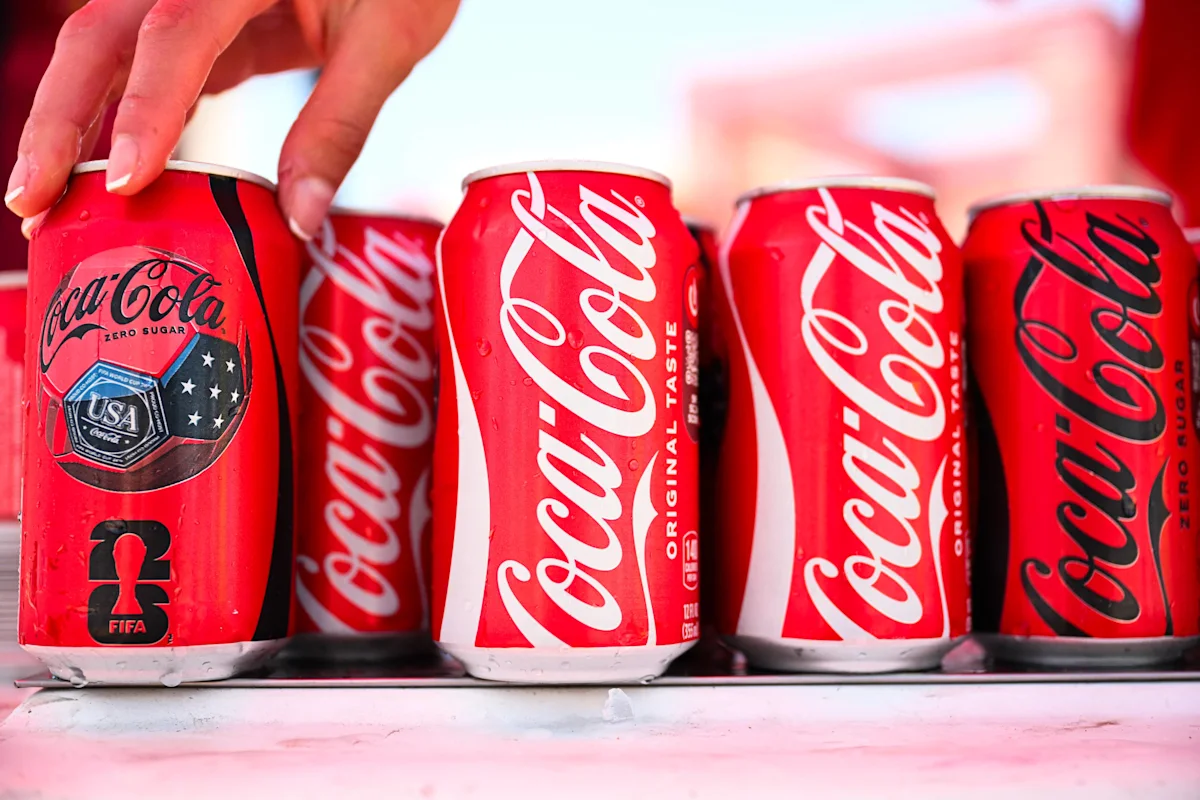
Broadcasters benefited from those minutes. So did Coca-Cola, the tournament's longtime beverage sponsor, whose in-stadium marketing during those breaks helped drive one of the company's more unusual quarters in recent years.
Coca-Cola, a 64-year Dividend King, is typically the kind of stock investors hold for consistency rather than surprises. Its latest results were not consistent in the usual sense.
Volume, revenue and profit all accelerated, and management raised its full-year outlook for the second time this year.
Revenue and profit grew faster than Coca-Cola's own targets
Second-quarter net revenue rose 7% to $13.4 billion, according to Coca-Cola's earnings release. Comparable earnings per share increased 11% to 97 cents, beating Wall Street estimates by five cents, Reuters reported.
Global unit case volume grew 5%, a pace the company has not matched in years outside pandemic-recovery comparisons.
Not all of that growth came from legacy Coke products. Zero Sugar volume jumped 16% in the quarter, more than triple the companywide pace, according to the earnings release.
That matters because it suggests the acceleration is coming from a reshaped portfolio, not just price increases on older products. For a company that spent years repositioning itself as a "total beverage company"—expanding beyond carbonated soft drinks into water, sports drinks, tea, and coffee categories—the quarter offered tangible evidence that the strategy is translating into volume growth rather than just portfolio reshuffling.
Diet Coke volume rose 7%, and Trademark Coca-Cola grew 5%, its strongest pace in 17 years outside pandemic-related swings, the company said on its earnings call.
Powerade volume climbed 8%, helped by placement during World Cup hydration breaks. A soda company long defined by one flagship drink is increasingly looking like one making several bets pay off at once.
The World Cup became more than a sponsorship deal
CFO John Murphy told Reuters the company was "not unhappy" with how the hydration breaks played out for Powerade.
Executives also said on the earnings call that the campaign generated tens of millions of new first-party customer data records, a haul of consumer information a decades-old beverage company rarely collects that quickly.
Not everyone is convinced the boost will last. One analyst quoted by Reuters framed the central question as whether World Cup-driven demand turns into sustained consumer behavior rather than a one-tournament spike.
That skepticism sits at the center of the growth-stock framing investors are now testing on a company built for stability.
Coca-Cola raised guidance for the second time this year
Coca-Cola now expects 2026 organic revenue growth of about 5%, up from a prior range of 4% to 5%, according to the earnings release. It also raised comparable EPS growth guidance to 9% to 10%, from 8% to 9% previously.
Two upward revisions in one year is not typical for a stock known mainly for its payout.
That payout remains substantial. In February, Coca-Cola's board approved its 64th consecutive annual dividend increase, lifting the quarterly payment 4% to 53 cents per share, according to the company's dividend announcement.
As a Dow Jones 30 component with a streak that long, Coca-Cola is usually valued for consistency rather than acceleration. Rising Treasury yields over the past two years have pressured income-oriented stocks by making risk-free government bonds more competitive with dividend equities, making Coca-Cola's share-price gains this year all the more notable against that backdrop.
India shows where the growth story faces pressure
While North American performance led the momentum, global operational issues still challenged the company's supply chain.
The quarter was not clean everywhere. Coca-Cola lost value share in India's ready-to-drink beverage market, CFO Murphy told Reuters separately, as aluminum can shortages left the company without the right packaging at mid-tier price points.
Rising aluminum and PET plastic costs are also pressuring margins companywide.
India market share loss: Aluminum can shortages limited mid-tier packaging just as demand recovered, Reuters noted.
Input cost inflation: Aluminum and PET prices rose more than Coca-Cola had budgeted for 2026.
World Cup fade risk: The tournament ended July 19, and the real test is whether the demand it generated shows up again once Coca-Cola reports results without a tournament behind it.
Coca-Cola closed the week near a record high
Coca-Cola (KO) shares closed at $87.05 on Friday, Aug. 7, up 0.23% on the day. That left the stock within about $4 of the 52-week high of $90.92 it set in the days after the July 28 earnings report.
The stock is up roughly 26% so far this year, consistently outpacing rivals such as PepsiCo. That kind of gain is unusual for a company many investors buy primarily for its dividend rather than for share-price appreciation.
Wall Street kept raising price targets for two weeks after the report. More than a dozen banks lifted estimates, with new targets ranging as high as $104 at Jefferies and UBS. The average 12-month target now stands at $94.70 across 24 analysts, with a consensus Buy rating.
MarketWatch described the stock as bucking broader consumer weakness on its way toward that record. That consumer weakness has been a recurring theme across the staples sector, where several major food and beverage companies have reported softer volumes as shoppers trade down to private-label alternatives and pull back on discretionary purchases.
A defensive playbook is starting to look different
The World Cup itself is already over, with Spain winning the final on July 19.
The next test comes with Coca-Cola's third-quarter report this fall, when the tournament's marketing spend disappears from the comparison and volume growth must stand on its own.
If the momentum holds, other mature Dow components may soon face the same question: whether decades of dividend consistency can coexist with a genuine growth phase, or whether this was simply what one very good marketing year looks like on a balance sheet.
This story was originally published by TheStreet on Aug. 9, 2026, where it first appeared in the Investing section.

