North America Must Deepen Regional Integration to Compete as Global Trade Fragments, Experts Say
Key Takeaways
- •Agustín Carstens urged the U.S., Mexico and Canada to pursue 'smart integration' to keep North America competitive amid geopolitical fragmentation, inflation risks and less resilient supply chains.
- •Carstens called for modernizing NADBank, arguing that decades of piecemeal infrastructure investment, particularly in border transportation, has constrained productive capacity and growth.
- •El Paso and Ciudad Juárez are jointly marketing themselves as a single economic region of about 2.7 million residents, anchored by the twin-city maquiladora manufacturing model.
- •The Borderplex is the fifth-largest manufacturing hub in North America by employment, with more than $140 billion in trade moving through the El Paso border region.
- •Mexico became the United States' largest trading partner in 2023, and future regional integration will depend partly on the 2026 USMCA joint review.
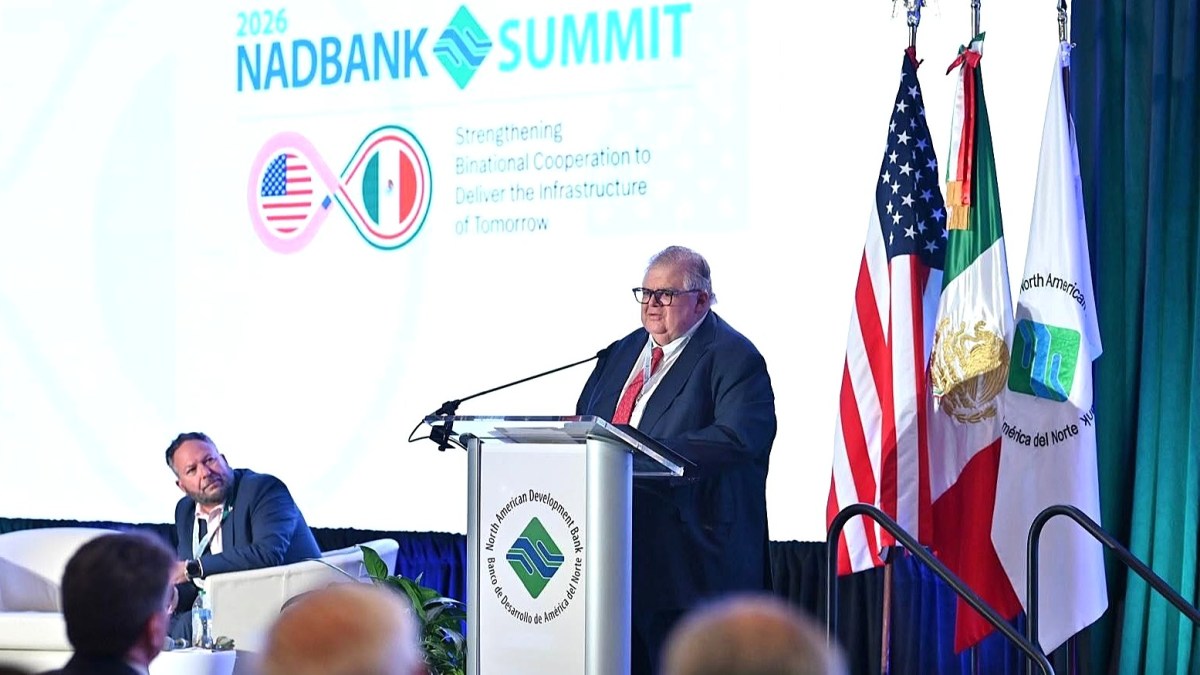
SAN ANTONIO — North America's ability to compete with China and other global economic powers will increasingly hinge on deeper regional integration and stronger coordination between the U.S. and Mexico, according to economic and city leaders speaking at the 2026 NADBank Summit.
Agustín Carstens, former governor of the Bank of Mexico and one of Mexico's most prominent economists, urged the U.S., Mexico and Canada to pursue what he called "smart integration" as the global economy confronts geopolitical fragmentation, inflationary pressures, artificial intelligence and less resilient supply chains.
El Paso Mayor Renard Johnson and Ciudad Juárez Mayor Hector Ortiz said closer cooperation between their cities will be critical to keeping cross-border trade moving as advanced manufacturing, aerospace, technology and data center investment expands across the Borderplex.
The comments came Thursday during the North American Development Bank Summit in San Antonio, an annual gathering of government officials, businesses, financial institutions, academics and infrastructure experts from the U.S. and Mexico. This year's summit focused on strengthening binational cooperation and financing infrastructure projects along the border. NADBank, capitalized by the two federal governments, has financed water, wastewater and other environmental infrastructure projects on both sides of the boundary since the mid-1990s.
Carstens: North America needs 'smart integration'
Carstens, whose keynote was titled "North American Integration and Global Trends," described the North American Free Trade Agreement as a watershed in the economic relationship among the U.S., Mexico and Canada. NAFTA took effect in 1994 and, since 2020, has been succeeded by the United States-Mexico-Canada Agreement, which is itself subject to a scheduled joint review by the three governments in 2026.
NAFTA also produced NADBank, which Carstens said represents a tangible example of the two countries working together to solve problems along what he repeatedly called "our border."
"It's our border, but it's also our problem," Carstens said, arguing that binational institutions can produce collaborative solutions to problems shared by both countries.
Carstens, who served as governor of the Bank of Mexico from 2010 to 2017 and later headed the Bank for International Settlements, framed North American integration against what he described as major structural changes in the global economy.
For decades, globalization, integrated supply chains, technological advances and expanding labor markets allowed producers to respond efficiently to growing demand, Carstens said. Mexico was one of the biggest beneficiaries, evolving from an economy heavily dependent on oil exports in the early 1980s into the United States' largest trading partner, a status it reached in 2023 as companies moved manufacturing closer to U.S. customers amid trade tensions with China.
But that economic environment has changed. Pandemic disruptions, geopolitical conflicts, higher energy costs, protectionism, trade tensions with China, labor constraints and insufficient investment have made global production less flexible, Carstens said. The result is an economy more vulnerable to inflation and slower growth.
At the same time, governments have less room to rely on fiscal and monetary stimulus to overcome economic shocks, he said.
"We see more inflation and less economic growth, a little bit similar to stagflation," Carstens said.
The answer, according to Carstens, includes structural reforms that expand productive capacity, investment in infrastructure and workforce skills, along with renewed regional cooperation.
"I think that we need to reintroduce smart integration, smart regional developments, join forces and move forward," Carstens said, adding that North America needs to think about "our competitiveness as a region with respect to the rest of the world."
Carstens also warned that artificial intelligence, while potentially delivering major productivity gains, could create the same kinds of economic dislocation that accompanied earlier waves of globalization and technological change. Governments should prepare workers with more flexible skills and education while investing in infrastructure that removes constraints on economic growth, he said.
"For many, many decades we have abandoned infrastructure," Carstens said. "We see it here on the border. It goes at a piecemeal approach, especially in terms of transportation."
Those transportation bottlenecks restrict productive capacity and ultimately constrain growth, he said, arguing that NADBank could play a larger role in addressing them.
"Let's think big about NADBank," Carstens said. "Let's modernize this institution because there is a lot that can contribute."
El Paso and Juárez market themselves as one economic region
The need for regional integration was echoed later in the summit by Johnson and Ortiz, who described El Paso and Juárez not as competing municipalities divided by an international boundary, but as pieces of a single economic region. The twin-city model, in which factories on the Mexican side of the border are paired with suppliers, logistics operations and shared management on the U.S. side, has anchored Borderplex manufacturing since the maquiladora program began in the 1960s.
Johnson said El Paso, Juárez and the surrounding area increasingly market themselves as a market of roughly 2.7 million residents rather than presenting El Paso alone as a city of about 800,000.
"We are in alignment for the first time in many, many years," Johnson said, pointing to aerospace, advanced manufacturing and technology as industries where the two cities can grow together.
Ortiz offered a similar assessment, describing the El Paso-Juárez-Las Cruces region as a large interconnected economic engine.
Juárez "can never be done alone," Ortiz said, adding that greater coordination with El Paso and Las Cruces could create a more significant commercial and economic development hub benefiting both Mexico and the United States.
The Borderplex is already the fifth-largest manufacturing hub in North America by employment, according to figures cited during the panel. Johnson said one in four El Paso jobs is connected to manufacturing and that every 100 manufacturing jobs created in Juárez generates about three jobs in El Paso.
Johnson said more than $140 billion in trade moves through the El Paso border region and argued that increasing throughput at the city's international bridges could generate billions of dollars in additional economic activity. The city operates the Paso del Norte, Ysleta and Stanton bridges.
"If we were to just increase cross-border traffic, you would see billions of dollars come into not only Texas, but throughout the United States," Johnson said.
Taken together, Carstens' keynote and the El Paso-Juárez discussion offered essentially the same message at different scales: as global supply chains become more fragmented and costly, North America's competitive advantage may depend on making its existing economic integration work better.
For the U.S.-Mexico border, that could mean improving bridges and transportation infrastructure, developing workers, securing water supplies and treating communities on opposite sides of the international boundary as parts of the same supply chain.
The push to strengthen North American supply chains could put border infrastructure, freight capacity and workforce development at the center of the region's competition with China and other global manufacturing powers. How far that push goes will depend in part on decisions the three national governments make in the coming year, including the scheduled 2026 USMCA review and any modernization of NADBank's mandate.
Source: FreightWaves
