Telecoms Contribute ₦5.2 Trillion to Nigeria's Real GDP in Q2 2026, Highest in Two Years
Key Takeaways
- •Nigeria's telecoms sector contributed ₦5.2 trillion, or 9.72%, to real GDP in Q2 2026, its highest share in two years and up 10.61% year-on-year.
- •Telecommunications accounted for 64.2% of the digital economy, which contributed 15% of the ₦53.47 trillion real GDP in the quarter.
- •Total telecoms subscriptions reached 192.2 million and internet users hit 156.9 million, with Nigerians consuming 7.1 million terabytes of data in the first half of 2026.
- •The federal government's 90,000km fibre optic Project Bridge and a rollout of 3,700 rural telecom towers are both scheduled to begin in October.
- •MTN Nigeria spent ₦620.5 billion on capital expenditure in the first half of 2026, while Airtel invested ₦287.6 billion ($211 million) in 4G/5G towers and other investments.
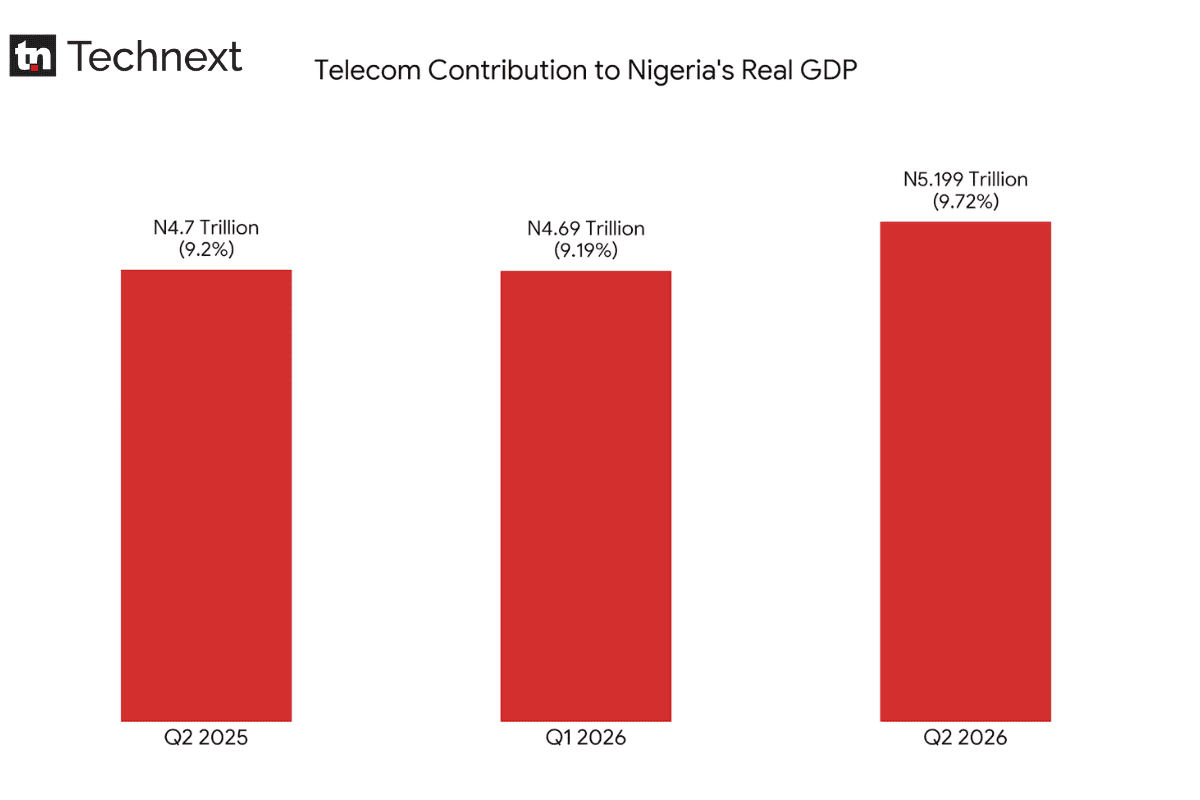
Nigeria's telecommunications industry contributed ₦5.199 trillion (approximately ₦5.2 trillion) to the country's real gross domestic product (GDP) in the second quarter of 2026, marking its highest GDP contribution in two years at 9.72%.
According to data released by the National Bureau of Statistics (NBS) on Monday, the figure represents a 10.61% year-on-year increase from the ₦4.7 trillion (9.2%) recorded in Q2 2025 — further evidence of the significant growth the Nigerian telecoms industry has experienced over the past 12 months.
The 9.72% contribution is the sector's highest share of Nigeria's real GDP since it recorded 14.58% in Q1 2024, nine quarters ago.
Telecoms also led the digital economy, accounting for 64.2% of a sector that contributed 15% to real GDP in Q2 2026. In monetary terms, the digital economy generated ₦8.1 trillion of the nation's ₦53.47 trillion GDP during the quarter.
The Nigerian Digital Economy sector comprises the Information and Communication (I&C) and Financial Institutions (FI) sectors, and has remained a top contributor to the national economy, driven specifically by telecom operators and the banking industry.
Sector breakdown
The I&C sector contributed 11.7% to real GDP in Q2 2026, compared with 11.8% in Q2 2025. In monetary terms, the sector generated ₦6.27 trillion, up from ₦5.72 trillion in Q2 2025.
Within the sector, Telecommunications accounted for ₦5.2 trillion (82.84%), followed by Broadcasting with ₦762.3 billion (12.15%), and Sound and Media Production with ₦305.6 billion (4.87%). Publishing recorded the smallest contribution of ₦8.6 billion, representing 0.14%.
The FI sector, comprising financial institutions and insurance, contributed 3.3% to real GDP in Q2 2026, amounting to ₦1.8 trillion. Financial Institutions accounted for the largest share at ₦1.57 trillion (87.2%), with Insurance contributing ₦230.6 billion (12.8%). By comparison, the FI sector contributed 3.23% of GDP in Q2 2025, amounting to ₦1.65 trillion.
Overall, Nigeria's real GDP grew by 4.43% year-on-year in real terms in Q2 2026, up from the 4.23% recorded in Q2 2025.
Context: telecoms' growing economic weight
For every ₦100 of economic output Nigeria produced in Q2 2026, ₦9.72 came from telecommunications. While oil has traditionally been a prominent driver of GDP, telecoms has been catching up, as nearly everyone makes voice calls and browses the internet. The shift matters for diversification efforts, as non-oil sectors like telecommunications now anchor a larger share of national output.
Industry data from the Nigerian Communications Commission (NCC), the industry regulator, shows total telecoms subscriptions now stand at 192.2 million, out of an estimated 230 to 250 million Nigerians. Internet users climbed to 156.9 million, meaning 81.6% of Nigerians are mobile data users.
Following the upward review of voice and data tariffs in January 2025 — the first major tariff adjustment in over a decade — the industry has continued to improve in data usage, internet penetration, and revenue streams for operators.
In the first six months of 2026, Nigerians consumed 7.1 million terabytes of data, reflecting massive internet usage amid demand for high-speed data, new smartphone interfaces, and increased file uploads and downloads. This coincides with a surge in financial inclusion powered by mobile money and smartphone adoption.
The sector's highest contribution in two years reflects the fact that more Nigerians are streaming audio and video, using social media, and working remotely. The growth of fintech and mobile money riding on telecom networks has also left more businesses dependent on the internet than before.
The surge in users underpins the rising contribution, which has been accompanied by a continuous increase in capital expenditure across the industry.
Infrastructure expansion ahead
Project Bridge, the federal government's 90,000km fibre optic cable rollout across the country, is set to commence in October. The project is expected to expand Nigeria's internet coverage and broadband penetration and enhance 4G/5G networks. Its rollout, alongside the tower deployment programme, will be a key factor to watch in coming quarters, as wider coverage typically expands the subscriber and data base on which sector GDP contribution depends.
Also scheduled to begin in October is the deployment of 3,700 telecom towers in rural areas, which seeks to connect underserved Nigerians currently without network coverage and aims to bring 20 million Nigerians living in these communities online.
Across the first half of 2026, MTN Nigeria, the country's largest operator by subscribers, reportedly spent ₦620.5 billion on capital expenditure, while Airtel said it used ₦287.6 billion ($211 million) for 4G/5G tower deployment and other necessary investments. Together, MTN and Airtel dominate the Nigerian mobile market, alongside smaller operators Globacom and 9mobile.
