September US Payrolls Rise 29,000 vs. 89,000 Expected, With 81,000 in Prior-Month Downward Revisions
Key Takeaways
- •US nonfarm payrolls increased by 29,000 in September, well below consensus expectations of approximately 89,000.
- •Revisions subtracted a cumulative 81,000 jobs from the two preceding months, leaving measured hiring smaller than initially reported.
- •The early benchmark incorporating QCEW data is growing more slowly than reported nonfarm payroll employment, though an Econbrowser assessment found it does not substantially change the overall picture.
- •Household survey employment has not regained its January 2025 level, and the freight services index declined sharply relative to its last reading, which ran through May.
- •The 29,000 payroll gain still exceeds some estimates of employment breakeven, according to analyses by Torsten Slok and Ernie Tedeschi recounted by AP via BNN Bloomberg.
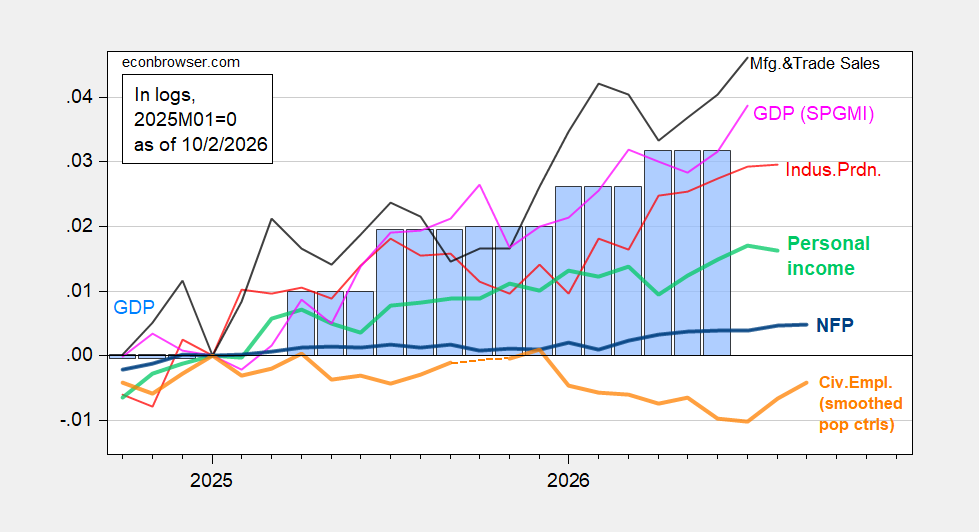
Nonfarm payrolls rose 29,000 in September, a downside surprise against expectations of roughly 89,000, while revisions subtracted a cumulative 81,000 jobs from the preceding two months. Because each monthly release also revises earlier estimates, those downward adjustments leave measured hiring for the prior two months smaller than initially reported. The payroll count comes from the establishment survey, which tracks jobs on employers' payrolls, while the separate household survey counts employed people and is the basis for the official unemployment rate — one reason the two measures can move differently. According to an Econbrowser assessment of business cycle indicators, factoring in the early benchmark does not substantially change the overall picture.
Figure 1: NFP employment (bold blue), civilian employment with smoothed population controls (bold orange), industrial production (red), personal income excluding current transfers in Ch.2017$ (bold light green), manufacturing and trade sales in Ch.2017$ (black), and monthly GDP in Ch.2017$ (pink), with GDP shown as blue bars, all log-normalized to 2025M01=0. Source: BLS via FRED, BLS, Federal Reserve, BEA 2026Q2 3rd release, S&P Global Market Insights (formerly Macroeconomic Advisers, IHS Markit; 9/2/2026 release), and author's calculations.
Employment from the household survey (Current Population Survey) continued to rise, but has not regained its January 2025 level. That measure carries wider standard errors, a byproduct of its smaller sample, though its trend is subject to less revision within the year, given consistent population controls.
The household employment series adjusted to the NFP concept — a research series — shows a much shallower gradient and also remains below January 2025 levels. In addition, the early benchmark, which incorporates QCEW data — the Quarterly Census of Employment and Wages, a near-census count of jobs assembled from state unemployment insurance records that anchors BLS annual benchmark revisions — is growing more slowly than reported NFP.
Figure 2: Civilian employment adjusted to the NFP concept with smoothed population controls, using experimental controls for 2025 (bold orange), manufacturing production (red), ADP private nonfarm payroll employment (light green), real retail sales deflated by CPI (black), freight services indexes (brown), and the coincident index in Ch.2017$ (pink), with GDO shown as blue bars, all log-normalized to 2025M01=0. Source: BLS, ADP via FRED, Philadelphia Fed, Bureau of Transportation Statistics, Federal Reserve via FRED, BEA 2026Q2 3rd release, and author's calculations.
Notably, the freight services index has taken a dive relative to its last reading, which ran through May. Freight gauges track the physical movement of goods, which places them alongside the employment, retail, and output measures in this coincident set of indicators.
The pattern of recent private NFP revisions appears as follows:
Figure 3: Private NFP from the August release (red), from the September release (blue), and implied Bloomberg consensus (red +), all in thousands, seasonally adjusted, on a log scale. Source: BLS, Bloomberg, and author's calculations.
The +29,000 gain is still above some estimates of employment breakeven — the pace of hiring generally needed to keep up with growth in the labor force — per Torsten Slok and Ernie Tedeschi, as recounted by AP via BNN Bloomberg. From here, the September figure's own revision path, future QCEW benchmark updates, and freight readings covering periods beyond May will indicate whether the softer signals across these indicators persist.
This article is based on the original commentary published on Econbrowser.

