Nigeria's Next Total Solar Eclipse Arrives in 2034; Five Partial Eclipses Precede It
Key Takeaways
- •Nigeria's next total solar eclipse on March 20, 2034 will share the same Saros cycle 130 and similar timing characteristics as the 2006 event.
- •Total darkness during the 2034 eclipse at any single Nigerian location is not expected to last more than three minutes.
- •Five partial solar eclipses will be visible across Nigeria between August 2027 and May 2031 before the total event.
- •Two total lunar eclipses scheduled for October 18, 2032 and April 14, 2033 will be safely visible to the naked eye throughout Nigeria.
- •Nigeria's 28-year gap between total solar eclipses in 2006 and 2034 is notably short given that any single location averages one approximately every 375 years.
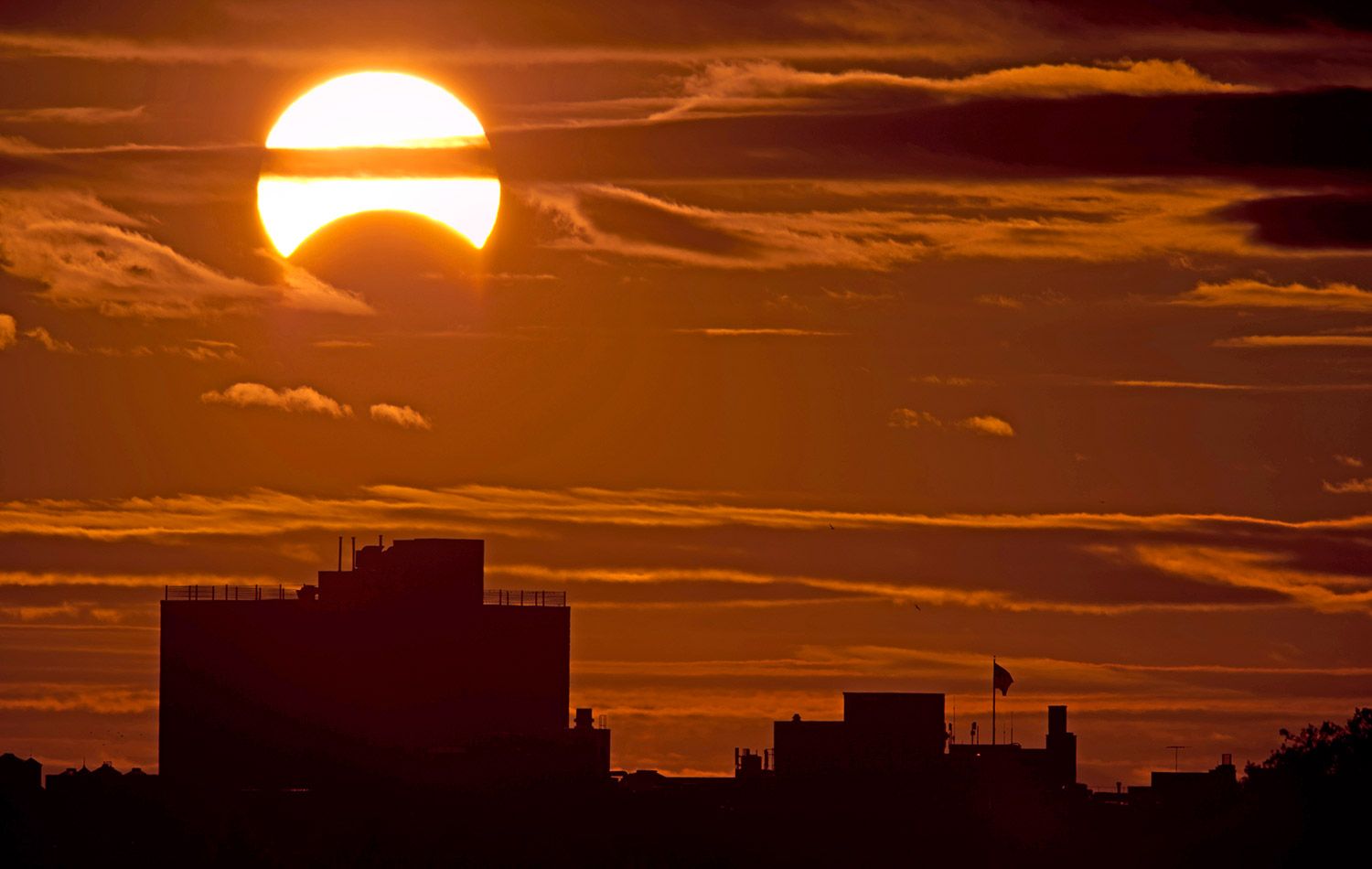
On the morning of March 29, 2006, an unusual darkness descended upon Nigeria without warning, wind, or rain. As citizens went about their daily routines, the bright morning sun was progressively obscured. In major cities such as Lagos and Abuja, the dimming prompted confusion and wonder. Further north, however—in places like Katsina, Kazaure, and Gusau—the darkness was total, bringing economic activity to a complete standstill.
Shaki, a town in Oyo State, experienced the full magnitude of the event. Word of the phenomenon had spread in advance, drawing crowds eager to witness the spectacle in its entirety. That event marked the most recent total solar eclipse visible from Nigeria. While total solar eclipses occur somewhere on Earth roughly every 18 months, any single location experiences one only about once every 375 years on average, making Nigeria's 28-year interval between the 2006 and 2034 events a notably short gap by historical standards. Eclipse paths are calculated using the Saros cycle, a predictable astronomical period of approximately 6,585 days that astronomers have used for centuries to forecast when and where eclipses will occur.
The Next Total Solar Eclipse: March 20, 2034
Nigeria's next total solar eclipse is expected on Monday, March 20, 2034—exactly 28 years after the 2006 event. It is forecast to begin around 9:00 am, the same starting time as the previous one, and span roughly three hours. The period of greatest darkness is expected to commence at approximately 10:17 am, sweeping across the country over the following 37 minutes. At any single location, total darkness is not expected to last beyond three minutes.
Numerous states are projected to experience the total eclipse, including the capital Abuja, the commercial hub Lagos, as well as Kaduna, Anambra, and Enugu. Cross River, Rivers, Akwa Ibom, and Kano would see a partial eclipse, while Zamfara and Sokoto are expected to experience a partial but comparatively brighter event. The 2034 eclipse is part of Saros cycle 130, the same family of eclipses that produced the 2006 event, which is why both share similar timing characteristics.
Five Partial Solar Eclipses Before 2034
In the lead-up to the 2034 total eclipse, Nigeria will witness five partial solar eclipses. Several lunar eclipses are also on the calendar, beginning with a partial lunar eclipse on August 28. Additionally, an annular solar eclipse—a phenomenon occurring when the Moon passes directly between the Earth and the Sun but is too distant to fully block the solar disk—will take place during this period.
1. Monday, August 2, 2027
The first partial solar eclipse on the path to 2034 will occur between 9:11 am and 9:55 am. It is expected to be most visible in northern states, including Adamawa, Bauchi, Borno, Gombe, Jigawa, Katsina, Kano, Niger, Sokoto, Yobe, and Zamfara. In many of these states, as much as 17.26% of the sun could be obscured.
Southern states such as Rivers, Lagos, Delta, Bayelsa, Edo, and Imo will experience minimal effects. In Rivers State, for example, obscuration may be as low as 1%.
2. Wednesday, January 26, 2028
The second partial eclipse is expected to be even less noticeable, owing in part to its evening timing. It will begin at 5:04 pm and conclude by approximately 5:45 pm. States with clearer viewing conditions include Sokoto, Zamfara, Yobe, Niger, Oyo, Kebbi, Katsina, Kano, Jigawa, and Bauchi. In Kebbi and Sokoto, obscuration could reach as high as 7%.
Bayelsa, Abia, Ebonyi, Enugu, and Rivers will see little to nothing. In Enugu, only 0.12% of the sun is projected to be obscured.
3. Saturday, June 1, 2030
A more pronounced partial eclipse will take place on this date, beginning as early as 5:35 am and lasting until about 6:23 am. Due to the early start time, many observers—particularly in regions where sunrise occurs later—may miss it.
Northeastern states such as Borno, Yobe, Adamawa, Taraba, Gombe, and Bauchi will experience the greatest effects. In Borno, up to 20% of the sun could be obscured. Conversely, states including Oyo, Osun, Ondo, Ekiti, Edo, Delta, Akwa Ibom, Abia, and Anambra will barely notice the event, with obscuration as minimal as 0.10% in some areas.
4. Monday, November 25, 2030
Later that same year, a lesser partial solar eclipse will occur during the morning hours, running from 6:02 am to 6:38 am. More southern states are expected to witness this event, with Anambra, Abia, Akwa Ibom, Cross River, Ebonyi, Imo, and Rivers among those with better visibility.
Middle-belt states will also participate, including Taraba, Kogi, Benue, and Adamawa. Up to 16% of the sun could be blocked in some southern states, while Lagos is expected to see no noticeable effect.
5. Wednesday, May 21, 2031
The final partial solar eclipse before the 2034 total event will begin at 5:48 am and continue through 6:26 am. Nearly every Nigerian state will observe it in comparable measure. Rivers, Edo, Enugu, Taraba, Imo, and Akwa Ibom are projected to see slightly greater obscuration.
In Rivers State, nearly 18% of the sun could be blocked. Zamfara and Sokoto will experience the least obscuration, at approximately 1%.
Lunar Eclipses in the Interim
Between May 2031 and the total solar eclipse of March 2034, two total lunar eclipses are scheduled to occur—on October 18, 2032, and April 14, 2033. Unlike solar eclipses, lunar eclipses are safe to view with the naked eye and are visible from anywhere on the night side of the Earth, meaning all of Nigeria will be able to observe both events provided skies are clear.
