NITDA DG Calls for Data and Cloud Independence at GITEX Nigeria AI Summit
Key Takeaways
- •NITDA Director-General Kashifu Inuwa Abdullahi warned at the GITEX Nigeria summit in Abuja that foreign control of AI systems could hold Nigeria hostage, urging that AI be treated as sovereign infrastructure.
- •The Presidency, speaking for SGF Senator George Akume, endorsed transforming Nigeria from a technology consumer into a builder and exporter of digital solutions.
- •The newly unveiled National Digital Cloud Policy targets $750 million in private sector investment for domestic cloud and data infrastructure over the next 24 months.
- •Project BRIDGE will deploy 90,000 kilometres of fibre-optic cable and roughly 3,700 telecom towers to connect more than 20 million unserved Nigerians.
- •The 3MTT initiative has received over 1.8 million applications and trained more than 105,000 fellows in AI, cloud computing, cybersecurity, and software engineering.
The global race for artificial intelligence has moved beyond innovation into what many now frame as a battle for Africa's national survival. As foreign technology giants accumulate computing power and set algorithmic standards, African nations face a narrowing window to secure their digital independence.
West Africa stands at a pivotal technological crossroads with a stark choice: build sovereign AI capabilities or remain dependent on foreign tech infrastructure. Outsourcing intelligence and relying on external data centres leaves critical national assets exposed to foreign manipulation. The stakes are sharpened by the reality that Africa accounts for only a small fraction of global data-centre capacity, despite hosting a rapidly growing share of the world's internet users, a gap that has kept much of the continent's data processing offshore.
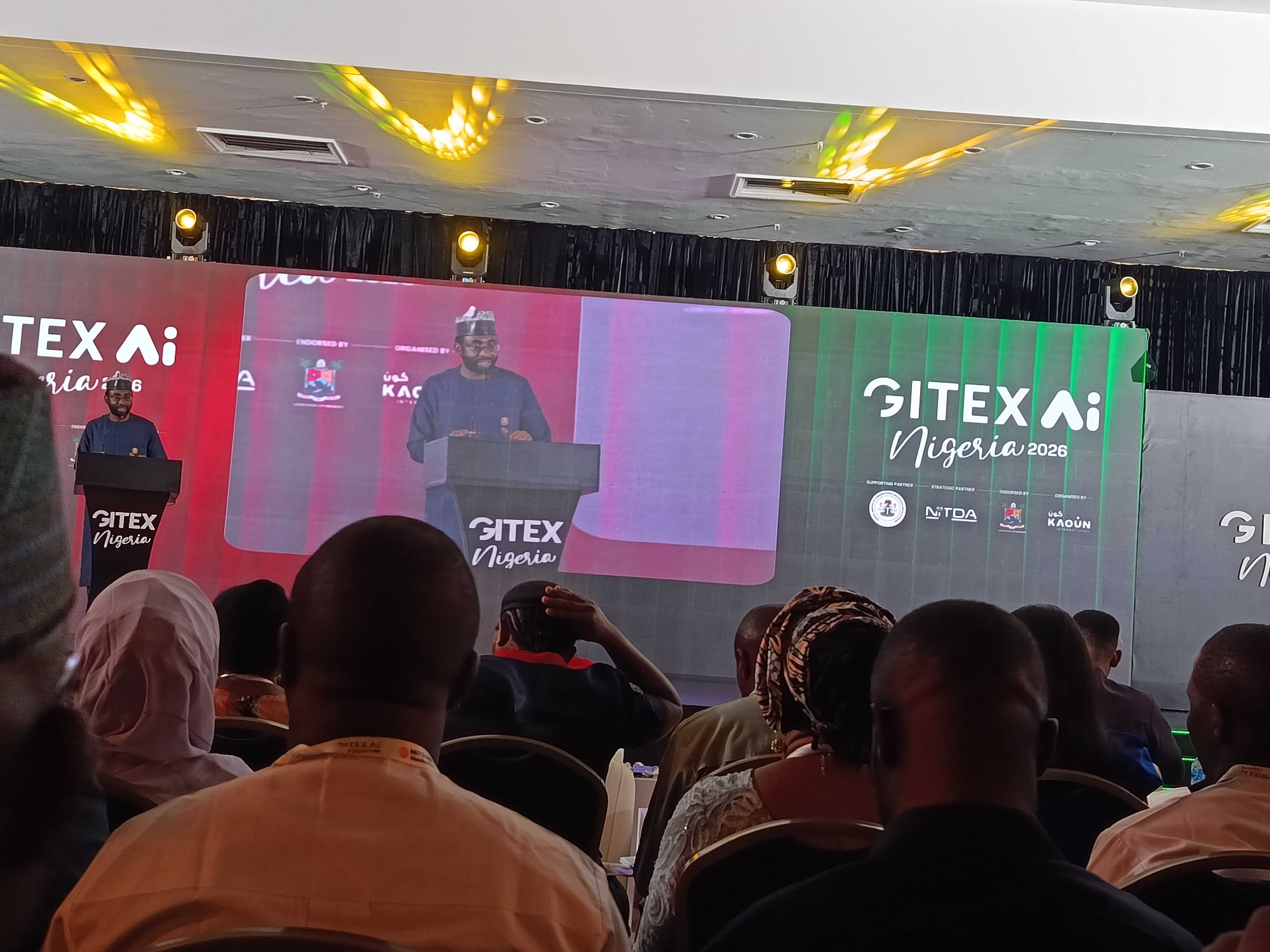
These concerns took centre stage at the GITEX Nigeria: Government Leadership and AI Summit in Abuja. Kashifu Inuwa Abdullahi, Director-General of the National Information Technology Development Agency (NITDA), delivered a sobering assessment of the continent's trajectory and issued a clear call for digital self-determination. NITDA, the country's IT development and regulatory agency, has in recent years anchored Nigeria's national digital economy and AI policy frameworks, giving the DG's warnings institutional weight.
"We missed the 4th industrial revolution; we mustn't miss the AI revolution," Inuwa told an audience of senior government officials, lawmakers, and industry executives.
Speaking to key policymakers, including the Chairman of the Senate Committee on ICT and Cybersecurity, Senator Shuaib Afolabi Salisu, the NITDA chief cautioned that artificial intelligence should no longer be treated as a passing tech trend. Rather, it must be regarded as essential sovereign infrastructure capable of generating intelligence about the Nigerian economy, security apparatus, and citizenry.
The consequences of inaction, Inuwa stressed, strike at national sovereignty itself. When algorithms that shape financial access, national security, and healthcare diagnostics are designed entirely in foreign jurisdictions, African institutions cede their autonomy.
"Whosoever controls the AI can hold us hostage," Inuwa warned. "If I control the system that manages all of this, I can control where you focus your attention, I can control your wealth, I can control your economy, and I can control everything about you."
Breaking this cycle, he argued, must begin with the raw fuel powering modern models: data. Inuwa rejected the idea that machine learning models are inherently biased on their own, instead placing responsibility on foreign training pipelines. It is a concern echoed in global AI governance debates, where under-representation of African languages and contexts in training datasets has been widely documented as a source of skewed model behaviour.
"AI is not biased; it's the training data that's biased," he said. "If we want AI that will serve us, we need to train it with our data."
Presidency stresses indigenous data governance
The demand for indigenous data governance and algorithmic control drew strong support from the Presidency. A representative delivering the keynote address on behalf of the Secretary to the Government of the Federation (SGF), Senator George Akume, reinforced the administration's commitment to transforming Nigeria from a market of passive consumers into a hub of digital producers.
"Nigeria must move from merely being consumers of technology to being builders, producers, and exporters of digital solutions and artificial intelligence," the SGF stated, adding that "the future of governance, economic competitiveness, and public service delivery will be digital."
The SGF's address outlined concrete policy measures already underway to anchor this digital sovereignty. Chief among them is the newly unveiled National Digital Cloud Policy, which targets $750 million in private sector investment for domestic cloud and data infrastructure over the next 24 months. The cloud policy builds on Nigeria's existing data protection regime, anchored by the Nigeria Data Protection Act of 2023, which governs how personal data is processed and stored domestically.
Supporting the policy push is Galaxy Backbone (GBB), the federal digital infrastructure company that operates Tier III and Tier IV certified data centres together with a nationwide sovereign cloud platform. Under a recent presidential mandate designating telecommunications and digital infrastructure as Critical National Infrastructure (CNI), GBB is expanding its role as the digital backbone for ministries, departments, and agencies.
These domestic data efforts are directly tied to physical connectivity. The Federal Government is executing Project BRIDGE, a landmark deployment of 90,000 kilometres of fibre-optic cable nationwide along with roughly 3,700 telecom towers intended to bring more than 20 million unserved citizens online.
On the human capital side, the Federal Ministry of Communications, Innovation and Digital Economy's Three Million Technical Talents (3MTT) initiative has received over 1.8 million applications across all 774 local government areas and has trained more than 105,000 fellows in artificial intelligence, cloud computing, cybersecurity, and software engineering.
Still, as both NITDA and the Presidency emphasised, infrastructure and talent pipelines address only part of the challenge. The broader task lies in developing indigenous foundational models rather than wrapping thin interfaces around foreign Application Programming Interfaces (APIs). That ambition will be tested by the enormous compute and capital requirements of frontier AI development, where leading models are trained on infrastructure costing billions of dollars, a scale no African nation has yet matched.
With Africa projected to capture a substantial share of the multi-trillion-dollar global AI economy over the coming decade, Nigeria's leaders are betting that sovereignty over the entire technology stack, from subsea cables and domestic data centres to local datasets, is the only path to ensuring the continent writes its own digital future. How quickly the $750 million cloud investment target, the Project BRIDGE rollout, and 3MTT's talent pipeline translate into locally built foundational models will be the measure of whether this summit's rhetoric becomes reality.
