Nigerian Police Arrest Woman Over Forged Notice Falsely Claiming OPay Shutdown
Key Takeaways
- •Nigeria's cybercrime police arrested Hafsat Abubakar on September 4 after digital forensic analysis tied her to the creation and circulation of a fake OPay shutdown notice.
- •The counterfeit document mimicked OPay's official branding and signature, told customers to remove their money immediately, and rapidly accumulated more than 572,000 views on X.
- •OPay filed a formal complaint on August 31 and issued legal notices to three social media users, demanding deletion of the false shutdown claims and public apologies.
- •Abubakar deleted her post and publicly apologized for sharing incorrect information, but the police investigation proceeded, resulting in her arrest and the seizure of three Apple mobile phones.
- •OPay executives reassured the public at a Lagos town hall that the company remains operational, citing more than 7,000 employees and new customer support offices, while police said the probe into other parties continues.
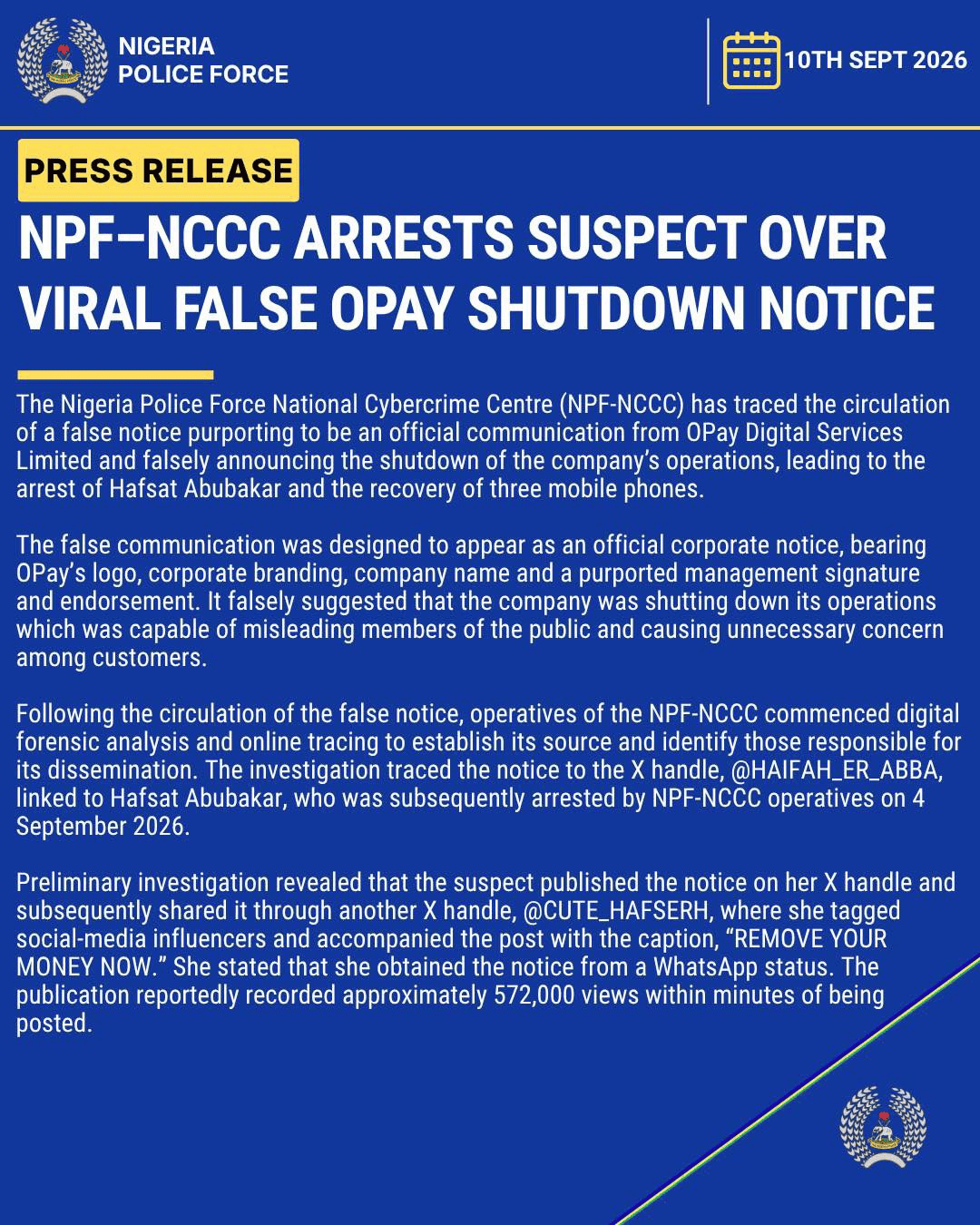
The Nigeria Police Force National Cybercrime Centre (NPF-NCCC) has arrested Hafsat Abubakar over a forged document that falsely claimed Nigerian fintech company OPay was shutting down its operations. Her arrest on September 4 followed digital forensic analysis that investigators said linked her to the creation and circulation of the fake notice.
The counterfeit document imitated OPay's official branding and carried a bogus management signature, suggesting that the company would cease its services. OPay has publicly denounced the claim as false, stressing that it could mislead customers and create unwarranted anxiety about the safety of their funds.
The case began after OPay filed a formal complaint on August 31, urging law enforcement to investigate the matter. Using advanced digital forensic tools, the NPF-NCCC traced the document to an account linked to Abubakar.
According to the police, Abubakar shared the notice on her X account and later reposted it from another account, @CUTE_HAFSERH, while tagging social media influencers. The fake message urged readers to “REMOVE YOUR MONEY NOW.” Abubakar told investigators she had found the notice on a WhatsApp status before posting it. The post spread rapidly, racking up more than 572,000 views within minutes. Three Apple mobile phones were seized from her as part of the investigation.
The NPF-NCCC is continuing to examine how the fake notice was created and spread, and whether others were involved. Once the investigation is complete, Abubakar and anyone else implicated will face charges.
CSP Ani Iniedu, the Force Public Relations Officer, urged Nigerians to double-check any information before acting on or sharing news related to financial institutions, according to a statement posted on the Force's official X account. The police specifically advised the public to rely on official channels when dealing with banks, fintechs, or other financial services providers.
The arrest marks the latest step in OPay's response to false claims that it would stop operating in Nigeria on September 1. The company issued legal notices to three social media users: Adamu B. Garba II on X, the TikTok account @viralgrabtvng, and Hafsat Abubakar (@haifah_er_abba). The notices, dated August 31 and September 1, demanded that the posts be deleted and apologies issued. OPay described the shutdown rumour as misleading and warned that it could trigger unnecessary customer withdrawals.
Abubakar deleted her post and publicly apologised, admitting she had shared incorrect information and confirming that OPay was operating normally. Despite her apology, the police investigation continued, leading to her arrest on September 4.
OPay also addressed the rumours at a town hall in Lagos, where Chief Operating Officer Dotun Adekunle reassured attendees that the company was functioning well, highlighting its workforce of more than 7,000 employees and its new customer support offices. Chief Legal Counsel Akinfolabi Moses Rokosu said the company was collaborating with law enforcement regarding the false claims.
The police said the investigation into the source of the forged documents and any other parties involved remains ongoing.
