NFL asks Supreme Court to classify sports prediction contracts as gambling
Key Takeaways
- •The NFL filed an amicus brief Thursday asking the Supreme Court to treat sports prediction agreements as gambling rather than derivatives, supporting New Jersey petitioners against a Third Circuit ruling that gave the CFTC exclusive authority over sports contracts.
- •The league argues that, unlike traditional swaps that mitigate existing financial risks, sports contracts generate underlying risk directly from game outcomes, and it is seeking strict anti-manipulation measures, higher minimum-age requirements, and direct communication with the league.
- •Kalshi, which operates under CFTC oversight, dismissed the NFL's claims and defended existing federal regulation and integrity provisions, while Major League Baseball, the National Hockey League, and Major League Soccer have all partnered with prediction platforms.
- •Sports trading accounts for roughly 44% of $330.4 billion in year-to-date prediction-market volume, with Kalshi processing $107.6 billion in sports volume compared with Polymarket's $37.9 billion.
- •Bernstein projects annual prediction-market volume could reach $10 trillion by 2035, but the firm does not expect US regulatory clarity before 2027–2028.
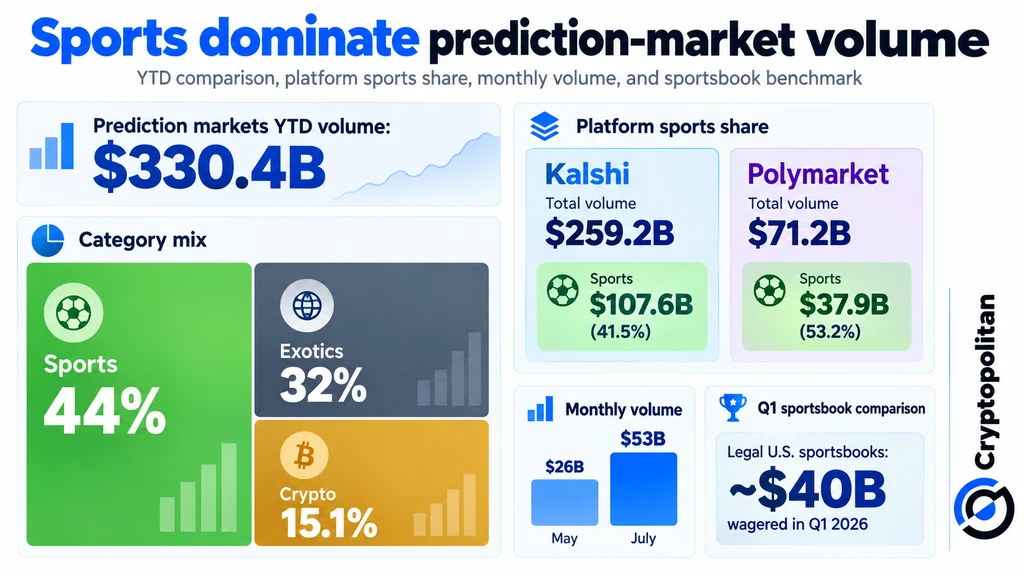
The National Football League (NFL) has asked the US Supreme Court to designate sports prediction agreements as gambling rather than financial derivatives. Such a classification could influence how Kalshi and its competitors respond to federal agencies or state gambling — and, in turn, the pace at which the industry grows. The question carries commercial weight because sports contracts have become the main growth engine for prediction platforms, a shift reflected in the trading figures below.
The league's case against calling them swaps
In an amicus brief filed Thursday — a legal filing by a non-party offering the court outside perspective — the NFL is backing petitioners from New Jersey in their challenge to a Third Circuit ruling that gave the Commodity Futures Trading Commission, the federal agency that oversees US derivatives markets, exclusive authority over all issues pertaining to sports contracts.
The league argues that traditional swaps serve to mitigate existing financial risks, while sports contracts generate the underlying risk themselves, since exposure stems directly from the outcome of a game. The NFL frames the dispute as a constitutional question, pointing to conflicting decisions among different appeals courts.
It is also pressing for strict anti-manipulation measures, higher minimum-age requirements, and direct communication with the league. The Supreme Court has not yet decided whether it will accept the case for consideration; if it declines, the Third Circuit's ruling would stand.
Kalshi pushes back as other leagues embrace the markets
Kalshi, which operates under CFTC oversight, dismissed the NFL's claims and argued in favor of the federal regulation and integrity provisions already in place. Other sports leagues have welcomed prediction markets: Major League Baseball has partnered with Polymarket, the National Hockey League has struck deals with both Kalshi and Polymarket, and Major League Soccer has signed an exclusive agreement with Polymarket. The NFL's stance thus sets it apart from peers that have entered commercial partnerships with the platforms.
Gaming law expert Daniel Wallach called the NFL's intervention important, saying the move increases the likelihood of the Supreme Court taking up the case.
What the trading data shows about exposure
The stakes become clearer in the trading figures. The NFL reported that $1.8 billion of the $3.3 billion traded on the season's opening Sunday involved its games.
Artemis data showed $330.4 billion in year-to-date prediction-market volume as of October 8. Sports represented roughly 44%, followed by exotics at 32% and crypto at 15.1%. Kalshi and Polymarket are the sector's two largest platforms by volume.
Kalshi has processed $259.2 billion in total, including $107.6 billion from sports trading (41.5%). Polymarket, by contrast, recorded $71.2 billion, with $37.9 billion coming from sports trading (53.2%). Kalshi's total sports volume is therefore significantly larger than Polymarket's, while sports trading accounts for a bigger share of Polymarket's overall activity.
According to Pew Research, the two companies' combined monthly trading has climbed sharply, from $26 billion in May to $53 billion in July. At the same time, Americans wagered roughly $40 billion through licensed sportsbooks in the first quarter. These amounts reflect trading or bets placed rather than platform revenue.
US uncertainty versus Europe's clearer line
The regulatory gap persists. Washington-based research institution Brookings has pointed to tension between federal derivatives regulation and state gambling legislation. The research group American Institute for Boys and Men has raised a separate concern: prediction markets can admit participants as young as 18, while sportsbooks uniformly require customers to be 21.
Europe takes a different approach. ESMA, the European Union's securities regulator, says qualifying binary event contracts face existing retail restrictions and investment-firm authorization requirements.
Why the growth story depends on the ruling
Cryptopolitan previously reported Bernstein's projection that annual prediction-market volume could reach $10 trillion by 2035. Yet the firm expects US regulatory clarity no earlier than 2027–2028.
State-level regulation could raise licensing costs, taxes, and compliance burdens, potentially weakening liquidity and slowing expansion. A sports-focused ruling would not automatically settle questions around crypto or political contracts. Still, it could reshape investment decisions and global competition by shaping the boundaries of federal oversight.

