NAVER (035420) Is Listed on edgeX: AI Commerce, Search, and the NAVER Trading Thesis
Key Takeaways
- •The NAVER/USDC perpetual on edgeX lets eligible traders take long or short positions around the clock, and it is a derivative contract that grants no shareholder rights, dividends, or voting power.
- •NAVER operates one of Korea's most important platforms across search, commerce, advertising, and content, making it a key way to trade the Korean internet economy.
- •The investment case hinges on whether AI features such as AI Tab and shopping AI functions can measurably improve commerce conversion and ad efficiency rather than serving as interface polish.
- •The principal risk is that AI infrastructure, product development, and merchant incentive costs arrive before monetization benefits, weakening the valuation thesis.
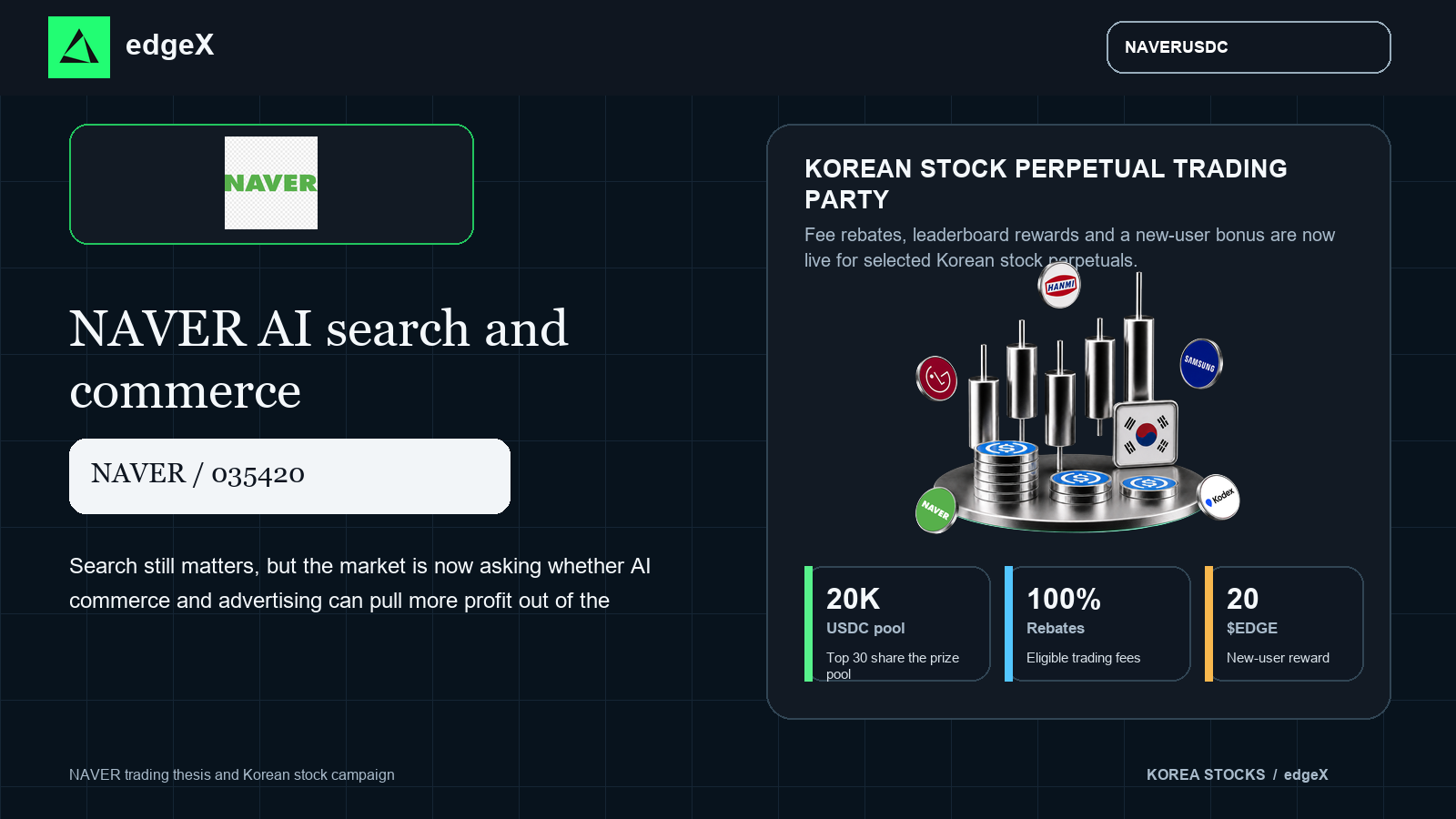
- •The edgeX Korean Stock Perpetual Trading Party runs from August 14 to August 24, 2026, offering fee rebates, a tiered prize pool of up to 20,000 USDC, and $EDGE rewards for new traders, with leaderboard qualification at 10,000 USDC in valid volume.
Quick Answer
NAVER is Korea's dominant platform name, and the NAVER/USDC perpetual on edgeX lets traders express a long or short view on whether search, commerce and AI tools can raise monetization quality. The stock matters now because the company is trying to turn AI features into a better shopping and advertising engine rather than just a larger traffic funnel.
https://x.com/edgeX_exchange/status/2088223391904092299
NAVER Arrives on edgeX as Search Becomes an AI Monetization Test
NAVER is one of the cleanest ways to trade Korea's internet economy because its business sits at the intersection of search, commerce, advertising and content. That makes it more than a web portal story. It is a market bet on whether a platform with enormous user flow can keep finding new ways to monetize attention without destroying the user experience that created the traffic in the first place.
That is why the NAVER/USDC perpetual belongs on edgeX. The setup is not simply "internet stock up or down." It is a real test of whether AI-driven search, shopping guidance and ad tools can expand conversion fast enough to justify a richer valuation than the market has historically given the name.
What NAVER Actually Sells
NAVER's core products are search, portal traffic, commerce, ad tools, content and cloud-adjacent services. The company has spent years building a massive domestic ecosystem around everyday activity rather than one speculative product line. That matters because a platform with broad daily usage can reprice faster when it proves that a small improvement in recommendation or shopping conversion produces a meaningful revenue lift.
Search is still the front door, but commerce is the monetization engine
The simplest way to think about NAVER is that search opens the door and commerce helps pay the bill. Users arrive to find information, compare prices, read content and navigate services. NAVER then tries to move those users toward shopping, transactions and advertising that can be measured. The business gets better when the platform can make that handoff feel useful rather than forced.
The AI layer matters because it can improve that handoff. Better intent understanding can make search answers more relevant, shopping more useful and ad targeting more efficient. But if AI only creates a prettier interface without changing conversion or monetization, the market will see it as product polish rather than earnings power.
| Driver | Bullish signal | Risk signal |
|---|---|---|
| Search intent | Better query-to-action conversion | Users keep finding answers without monetizing |
| Commerce | Higher basket quality and merchant spend | Subsidies are needed to keep traffic flowing |
| Advertising | More relevant ads and stronger ROI | Ad demand softens or pricing weakens |
| AI features | AI Tab, shopping agents and personalization improve use | AI becomes a feature layer without margin lift |
| Stock setup | Korea platform exposure plus 24/7 access on edgeX | Broad market beta or sector de-rating overwhelms thesis |
The Latest Developments Show Why the Story Changed
NAVER's recent product push has been about making the platform feel more like an assistant than a directory. The company has been rolling out AI Tab and shopping AI functions that make discovery more conversational and commerce more intentional. That matters because the company is not trying to invent an entirely new category. It is trying to make the categories it already owns work harder.
The broader market is also paying more attention to Korea's platform and AI names when it looks for beneficiaries of higher ad efficiency and better consumer conversion. That means NAVER can move not only on its own release schedule, but also on how investors re-rate Korean internet exposure versus semiconductor and battery beta.
Why this is different from the old portal trade
The old NAVER trade was mostly about traffic scale. The newer version is about platform efficiency. Investors now care more about whether every user session produces a more valuable outcome: a sale, a better ad click, a subscription action or a measurable commerce event. If NAVER can prove that the AI layer improves those outcomes, the stock can trade on quality of monetization rather than raw page views.
That is also why the stock can remain volatile. A good product update can move the market because it changes the narrative around conversion. A weak ad market or a modest quarter can do the opposite because it reminds investors that scale alone does not guarantee leverage.
What the Market Is Really Pricing In
The market is not simply pricing "more AI." It is pricing whether AI helps NAVER turn one of the most valuable consumer platforms in Korea into a more efficient cash-generating machine. That is a narrower question, but it is also a more useful one. If AI improves search relevance and shopping conversion without a matching rise in acquisition cost or subsidy spend, NAVER deserves a better multiple.
If the company has to spend heavily to keep traffic engaged or merchants active, the thesis is weaker. The right question is not whether NAVER can launch more AI features. It is whether the features make the same traffic more profitable. That is the metric traders should keep in mind when they read the next update.
The main risk is paying for innovation before the economics arrive
NAVER can look exciting if investors focus only on product releases. The risk is that the monetization benefit arrives slowly, while the cost of keeping the platform competitive arrives immediately. AI infrastructure, product development and merchant incentives all cost money. The stock works best when the company proves that those costs are creating measurable output, not just a more modern interface.
In other words, NAVER is a good market test for how a large Korean platform transforms itself in the AI era. The result could be a cleaner commerce engine. It could also be a story where innovation stays visible before margin expansion does.
A Scenario Framework for NAVER
In a bullish scenario, NAVER proves that AI features make search and shopping meaningfully more valuable. Users convert more often, merchants pay more willingly, and advertising quality improves without an equivalent jump in traffic-acquisition cost. In that version of the story, the market stops treating NAVER as a mature portal and starts treating it as a platform that found a new monetization curve inside an old distribution base.
In a base scenario, the company keeps shipping useful AI features, but the financial payoff arrives unevenly. Search gets better, shopping tools improve and ad products look smarter, yet the income statement changes more slowly than the product narrative. That outcome would still keep the stock tradable, but it would also keep it sensitive to every quarterly signal around commerce take rate, ad demand and cost discipline.
In a bearish scenario, AI raises expectations faster than it raises profit. The platform may remain culturally and commercially relevant, but investors could decide that the product cycle is too expensive or too slow to justify a stronger valuation. That does not require NAVER to fail. It only requires the market to decide that the incremental returns on product investment are lower than hoped.
What the Next NAVER Readout Has to Prove
The next truly important NAVER signal is not a headline about AI in the abstract. It is evidence that users, merchants and advertisers are changing behavior in measurable ways. Traders should want to see better commerce conversion, stronger ad efficiency and proof that AI-guided discovery keeps users inside the NAVER ecosystem longer without making the platform more dependent on incentives.
That is why this stock deserves deeper attention than a simple Korea tech label. NAVER sits at the point where product design, traffic economics and ad monetization meet. If management can make those pieces reinforce one another, the stock has room to re-rate. If the company can only show better features and not better economics, then the market will keep treating the name as a capable platform with limited multiple expansion.
Why NAVER's Competitive Position Still Matters
NAVER is not fighting for attention in a vacuum. It is competing inside a Korean internet market where user behavior, mobile habits and ad budgets can shift quickly. That competitive reality matters because a platform's value is not only about its own product quality. It is also about whether users keep choosing it when alternatives become easier or more rewarding to use.
The good news for NAVER is that it still enters that competition with structural advantages. Search habits are sticky, commerce relationships are hard to replace and content ecosystems create their own repeat behavior. The challenge is that each of those moats needs maintenance. If the company gets the product wrong, a moat can narrow slowly without looking broken in a single quarter. That is why the stock deserves more than one simple AI headline.
What Traders Should Watch in the Next Quarter
For NAVER, the next quarter should be read through conversion, monetization quality and product retention. Traders should ask whether AI tools improve shopping usefulness, whether ad products become more efficient and whether the company can show growth without paying too much to keep the same user base engaged. Those signals matter because they tell the market whether AI is creating operating leverage or just a cleaner interface.
The stock becomes more compelling when product improvements translate into business improvements. That sounds obvious, but it is exactly where many platform stories break down. If the market sees better search or shopping tools but no measurable profit change, it will treat the update as a feature cycle. If the same update shows up in monetization, NAVER can begin to look like a much more durable platform trade.
edgeX Korean Stock Perpetual Trading Party
The edgeX Korean Stock Perpetual Trading Party is useful for a name like NAVER because it rewards active positioning around a stock that can respond quickly to product and sector headlines. The campaign period runs from August 14, 2026 to August 24, 2026, and it covers NAVERUSDC along with the other selected Korean pairs. Users can trade the selected contracts for fee rebates, compete for a tiered prize pool of up to 20,000 USDC, and new users can also unlock $EDGE rewards.
Why this campaign fits a news-driven NAVER trade
NAVER does not usually trade like a sleepy utility. It moves when investors re-price platform growth, AI adoption or domestic tech sentiment. That makes fee rebates and leaderboard incentives more relevant than they might look at first glance. Traders who want to express a view on a product update, an AI rollout or a broader Korea internet rotation may appreciate a market where the campaign lowers friction and rewards activity.
The campaign page is specific enough to matter: traders who reach at least 10,000 USDC of valid volume can qualify for the leaderboard, while new perpetual traders can target 10 $EDGE or 20 $EDGE depending on their net deposit and volume. For a stock like NAVER, the point is not that the campaign changes the company story. It is that it can change how efficiently traders can act on the story when sentiment shifts.
What Could Strengthen or Weaken the NAVER Thesis
The bullish case strengthens if AI Tab and shopping tools improve conversion, advertiser value and merchant economics at the same time. That would show that NAVER is not just adding product surface area; it is making the platform more efficient. A second positive sign would be stronger evidence that the company can grow revenue without a parallel jump in subsidy or acquisition spend.
The thesis weakens if AI features feel decorative, if advertiser demand softens, or if the company needs to spend aggressively just to keep the same traffic in motion. NAVER's valuation will not be built on the idea that it can hold today's usage forever. It will be built on whether it can monetize that usage more intelligently.
Trade NAVER Perpetuals on edgeX
TradFi access no longer has to stop when traditional exchanges close. edgeX gives traders around-the-clock access to selected stock perpetuals through a self-custodial venue. Users keep control of their assets while the platform is built for fast execution and transparent on-chain settlement.
The NAVER/USDC perpetual lets eligible traders express a long or short view without waiting for the next Korean session open. A perpetual is a derivative, not ownership of NAVER shares, so traders should verify current leverage, funding, fees, liquidity, index methodology, contract specifications and regional availability before acting.
Frequently Asked Questions
What is NAVER's core business?
NAVER runs one of Korea's most important platforms across search, commerce, advertising and content. It is best understood as a platform that monetizes daily user behavior.
Why does AI matter so much for NAVER?
AI can improve search relevance, shopping guidance and ad targeting, which matters only if those improvements also raise conversion and revenue quality.
Is the edgeX perpetual the same as owning NAVER stock?
No. It is a derivative contract. It does not grant shareholder rights, dividends or voting power.
What is the biggest risk for NAVER traders?
The biggest risk is that AI feature launches improve the interface faster than they improve monetization, leaving the market to pay for innovation before the economics arrive.

