Nasdaq Logs Worst Week Since June as AI Sell-Off Hits Chip Stocks
Key Takeaways
- •The Nasdaq Composite fell 2.14% to 26,140.03 on Friday, marking its worst week since June and ending a four-week winning streak.
- •US technology stocks erased more than $3 trillion in market capitalization over 10 sessions, leaving the Nasdaq 100 roughly 2.5% away from a technical correction.
- •The VanEck Semiconductor ETF lost 3% on Friday and 10% for the week, its biggest weekly decline since April 2025, driven by worries over competition from China.
- •CoreWeave dropped nearly 12% on Friday and 25% for the week, with its total debt rising above $51 billion.
- •West Texas Intermediate crude rose 3.51% to $101.41 per barrel and Brent gained 3.72% to $109.86 as tensions escalated between the United States and Iran and between Russia and Ukraine.
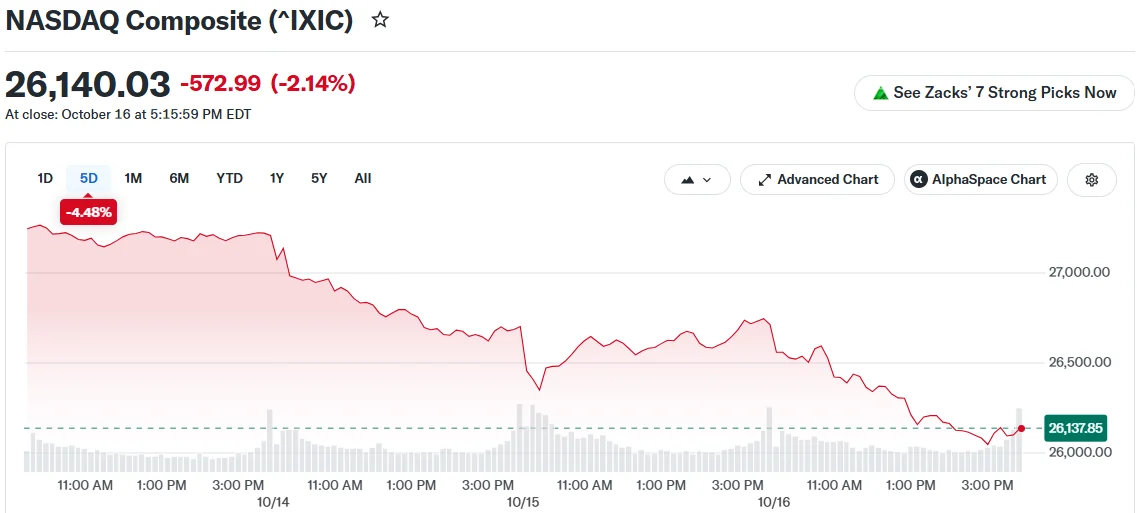
US equities came under sustained selling pressure on Friday as investors moved out of technology and artificial intelligence shares, while rising oil prices added a further layer of strain to an already difficult session.
The Nasdaq Composite lost 2.14% to close at 26,140.03, capping its worst week since June and ending a four-week winning streak for the index. The S&P 500 fell 1.09% to 7,659.44, and the Dow Jones Industrial Average dropped 175.28 points, or 0.34%, to 52,002.41. Both the S&P 500 and the Nasdaq finished the session below their 50-day moving averages, a threshold many traders use as a quick read on whether a market's medium-term trend is still intact. The Cboe Volatility Index, a widely followed measure of expected market turbulence, rose above 22 for the first time in four months.
Chip Stocks Lead the Decline
Chipmakers were again among the hardest-hit names. The VanEck Semiconductor ETF lost 3% on Friday, led lower by Micron Technology, Advanced Micro Devices and Sandisk. The fund dropped 10% for the week, its biggest weekly decline since April 2025, as investors have worried about competition from China. Semiconductors are a core input to AI infrastructure, which has made the group a common proxy for sentiment on the wider AI trade.
Market commentary outlet The Kobeissi Letter flagged the scale of the pullback in a post on X:
There it is folks. The Nasdaq 100 is now down -3% on the day and on track for its biggest weekly decline since April 2025. US tech stocks have erased over -$3 trillion in market cap in just 10 days. This puts the Nasdaq 100 just ~2.5% away from entering a technical correction.… pic.twitter.com/Llhtk5QUoj
Per the figures cited in the post, the Nasdaq 100 was tracking its steepest weekly drop since April 2025, with US technology stocks shedding more than $3 trillion in market capitalization over 10 sessions and sitting roughly 2.5% away from a technical correction. A technical correction is conventionally defined as a decline of 10% or more from a recent peak, a threshold that typically draws heightened attention from market watchers.
CoreWeave, an AI-focused cloud infrastructure provider, fell nearly 12% on Friday and is down 25% for the week. The company's total debt has risen to more than $51 billion. Losses extended across the technology sector, with CrowdStrike dropping 7% and Oracle falling 4.5%. Investors are also asking questions about the business models of Anthropic and OpenAI.
Nick Colas of DataTrek Research said investors are “burnt out on AI,” adding that the catalyst is interest rates. Michael Rosen, chief investment officer at Angeles, said rising debt issuance is worth watching, though he noted that the market is not close to excessive levels right now. The rate sensitivity Colas points to helps explain why the selling has centered on AI and technology shares: their valuations lean heavily on projected future profits, so expectations for the path of interest rates feed directly into how they are priced.
The declines were not universal. In the S&P 500, 21 stocks rose on Friday, and the Dow managed a weekly gain of 0.7% — a divergence showing the week's damage was concentrated in technology rather than spread evenly across the market.
Oil and Inflation Add Pressure
Oil prices climbed as tensions grew between the United States and Iran, and between Russia and Ukraine. West Texas Intermediate crude rose 3.51% to $101.41 per barrel, holding above the $100 level, while Brent crude gained 3.72% to $109.86. Energy stocks such as Chevron rose and helped limit the Dow's losses. Oil's climb cuts both ways for equity investors: it supports energy-sector earnings, but it also feeds the broader price pressures that have kept inflation elevated.
Inflation data has also been a source of concern for investors. Wholesale inflation posted its biggest gain since 2022 this week, and consumer inflation remains well above the Federal Reserve's 2% target.
Fed Chairman Kevin Warsh spoke at an International Monetary Fund event in Bangkok overnight but did not say whether the Fed would raise rates before the end of the year. Traders took that as a sign the central bank will hold policy steady. The CME Group's FedWatch tool shows an 82% chance the Fed keeps rates unchanged at its Oct. 27-28 meeting. Between the Fed's decision, oil's path around the US-Iran and Russia-Ukraine tensions, and upcoming inflation readings, investors have a clear near-term checklist as they digest the week's losses.

