Antarctica's Mt. Erebus Volcano Ejects Microscopic Gold Particles Daily
Key Takeaways
- •Mount Erebus, located on Ross Island roughly 840 miles from the South Pole, is the only known volcano that ejects high volumes of crystalline gold into the air.
- •Researchers estimated in 1991 that the volcano releases approximately 80 grams of microscopic gold dust per day, equaling about 900 ounces annually with an estimated value of $3.6 million at current gold prices.
- •The gold particles display intricate faceted geometric crystal structures visible under electron microscopes, with some measuring up to 60 micrometers across.
- •Wind currents disperse the microscopic gold particles up to 1,000 kilometers from the volcano before they settle, making collection impractical.
- •Scientists have proposed two competing theories for crystal formation—crystallization from cooling chlorine and sulfur compounds or deposition as a crust on the lava lake surface—and decades of monitoring data may eventually help resolve the question.
Antarctica's Mt. Erebus Volcano Ejects Microscopic Gold Particles Daily
Antarctica's Mount Erebus, one of the world's southernmost active volcanoes, has been emitting microscopic particles of crystalline gold for decades, according to researchers. The phenomenon, while not entirely unique in volcanic systems, is notable for both the volume and the distinctive crystal structure of the gold particles produced.
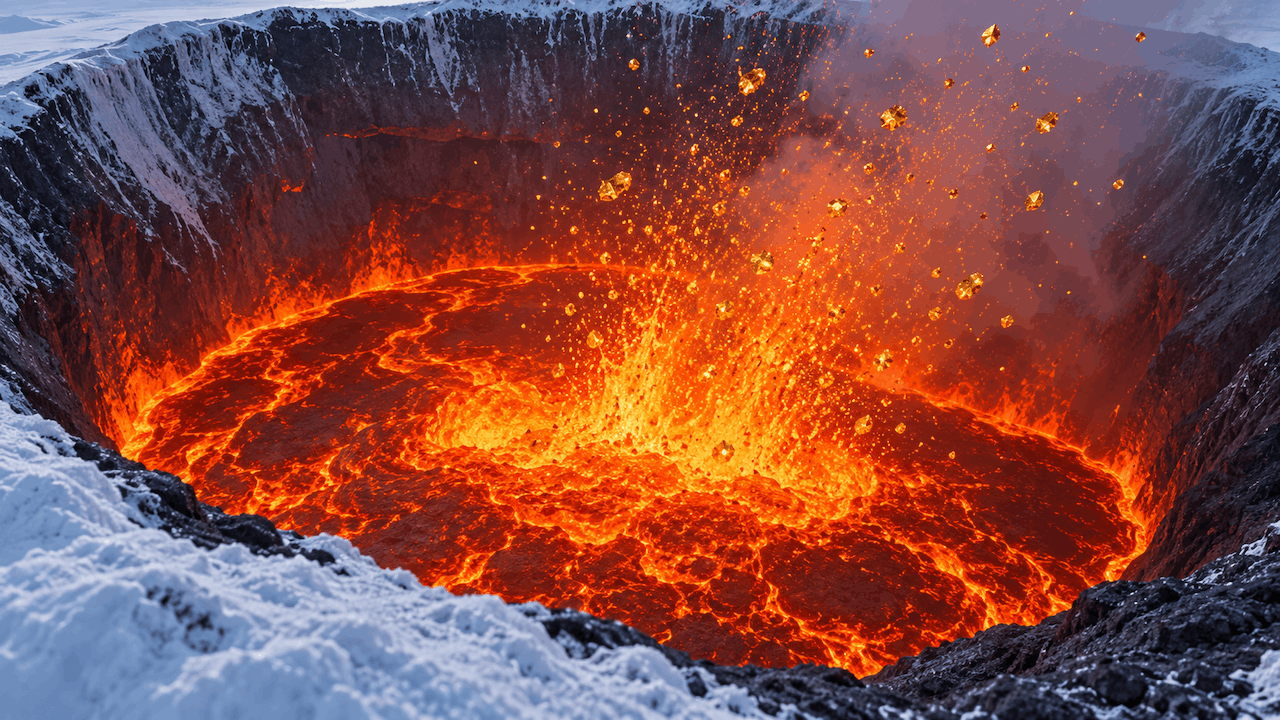
Mount Erebus is located on Ross Island, situated in the Ross Sea—a deep bay approximately 840 miles from the South Pole. The volcano is characterized not by violent eruptions but by a persistent, bubbling lava lake that continuously releases gases. Embedded within those gases are fine particles of gold. Only a handful of volcanoes worldwide maintain long-lived lava lakes, making Erebus a comparatively accessible natural laboratory for studying how deep-Earth materials reach the surface.
In 1991, researchers estimated that Mt. Erebus releases approximately 80 grams—roughly 2.5 troy ounces—of microscopic gold dust into the atmosphere every day. That amounts to about 900 ounces per year, valued at approximately $3.6 million at current gold prices. Collecting the gold, however, is impractical. The particles are microscopic, and wind currents disperse them up to 1,000 kilometers from the volcano before they settle to the ground.
Gold traces in volcanic emissions are not unprecedented. Scientists have detected gold around volcanoes in Hawaii, for example. However, Mt. Erebus is the only known volcano to eject high volumes of crystalline gold into the air.
As a Yahoo News article explained: "A volcano is basically a hole in Earth's crust, through which molten material from deep below the ground seethes upward."
Thousands of miles of nearly impenetrable rock—known as the mantle—lie between the Earth's core and its surface. The mantle extends from roughly 22 miles beneath the crust down to the core, with the boundary between the planet's center and the mantle situated approximately 1,800 miles deep.
Scientists estimate that the Earth's molten outer core contains roughly 99.9 percent of the planet's gold and other precious metals. According to those estimates, as much as 1.6 quadrillion tonnes of gold may be locked within the Earth's center—enough to coat the entire surface of the planet with a 20-inch-thick layer of the metal. While mining the core is impossible, natural geological processes occasionally transport small quantities of gold toward the surface.
Despite the extreme heat of lava, it cannot vaporize gold. The boiling point of pure gold exceeds volcanic temperatures, meaning that gold emerging from the Earth is generally in a liquid state. Researchers believe gold is transported to the surface via volatile chlorine- or sulfur-bearing compounds present in hot volcanic gases.
The crystalline structure of the gold emitted by Mt. Erebus is distinctive. According to Yahoo News: "Under an electron microscope, the particles appeared as intricate, faceted, almost perfectly geometric crystals rather than irregular specks, some measuring up to about 60 micrometers across."
One theory suggests that, given the specific environmental conditions around Mt. Erebus, gold crystallizes from chlorine and sulfur compounds as the gases cool. However, these compounds typically contain only trace amounts of gold, and it remains unclear how such large crystals could form.
An alternative theory proposes that gold gradually deposits as a crust on the surface of the lava lake before being lofted into the air by rising gases. Because Erebus has been continuously active and studied for decades—monitored by the Mount Erebus Volcano Observatory and teams working from nearby McMurdo Station—researchers have a long-running dataset that could eventually help distinguish between these competing mechanisms.
As Yahoo News described: "Something about Mount Erebus – whether it's the chemistry, the ambient temperature, the geology, or something else – appears to give it a unique ability to sprinkle the snow with gold dust like a mischievous pixie."

