Driver Shortages and Booming Exports Reshape the U.S.-Mexico Freight Market
Key Takeaways
- •Mexican exports increased 34.4% in June and posted their fifth consecutive month of double-digit growth.
- •The United States took about 84% of Mexico’s non-oil exports in the first half of 2026.
- •Stricter B-1 visa enforcement and English-language requirements are reducing the pool of drivers available for cross-border freight runs.
- •Mexico’s automotive output softened in the first half of 2026, while computing equipment became its largest export category to the United States.
- •Congestion at the Port of Manzanillo is causing truck queues and unpredictable drayage times, prompting shippers to consider extra buffer time or alternate gateways.
Mexico's export sector is accelerating even as tariffs, immigration enforcement and shifting automotive production continue to create uncertainty, according to a cross-border freight market report from logistics provider C.H. Robinson.
The report found that Mexican exports rose 34.4% year over year in June, marking the fifth consecutive month of double-digit growth and lifting first-half export growth to 24.6%. Manufacturing exports climbed 35.3% in June, led by electrical and electronic equipment as well as food and beverage shipments.
C.H. Robinson (Nasdaq: CHRW) is a global third-party logistics company providing freight transportation and supply chain management services.
The United States continues to dominate Mexico's export market, absorbing roughly 84% of the country's non-oil exports during the first six months of 2026. Non-oil exports to the U.S. increased 35.8% in June, compared with 25% growth for exports to the rest of the world.
For carriers operating between the two countries, the export surge is sustaining demand for northbound freight capacity.
"Northbound lanes out of the Coahuila and Nuevo León corridors continue to present higher load-to-truck ratios compared to southbound, keeping carriers selective and holding rates firm," C.H. Robinson analysts wrote.
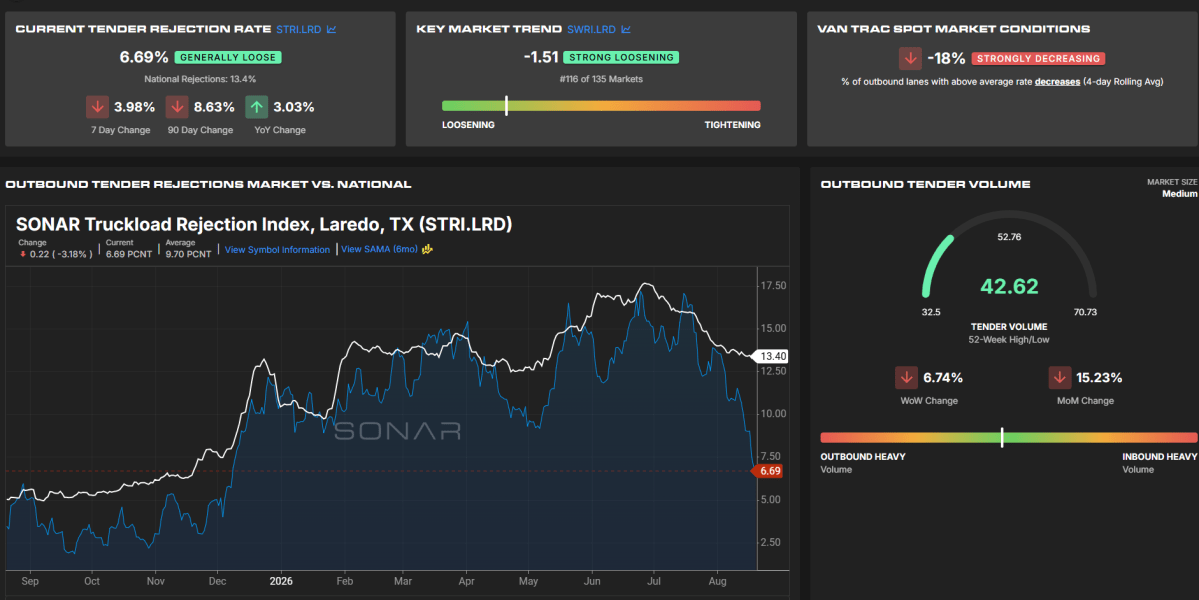
Although northbound demand remains strong, volumes at Laredo, Texas — the top international truck gateway, which in recent years has ranked among the busiest U.S. customs districts by two-way trade value — cooled in August, falling 6.7% week over week. Laredo's truckload rejection index (STRI.LRD), which measures how often carriers turn down tendered loads, has also declined to 6.69%, indicating that capacity has loosened over the past seven days, according to SONAR data.
Driver Shortages and Visa Enforcement Constrain Capacity
While freight demand remains strong, capacity is being constrained by a shrinking pool of drivers qualified to operate cross-border routes, C.H. Robinson reported.
Stricter enforcement of B-1 visas and English-language requirements is reducing the number of Mexican drivers willing or able to make cross-border runs into the United States. The tightened scrutiny follows 2025 U.S. actions that suspended new B-1 visa issuance for Mexican truck drivers and stepped up English-proficiency checks at ports of entry under a presidential directive on commercial driver standards. Increased scrutiny of shipping documentation, cargo values, weight declarations and cargo securement is also slowing operations and making carriers more selective about the freight they accept.
With roughly 81% of Mexico's land freight moving by truck, these constraints are having an outsized impact on cross-border supply chains, the company said.
"Carriers are willing to offer attractive rates and allocate capacity to shippers who make operations and compliance easy, rather than just going with the highest bidder," the report stated.
Automotive Softens While Technology Freight Grows
The automotive sector, long viewed as the backbone of U.S.-Mexico freight flows, is showing signs of moderation. Light-vehicle production in Mexico was essentially flat during the first half of 2026, declining 0.4%, while exports rose just 1.4%. Heavy-duty truck production and exports both fell by double digits.
C.H. Robinson noted that some manufacturers are adjusting production strategies amid tariff uncertainty, citing Toyota's plan to shift Tacoma pickup production from Tijuana, Mexico, to San Antonio, Texas, once its expansion project is completed. The scheduled 2026 joint review of the U.S.-Mexico-Canada Agreement adds another layer of trade-policy deliberation for manufacturers weighing production footprints on both sides of the border.
At the same time, technology-related freight is emerging as a major growth driver. Mexico remains the top U.S. trading partner, accounting for nearly 17% of U.S. imports, and has been the largest source of U.S. goods imports since overtaking China in 2023 amid the broader nearshoring of manufacturing closer to U.S. customers. Computing equipment has now surpassed automotive products as Mexico's largest export category to the United States, a milestone that tracks the rapid expansion of Mexico's electronics manufacturing sector.
Intermediate Imports Signal Continued Freight Growth
Another indicator pointing toward sustained freight demand is Mexico's rising imports of intermediate goods used in manufacturing. Imports of intermediate goods increased 30.9% year over year in June and now account for roughly 80% of the country's total imports. Because those materials are used to manufacture future exports, C.H. Robinson said the trend suggests export growth could continue through the remainder of 2026.
Congestion Persists at the Port of Manzanillo
The report also highlighted growing congestion at Mexico's Port of Manzanillo, a Pacific Coast port and the country's busiest container gateway. Road construction on the Colima-Manzanillo highway, combined with capacity constraints inside the port, is creating long truck queues and unpredictable drayage transit times, C.H. Robinson said.
Container volumes through Mexican ports increased 3.1% during the first half of the year, with Manzanillo handling 43% of the country's total container traffic. C.H. Robinson advised shippers to build additional buffer time into supply chains or consider alternative gateways such as Lázaro Cárdenas, Mexico's second-largest container port.
According to the report, strong export growth and rising technology shipments are keeping U.S.-Mexico freight demand elevated, while tightening driver availability, stricter border enforcement and infrastructure bottlenecks continue to limit capacity and support higher transportation rates.
