MEXC Fees Explained: How the Exchange's Fee Structure Works and Ways to Reduce Costs in 2026
Key Takeaways
- •MEXC charges 0% maker and 0.05% taker on spot trades, and 0% maker and 0.02% taker on futures for standard accounts.
- •Traders can reduce fees by signing up with the referral code "mexc-bestbonus", using post-only limit orders, enabling MX token deduction for a 20% discount, and trading zero-fee promotional pairs.
- •Cryptocurrency deposits and internal transfers between MEXC users are free, while withdrawals carry fixed fees that vary by coin and network.
- •MEXC's former 50% MX Holder Discount has been suspended, but the 20% MX deduction discount remains available.
- •MEXC's standard non-VIP rates are lower than Binance, Bitget, and Bybit in most spot and futures comparisons.
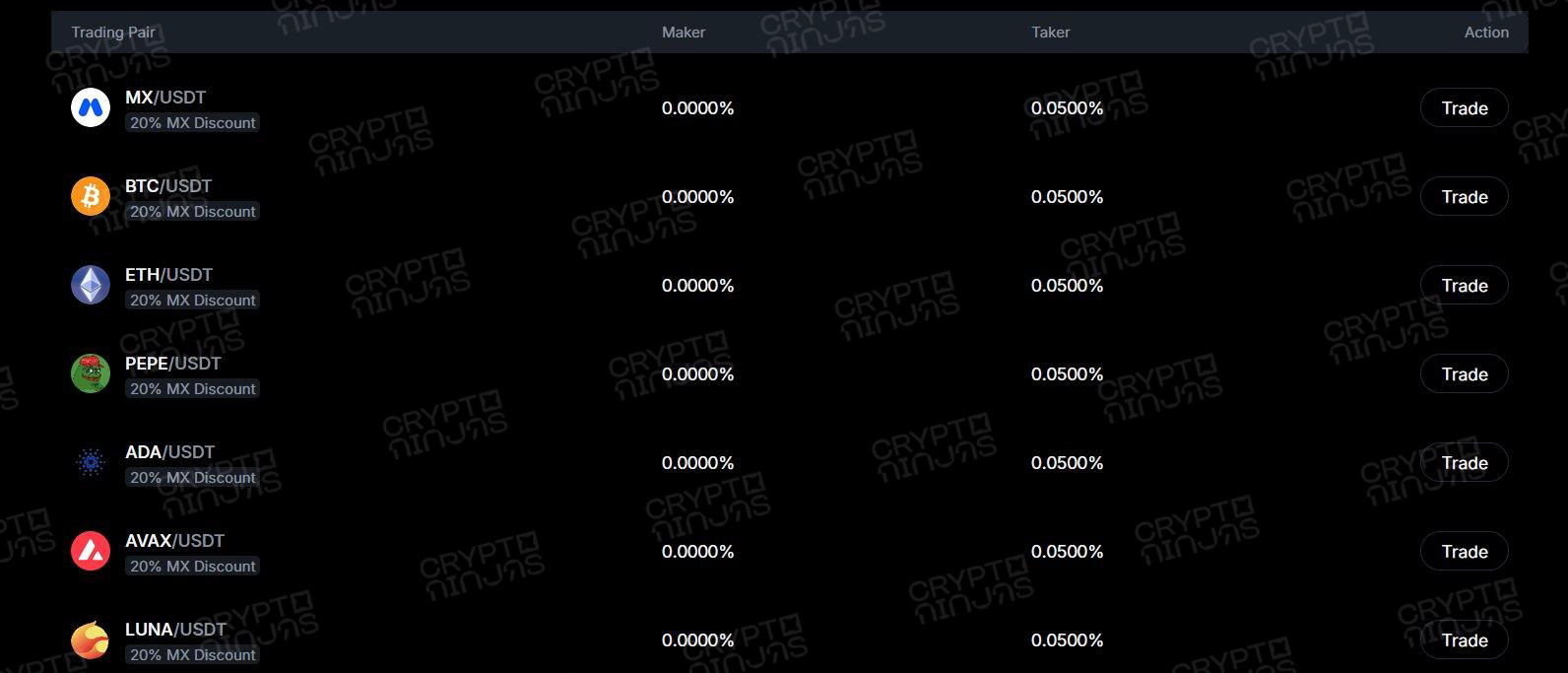
MEXC fees start at 0% maker and 0.05% taker on spot trades, and 0% maker and 0.02% taker on futures, although the actual rate a user pays can vary by location, account tier, and active promotions. For anyone trading crypto on MEXC or considering the exchange, these costs directly affect every order, so understanding where fees apply and how to reduce them can make a noticeable difference to results — and because fees compound with every fill, frequent traders and high-frequency futures strategies are the most sensitive to even small percentage differences. Trading fees on MEXC can be lowered by using the referral code "mexc-bestbonus" during sign-up, placing maker orders, or turning on the MX deduction feature.
This guide covers how MEXC fees work across spot and futures trading, deposits, withdrawals, and listing costs. It also explains how maker and taker orders change what traders pay, where zero-fee promotions and discounts apply, and how MEXC compares with Binance, Bitget, and Bybit using standard non-VIP rates.
What Are MEXC's Fees?
MEXC fees are the direct charges paid to the exchange whenever a user trades, withdraws funds, or uses special features on the platform. Currently, MEXC's fees cover five main areas: spot trading, futures trading, deposits and withdrawals, token listings, and newer products like RealStocks and tokenized stocks.
Overview of MEXC's Fees
MEXC's overall fee schedule is a straightforward structure with low fees, covering every category at a glance. Note that these numbers can vary somewhat depending on account tier, region, and whatever promotion MEXC is running in a given month.
Spot Trading Fees
Spot trading on MEXC comes with a permanent 0% maker fee and a taker fee of 0.05% for the standard account tier. That taker rate is half of what Binance and Bitget charge on their base plans, so spot traders save money from their first trade. Aggressive zero-fee maker pricing has become a common competitive tool among newer exchanges seeking market share from established venues, and MEXC's schedule is one of the more visible examples of that trend. There is also an MX Deduction feature that provides a flat 20% discount when fees are paid directly in MX.
Tip: A maker order rests on the order book and waits to be filled, while taker orders or market orders execute immediately against someone else's order.
Example: A $100,000 market order counts as a taker order, so it costs $50 in trading fees. The same order placed as a limit order that waits in the book instead of executing instantly as a market order costs nothing at all.
MEXC Futures Trading Fees
MEXC futures fees are 0% for makers and 0.02% for takers on standard USDT-margined perpetual contracts. That taker rate runs well below the industry average, which usually lands somewhere around 0.05% to 0.06% on other major exchanges. As with the spot market, a 20% discount is also available with the MX token.
Some users may see a different number based on their account tier and region. MEXC has applied rates of 0.01% maker and 0.04% taker to selected users and regions, and active traders can join the VVIP program for reduced fees.
MEXC charges separate, somewhat higher fees for futures API trading. API trading on MEXC futures currently costs a 0.04% maker and 0.06% taker fee.
A funding fee is also paid every 8 hours while trading futures contracts. The funding rate is a periodic payment exchanged directly between long and short traders in perpetual futures markets to keep contract prices aligned with spot prices, so MEXC futures costs can also include this item on perpetual contracts. In short, funding is the market paying itself, not a fee MEXC keeps. These rates are generally between 0.01% and 0.03%, subject to change. Leverage, margin, and position size directly affect futures trading risks and overall profit potential.
MEXC Deposit Fees
MEXC charges zero deposit fees for all cryptocurrencies deposited into an account. Users can transfer USDT, Bitcoin, Ethereum, or any other supported token into MEXC without paying any platform surcharge. Generally, the only cost is the standard network fee charged by the external sending wallet or the sending exchange.
For fiat deposits, bank transfers, cards, Apple Pay, Google Pay, e-wallets, and outside payment firms may show a provider charge, but MEXC itself does not charge any fees.
Bank Transfers (e.g., SEPA): MEXC charges 0% platform fees for direct regional bank transfers, but a personal bank may charge standard cross-border or wire fees.
Credit and Debit Cards / Instant Buy: MEXC applies 0% service fees for card purchases, but third-party processing gateways (like MoonPay, Banxa, or Mercuryo) or card issuers can add processing or foreign exchange charges ranging from 2% to 4%; these are external charges, not part of MEXC's own fee structure.
P2P Trading: Peer-to-peer fiat transactions via supported local payment methods carry 0 fees charged by MEXC.
This is platform cost information only, not financial or investment advice.
MEXC Withdrawal Fees
MEXC charges a fixed withdrawal fee based on the coin and blockchain network selected. Withdrawal fees vary by coin and selected blockchain network, and MEXC shows the exact fee and the amount the user will receive before the transfer is confirmed.
Withdrawal fees by coin and network are subject to change. Internal transfers to another MEXC user's address are completely free and normally arrive faster because they do not require an on-chain transfer.
MEXC's 24-hour withdrawal limits are 10 BTC with no KYC, 80 BTC with Primary KYC, 200 BTC with Advanced KYC, and 400 BTC for an institutional account. These are mostly maximum account limits, not a guarantee that every user can withdraw that amount at any time.
Some countries have a much lower limit for unverified accounts (up to $1,000 per day), and some regions have mandatory KYC. Users must verify their limits under their account settings.
MEXC RealStocks Trading Fees
MEXC currently charges 0% commission on RealStocks trading as part of an ongoing promotion with no announced end date. RealStocks lets users buy actual shares of more than 7,000 US-listed stocks and ETFs using USDT. MEXC also offers Stock Futures and separate tokenized stock products, both of which have carried zero trading fees during recent promotional events as well.
MEXC Listing Fee
MEXC does not publish a fixed fee for listing a new crypto token. Its public listing form asks a project to submit its team, token, funding, market, and security details for review, but it does not show a standard price that every project can pay.
The listing fee is not a cost for a normal trader buying a listed coin; it concerns the token team that wants MEXC to add its asset.
How Do Maker and Taker Orders Affect Trading Rates?
Maker and taker orders determine whether a trader pays a 0% fee or a standard rate, because of how they provide or remove liquidity from the order book.
A maker order adds liquidity to the exchange's order book. It is created by placing a limit order at a price that does not fill right away, such as a buy order below the current market price. MEXC rewards maker orders with a 0% maker fee because they help the market grow deeper.
A taker order removes liquidity instantly, and taker fees apply when a marketable order removes liquidity immediately. A trader becomes a taker when using a market order or a limit order that matches an existing listing immediately. Traders use market orders when they want to buy or sell right away at the best available price. MEXC charges a small taker fee (0.05% spot, 0.02% futures) to process that instant trade.
How to Reduce MEXC Fees
MEXC fees can be reduced through several options for lowering overall trading costs: registering with the MEXC referral code "mexc-bestbonus", using limit orders (maker orders), holding MX tokens for automatic fee deductions, and trading zero-fee promotion pairs.
Using the MEXC Referral Code
The MEXC referral code "mexc-bestbonus" provides a 10% discount on eligible trading fees for a qualifying new account. The code must be entered in the referral field during sign-up, and users should confirm that the rate appears in their account. The discount only applies where MEXC charges a fee, so a 0% maker order stays at 0%.
Use Limit Orders (Maker Orders)
"Post-Only" limit orders can cut the normal MEXC maker fee to 0% and prevent the order from becoming a taker. The trader must choose a price that does not fill at once: enable the "Post-Only" order type and let the order sit in the book until another trader matches it.
The catch is that a limit order might not fill if the market moves away from the chosen price before someone matches it. For anyone not in a rush, however, this single habit is probably the easiest way to trade for free on MEXC.
Hold MX Tokens
Users can buy MX tokens directly in the spot market and turn on the "Deduct using MX" toggle in account settings. The platform then automatically deducts trading fees from the MX balance at a 20% reduced rate. For futures discounts, MX may also need to be moved into the futures wallet, with fee deduction enabled separately for that account.
Note: MEXC temporarily suspended the old MX Holder Discount (the 50% trading fee reduction for holding 500 MX or more). That discount is no longer available, but the 20% trading fee discount still applies when paying fees via MX deduction. The suspension is a useful reminder that exchange fee perks — including native-token discounts and promotional zero-fee windows — can change with little notice, so it is worth re-checking the current fee page before relying on any discount over the long term.
Trade Zero-Fee Promotion Pairs
Trading on MEXC's eligible promotion pairs can mean zero-fee trading with 0% on both maker and taker orders for that specific coin, with no MX or referral code needed.
MEXC rotates these promotions across popular pairs like BTC, ETH, XRP, and DOGE. A campaign may apply to a specific trading pair or selected futures pairs; in some cases, it offers zero fees on one side or both sides. The RealStocks and Stock Futures products have carried similar zero-fee windows during recent events as well. Users can check the MEXC announcement page or fee dashboard to see which pairs currently have active 0-fee promotions and confirm whether taker fees or waived pricing applies during the current promotion.
How MEXC Fees Compare to Other Exchanges
MEXC has competitive fees versus Binance, Bitget, and Bybit for standard users, with lower base trading fees in most like-for-like trades. The comparison below uses standard rates and does not count short offers, VIP tiers, referral deals, or native-token discounts.
MEXC vs. Binance Fees
MEXC is considerably cheaper than Binance at the normal entry level for both spot and futures trading. Binance charges a regular user 0.10% for spot maker and taker orders, while MEXC's normal spot rates are 0% maker and 0.05% taker.
Binance's common USD-margined futures rate is 0.02% maker and 0.05% taker for a regular user. MEXC commonly charges 0% and 0.02% on the web and app, although some selected MEXC regions can see 0.01% and 0.04% — still well below Binance's rates.
MEXC vs. Bitget Fees
Bitget also charges 0.10% for both spot makers and takers, while MEXC normally charges 0% and 0.05%. Bitget cuts its spot rate to 0.08% when BGB is used for fees, which still sits above MEXC's normal taker rate.
Bitget's standard futures fees are 0.02% maker and 0.06% taker. MEXC's common web and app rate is 0% maker and 0.02% taker, so traders who use limit orders can save considerably more on MEXC.
MEXC vs. Bybit Fees
MEXC is also cheaper than Bybit for a normal non-VIP spot or futures trader. Bybit charges 0.10% for both spot sides and 0.02% maker plus 0.055% taker for regular perpetual and futures trades. That lower base pricing makes MEXC especially notable among traders comparing futures platforms.
Bybit's MNT payment option can cut standard spot fees by 25% and futures fees by 10%, bringing its non-VIP rates to 0.075% on spot and 0.018% maker plus 0.0495% taker on futures. MEXC still has a lower normal spot taker rate of 0.05% and a lower common futures taker rate of 0.02%, which can mean lower overall costs for many common trading strategies when managing capital across frequent futures trades.
