Meta Plans Free Personal Superintelligence for Everyone Worldwide
Key Takeaways
- •Meta intends to offer personal superintelligence as a free service globally, with a paid tier providing additional computing power for advanced features.
- •Zuckerberg positioned privacy as a core feature of the planned AI agents, stating that user data must remain confidential and never be misused.
- •Meta confirmed plans to release some of its AI models publicly, maintaining that open-source AI is safer and more beneficial than proprietary alternatives.
- •The envisioned AI assistant would provide personalised expertise in areas such as financial planning, health navigation, education, and business strategy.
- •Meta's existing user base of more than three billion across Facebook, Instagram, WhatsApp, and Messenger provides the distribution infrastructure to support this large-scale rollout.
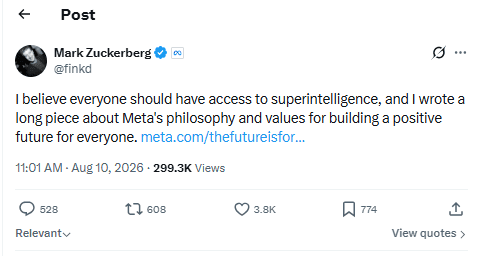
Mark Zuckerberg has outlined what he calls his most ambitious vision for Meta: providing personal superintelligence to people across the globe at no cost. He described the initiative as one of the most significant technological shifts in human history.
In a statement released today, Zuckerberg announced that Meta is developing AI designed to serve as a personal expert for each user. The system aims to assist individuals across multiple domains — including finances, health, career decisions, education, and other areas where high-quality, personalised guidance is often difficult to obtain.
"Throughout history, having access to a brilliant friend who happened to have the knowledge of a doctor, lawyer, financial advisor, or expert in whatever you need has been one of the greatest advantages a person can have," Zuckerberg wrote. He argued that most people lack such access, and that Meta intends to change that reality.
Meta's plan envisions a two-tier service model. A free version of the company's superintelligence tools will be available to everyone, while paying users will be able to purchase additional computing power to unlock more advanced features. Zuckerberg also emphasised the company's goal of building fully private AI agents, stating that personal data shared with these assistants should remain confidential and never be misused. He framed privacy not merely as a response to criticism, but as a core feature essential to making the tools genuinely trustworthy.
Zuckerberg confirmed that Meta plans to release some of its AI models to the public, a decision that sits at the centre of an ongoing industry debate over whether powerful AI models should be open-source or kept proprietary. He has consistently maintained that open-source AI is both safer and more beneficial than AI controlled by a small number of companies, reiterating: "We believe that AI should be widely available and not just in the hands of a few companies or governments."
The announcement is notable for its scope. Zuckerberg is not describing a new application or a chatbot update; rather, he positions AI as essential infrastructure — comparable to electricity or the internet — that should be accessible to everyone regardless of income or geographic location.
He offered concrete examples of what personal superintelligence could look like in practice. The AI would function as an assistant that understands a user's financial situation and can deliver advice comparable to what a human financial planner might charge hundreds of dollars per hour to provide. It would serve as an agent familiar with a user's health history, helping them navigate a medical system that is frequently complex and expensive. It could also support a first-generation entrepreneur in building and operating a business with the kind of strategic guidance typically available only to larger companies through paid consultants.
The ambition, as Zuckerberg frames it, is fundamentally redistributive: advanced AI should not remain the exclusive preserve of those who can afford premium subscriptions or enterprise contracts. That framing also puts Meta in the broader race among major technology companies to define how everyday users will access increasingly capable AI systems, and whether those systems arrive as closed services or as models that developers and researchers can inspect and build on.
Meta's route to realising this vision runs through its existing product ecosystem. With more than three billion people using Facebook, Instagram, WhatsApp, and Messenger each month, the company already possesses the distribution infrastructure to reach a majority of the world's internet-connected population. What Zuckerberg is now describing is the layering of superintelligence on top of that infrastructure — transforming Meta AI from a feature embedded in those apps into a personal agent that operates across every aspect of users' lives. The scale of that rollout also means the company will have to balance convenience, privacy, and reliability at a level far beyond a standalone chatbot.
The central question for Meta's future is whether it can deliver on this vision: achieving technical and financial viability while earning the trust of users who share deeply personal information with its systems.

