The Week Ahead: Inflation Data, Fed Concerns and AI Earnings Could Move Markets
Key Takeaways
- •All three major U.S. stock indexes posted their strongest weekly gains since April, with the Nasdaq rising 5.2%, the S&P 500 adding 3.6%, and the Dow gaining 3%.
- •Economists expect both headline and core July CPI readings to rise 0.2%, though Middle East disruptions to oil shipments risk pushing energy costs higher and complicating the disinflationary trend.
- •The White House indicated it is considering removing Fed Governor Lisa Cook and revealed regular communication between the president and potential Fed Chair candidate Kevin Warsh, raising concerns about central bank independence.
- •AI infrastructure companies reporting this week have shown sharply divergent stock performance, with Nebius Group up 122% year to date while Cerebras Systems has fallen 35% since its IPO.
- •Consumer spending rose 0.2% in June, but the savings rate dropped to a four-year low, a pattern economists monitor for signs of household financial strain.
U.S. markets head into a busy week with inflation data, renewed Federal Reserve independence concerns, and a fresh round of earnings from AI infrastructure companies.
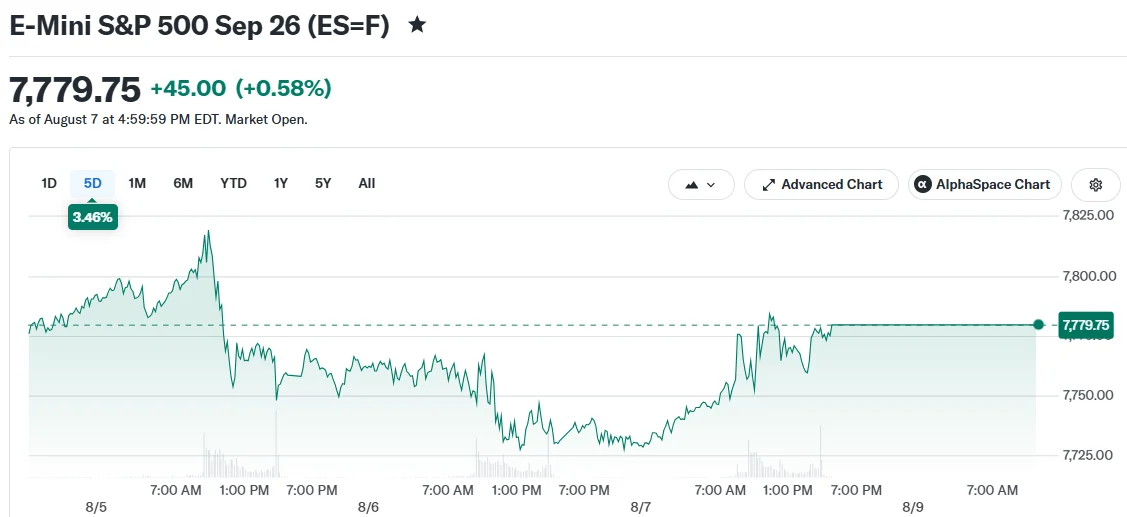
The S&P 500 closed Friday at a record high, rising 0.6% on the day. For the week, the Nasdaq gained 5.2%, the S&P 500 added 3.6%, and the Dow rose 3%. It was the strongest week for all three major indexes since April.
Friday's jobs report was the main catalyst, easing investor concerns about near-term rate hikes from the Federal Reserve. The rally also reflected growing market confidence that inflation is trending back toward the Fed's 2% target, though this week's data will be a critical test of that narrative.
Inflation Data Takes Center Stage
The July Consumer Price Index report is due Wednesday at 8:30 a.m. ET. Economists expect both the headline and core CPI readings to rise 0.2%.
CPI fell in June, but conditions have shifted since then. Fighting in the Middle East has disrupted oil shipments through key shipping lanes, pushing energy prices higher. Energy costs feed into broad inflation measures, and a pickup there could complicate the disinflationary trend that has defined much of the past year.
The Producer Price Index, which measures wholesale inflation, follows on Thursday. PPI declined in June after surging in May. Higher wholesale costs can be an early signal that consumer prices may rise later.
Bank of America economist Stephen Juneau said last month's CPI was likely a "one-off" and that a reading in line with expectations would strengthen the case for a September rate hike. The Fed has held rates steady at its last two meetings, and futures markets have been pricing in the timing of the next move based on incoming data.
The week concludes Friday with retail sales data and the University of Michigan consumer sentiment survey. Consumer spending rose 0.2% in June, although the savings rate fell to a four-year low. A declining savings rate suggests consumers may be leaning on savings or credit to sustain spending, a pattern that economists watch for signs of strain.
Fed Independence Back in Focus
The week ended with two developments that renewed attention on the Federal Reserve's independence.
The White House sent a letter saying the president was "considering" removing Fed Governor Lisa Cook. The move follows a Supreme Court opinion from late June that addressed presidential authority over certain independent agency officials, opening the door to questions about whether similar reasoning could apply to the Fed's governance structure.
White House National Economic Council Director Kevin Hassett also said publicly that potential Fed Chair candidate Kevin Warsh and the president "talk about the economy all the time." Regular communication of that kind between a president and a Fed official is unusual and raises questions about central bank independence. The Fed's operational autonomy from the executive branch has been a cornerstone of U.S. monetary policy since the 1951 Treasury-Fed Accord, designed to keep interest rate decisions insulated from short-term political pressures.
Bond markets will be watching closely. A rise in bond yields last week already reflected what some observers described as a credibility concern at the Fed. Investors typically demand higher yields when they perceive greater uncertainty about a central bank's policy trajectory or willingness to control inflation.
AI Earnings Offer a Reality Check
Three AI infrastructure companies report earnings this week.
Nebius Group is up 122% year to date. CoreWeave has gained 25%. Cerebras Systems has fallen 35% since its IPO.
The mixed performance suggests that enthusiasm for AI spending has not lifted every company equally. Capital expenditure on AI infrastructure from major technology firms has reached unprecedented levels, but the returns and competitive positioning among suppliers remain uneven. This week's earnings reports should provide a clearer picture of which firms are benefiting and which are not.
CoreWeave and Nebius both joined the Nasdaq 100 this summer, and Nvidia has invested in both. Cerebras beat expectations in its first quarterly report as a public company in June.
Super Micro Computer also reports Tuesday after releasing preliminary numbers showing profit margin growth and a record order backlog.
Applied Materials reports Thursday, rounding out a key week for the semiconductor and AI hardware sector. Applied Materials supplies manufacturing equipment used by chipmakers, making its results a broader barometer for industry capacity expansion.
#earnings for the week of August 10, 2026 $NBIS $SMCI $RKLB $CRWV $LITE $AMAT $ASTS $FLY $CSCO $PLUG $QUBT $HIMS $INFQ $COHR $GCTS $CBRS $SE $BRK.B (Saturday) $ARCO $CAVA $BETA $MLCO $CEVA $FIGR $LUNR $GPRO $ENVX $EAT $CAH $FRMI $B $AIT $BGS $TRMB $FNV … pic.twitter.com/GN5RVs0i2o — Earnings Whispers (@eWhispers) August 7, 2026

