Maersk tipped to slip from the liner top three as COSCO and CMA CGM expand
Key Takeaways
- •COSCO added 18 newbuildings totaling about 280,000 teu and raised its orderbook to 1.89 million teu.
- •COSCO’s latest orders bring its containership contracting this year to 48 ships, or about 676,800 teu, worth roughly $8 billion.
- •Maersk’s operated fleet has risen above 4.7 million teu, and the company has said it will ensure it has capacity to grow.
- •Linerlytica expects COSCO to overtake Maersk by 2028, while CMA CGM is closing on second place.
- •The global containership orderbook has reached 14.84 million teu, equal to 43.1% of the existing fleet.
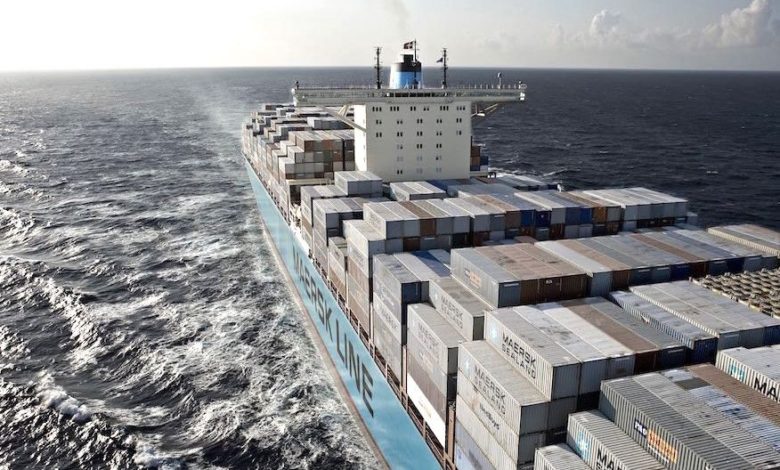
Maersk could fall from first to fourth place in the global liner rankings within six years as CMA CGM and COSCO continue to expand at a pace the Danish carrier has so far been unwilling to match, highlighting how quickly scale can shift in a capital-intensive industry where ordering decisions are made years before ships arrive.
After surrendering the liner crown to Mediterranean Shipping Co (MSC) in early 2022, Maersk is facing increasing pressure from the two carriers directly behind it.
Consultancy Linerlytica expects COSCO to overtake Maersk by 2028, while CMA CGM is already closing rapidly on second place and has a substantially larger orderbook than its Danish rival.
The latest shift came after COSCO added another 18 newbuildings totaling about 280,000 teu, taking its overall orderbook to 1.89 million teu. That equals 52% of its current 3.67 million teu fleet, the highest orderbook-to-fleet ratio among the world’s top 10 carriers.
COSCO said this week that the latest package consists of 12 LNG dual-fuel 22,000 teu ships at Shanghai Waigaoqiao Shipbuilding and six 3,200 teu wide-beam feeders at Huangpu Wenchong, with a combined value of RMB20.27 billion, or $2.99 billion. The orders bring COSCO’s containership contracting this year alone to 48 ships, around 676,800 teu, representing about $8 billion of investment.
MSC, meanwhile, has moved decisively clear at the top. When it overtook Maersk in early 2022, both companies controlled slightly more than 4.2 million teu. MSC has since added several million teu while continuing to operate the industry’s largest newbuilding programme.
Maersk’s response is now beginning to change. As Splash reported last month, the carrier appears to have abandoned one of the defining elements of its strategy this decade: keeping its fleet broadly capped between 4 million and 4.4 million teu.
Its operated fleet has already climbed above 4.7 million teu, and management said alongside second-quarter results that Maersk would “ensure that we have the capacity to grow”. That marks a significant shift for a company that spent much of container shipping’s most profitable period stressing that newbuildings would mainly replace older tonnage, rather than add materially to overall fleet size.
Linerlytica calculates that Maersk’s annualized fleet growth since 2018 has been just 2%, compared with 11.7% among key competitors.
The challenge is that Maersk is now trying to accelerate after the ordering cycle has already moved sharply against buyers.
The global containership orderbook has reached a record 14.84 million teu, equal to 43.1% of the existing fleet, following COSCO’s latest deals. That level of committed capacity matters because it will shape the competitive landscape well beyond the current market cycle, with deliveries scheduled against a backdrop of already heavy ordering across the sector.
Alphaliner analyst Jan Tiedemann told Splash last month that Maersk had been chartering “very aggressively,” which he viewed as evidence that the group mistimed the newbuilding market.
“I would say that Maersk has got its timing wrong,” Tiedemann said. “They have ordered large newbuildings too late and too few, and they need one or two dozens more.”
Others are more cautious about following rivals into an already swollen orderbook.
Drewry managing director Philip Damas argued that Maersk’s earlier restraint leaves it less exposed to the overcapacity expected from late 2027 onward, and suggested the carrier could instead buy vessels cheaply during the next downturn.
Andy Lane of CTI Consultancy also warned that about another 25% of today’s global fleet is due to enter service during 2027-28, potentially at a time when a number of current disruptive factors — notably the Red Sea shipping crisis — ease up.
