Commerce Secretary Howard Lutnick Faces Escalating Bipartisan Scrutiny Over Nvidia Chip Flows to China
Key Takeaways
- •Nvidia CEO Jensen Huang resigned on Thursday following reports of affairs with a direct report and with Alice Huang, whom U.S. officials assessed was recruited by China's Ministry of State Security to gather intelligence on him and American AI chips.
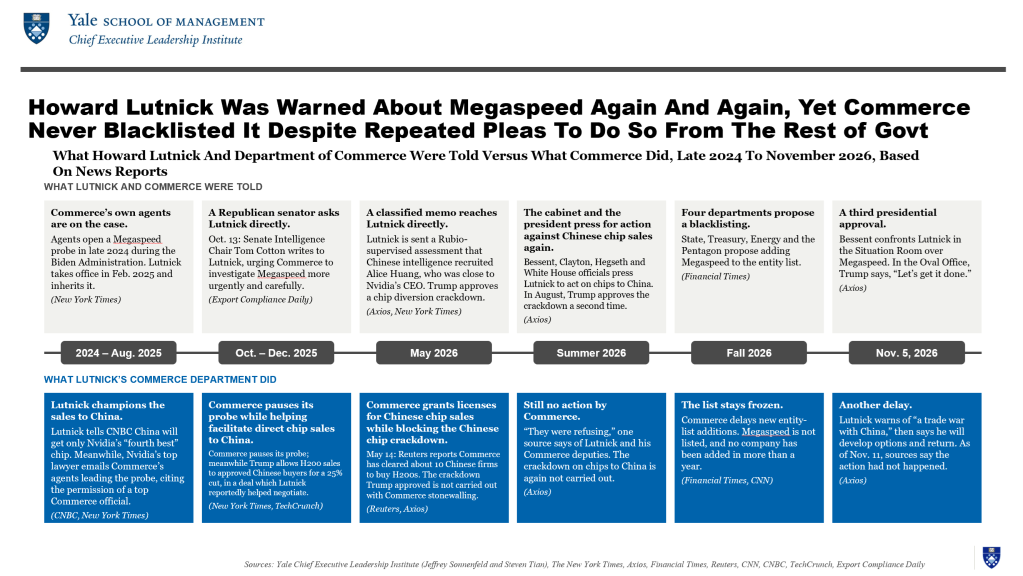
- •The Commerce Department paused its 2024 investigation into Megaspeed, a Singapore-based Nvidia customer suspected of diverting advanced chips to China, after Nvidia's general counsel contacted the agents with permission from Lutnick's export-control chief, Jeffrey Kessler.
- •Despite repeated proposals from the State, Treasury, and Energy Departments and the Pentagon, Lutnick's Commerce Department refused for more than a year to add any company, including Megaspeed, to the entity list.
- •President Trump approved crackdowns on chip diversion to China three times, in May, August, and on Nov. 5, and Axios reported that Lutnick and his deputies resisted implementing each order while other Cabinet officials supported them.
- •Democrats will hold committee gavels starting in January and are preparing to demand records from Lutnick, including scrutiny of perceived conflicts of interest tied to Cantor Fitzgerald, the USA Rare Earth deal, and Tether.
When weighing the motives of public officials, the Roman orator Cicero was said to rely on a pointed shorthand: “cui bono?” — whose interests come first? That ancient question frames the predicament now confronting Commerce Secretary Howard Lutnick, who faces rapidly escalating bipartisan scrutiny over his role in the flow of Nvidia chips into China.
The pressure intensified after Nvidia founder and CEO Jensen Huang resigned on Thursday following reports of affairs with a direct report and with Alice Huang, a suspected Chinese spy. Yet the national security questions Huang left behind keep growing amid escalating congressional investigations. Megaspeed, the Nvidia customer where Alice Huang served as an executive, had been suspected of funneling advanced chips to China for years, yet the U.S. government took little action. Many are now asking: who knew what, and when? And why is this surfacing only now?
Fortune has previously described Nvidia directors' exposure to shareholder lawsuits over their own failures of oversight. Now the scrutiny is shifting to Washington — to the question of how the U.S. government looked past so grave a threat to national security for so long and let these sales go on. As the reporting accumulates, multiple accounts point to one person who blocked action over the objections of fellow Cabinet members and leading voices in both parties in Congress: Commerce Secretary Howard Lutnick. He is now squarely on the hot seat, and it grows hotter by the day as more information comes to light.
Untangling the Truth of a Muddled Timeline
Megaspeed has long been a major target of U.S. government focus amid pervasive allegations that the Singapore-based data center company helped Chinese firms evade U.S. export controls on sensitive Nvidia chips.
Those controls are the backbone of a policy sustained across administrations of both parties: keeping Nvidia's most advanced AI processors out of Chinese hands on national-security grounds. Rules of this kind matter only as much as their enforcement, which is why decisions made — or deferred — inside Commerce's export-control apparatus sit at the center of the current controversy.
The Department of Commerce's own agents began investigating Megaspeed in 2024, under the Biden administration. The Singapore firm had bought billions of dollars of Nvidia chips and was suspected of diverting them to China. After the change of administration, and with the probe still ongoing, The New York Times reported that in 2025 Nvidia's general counsel emailed those agents directly, citing permission from Lutnick's export-control chief, Jeffrey Kessler. Commerce soon paused its work on the investigation.
That sparked concern even within the GOP. Senate Intelligence Committee Chair Tom Cotton wrote to Lutnick directly, urging Commerce to investigate Megaspeed more carefully. Still, Megaspeed never landed on the entity list, the blacklist kept by the Department of Commerce that cuts suspect firms off from American technology — even though other agencies repeatedly agreed on proposing to add the company to the list. The Financial Times reported that the State Department, Treasury Department, Energy Department and the Pentagon were pushing particularly aggressively for that step. Despite these entreaties, Lutnick's Commerce Department was unmoved, steadfastly refusing to add a single company to the entity list for more than a year.
Then came the memo. The New York Times reports that this spring, Secretary of State Marco Rubio oversaw the drafting of a highly classified assessment built on electronic surveillance of Alice Huang. Its conclusion was as stark as can be: China's Ministry of State Security had recruited her to gather intelligence on Jensen Huang and on America's AI chips, and she had grown close to the Nvidia CEO. U.S. officials assessed that Beijing's aims may have gone further — to steering Nvidia into pressing Washington for greater Chinese access to its most advanced chips.
The memo went to a handful of senior officials before President Trump's May trip to China, and Axios reported that Lutnick was among those who received it directly. Perhaps not coincidentally, Jensen Huang was originally left off the delegation of business leaders traveling to China with Trump, before being added at the very last possible minute during an Alaska refueling stop.
That same month, Reuters reported that Commerce had cleared about 10 Chinese companies to buy H200s. The H200 is among the most powerful data-center GPUs Nvidia sells — precisely the tier of hardware the export-control regime was designed to gate, which is why approvals of that kind draw such intense scrutiny from national-security officials.
Perhaps even more alarming, but less widely known than the existence of the memo, Axios also reported that President Trump approved a crackdown on chip diversion to China no fewer than three times — in May, in August, and on Nov. 5 — with even Elon Musk supportive, and that Lutnick and his deputies had resisted carrying out each order. As Maria Curi and Marc Caputo of Axios reported pithily, “One administration official has repeatedly stood in the way: Commerce Secretary Howard Lutnick,” noting that virtually every other administration official was supportive of these crackdowns.
Just last week, after news of the Jensen Huang spy scandal broke, Axios reported that Bessent confronted Lutnick about why his department has resisted implementing the export controls, particularly on Megaspeed, the company at the center of the spy scandal. Virtually all other administration officials sided with Bessent, yet Lutnick apparently continued to stall.
Going forward, the near-term markers are concrete: whether Commerce finally places Megaspeed on the entity list, and whether the Nov. 5 directive — the third such order — is implemented rather than resisted. Those two developments are the clearest observable tests of whether the department's stance has shifted.
Already, there has been speculation that the leaks over the last week that felled Huang came from sources within the Trump administration — perhaps from within the National Security Council — who were frustrated at Lutnick pushing what they perceived to be pro-China policies. Many have remarked on the suspicious timing of the leaks, which came right after the midterm elections, even though the original memo was circulated in May of this year, six months ago.
Lutnick Loses Cabinet Confidence and GOP Trust
What makes this scrutiny so hot is who is turning up the temperature. Lutnick's chief antagonists on the issue of China chip controls are almost entirely his own colleagues within the administration, ranging from Treasury Secretary Scott Bessent, Defense Secretary Pete Hegseth, U.S. Trade Representative Jamieson Greer and National Security Adviser and Secretary of State Marco Rubio, to U.S. Director of National Intelligence Jay Clayton — all of whom reportedly favor a far tougher approach than Lutnick has been willing to impose.
Lutnick's Republican detractors are plentiful outside the administration as well, particularly within GOP congressional ranks. Republican Sen. John Kennedy says Lutnick must explain himself “in front of God and country.” Rep. Bill Huizenga has attacked Lutnick's lack of responsiveness to Congress as “frustrating,” and the Republican chairs of the House China and Foreign Affairs committees, Rep. John Moolenaar and Rep. Brian Mast, have made their unhappiness with Lutnick just as vivid.
All these intraparty critics join legions of Democratic senators who are demanding records from Lutnick. And after last week's midterms, their party takes the committee gavels in January, with detractors making clear that Lutnick is one of their top targets — for reasons extending far beyond merely his role in sensitive U.S. technology making its way to China.
The Conflicts That Continue at Commerce Under Lutnick
Many congressional Democrats are eager at the prospect of issuing subpoenas to examine Lutnick's perceived business conflicts of interest, and their files are already thick with hard questions he will have to answer.
Start with rare earths as one prominent example. In January, Commerce announced a tentative $1.6 billion deal that gives the government a roughly 10% stake in USA Rare Earth. To close it, the company raised $1.5 billion in a private stock offering and chose as its lead placement agent Cantor Fitzgerald — the firm Lutnick led for decades, and which his son Brandon Lutnick, 27 when he took over, now oversees as chairman. By the lawmakers' account, the company's CEO credited Lutnick's personal involvement for the deal. Sens. Elizabeth Warren, Ron Wyden and Chris Van Hollen have pressed for documents since February.
Crypto brings another tangle of problems for Lutnick. Cantor has been custodian of the reserves of Tether, the largest stablecoin issuer, since 2021, and holds a stake that Sen. Richard Blumenthal says has swelled from about $600 million to an estimated $10 billion since Trump returned to office. A trust for Lutnick's children reportedly borrowed from Tether around the time he transferred his Cantor stake to them. Cantor also launched Twenty One Capital, the bitcoin treasury company known by its ticker XXI, with Tether — an arrangement about which Blumenthal has already raised questions.
That does not even factor in any potential lingering issues related to Lutnick's longtime ties to Jeffrey Epstein, his onetime next-door Manhattan neighbor. Lutnick long maintained that he cut ties with Epstein in 2005, but Justice Department files showed a 2012 family visit to Epstein's island, a shared investment, and emails as late as 2018 — disclosures that many called “grossly deceptive.” Republican Rep. Thomas Massie called on him to resign in February, and his closed-door testimony to House Oversight in May left Democrats on the panel calling him evasive.
For Lutnick, each of these issues raises the exact question Megaspeed poses: whose interests came first, and whose side was he really on?
Bluster Is Not an Escape Strategy
Defenders of Lutnick point out that he is merely carrying out Trump's wishes as part of a broader implicit trade deal with China, in which the U.S. continues to provide cutting-edge chips and, in exchange, the Chinese continue to provide the U.S. with rare earth minerals. But the Fortune commentary argues this is a misleading and misguided defense on several counts.
First, it contends, the U.S. is not nearly as dependent on China for rare earth minerals as many imagine: the U.S. possesses tremendous reserves of rare earth minerals and needs mainly sustained investment to extract and process them. Second, this implicit deal apparently did not restrain other Cabinet members, such as Secretary of State Rubio and Treasury Secretary Bessent, from registering their concerns about Lutnick's stances. Third, Trump himself has endorsed Tim Cook, the widely admired former CEO of Apple, as the next CEO of Nvidia — echoing Fortune's own earlier endorsement of Cook. Cook, the commentary notes, has scrupulously abided by national security policies while capably balancing commerce in China with protection of U.S. national security, and there is nothing to suggest Cook would knowingly undermine U.S. national security by continuing the illicit flow of chips into China.
As the questions pile up, there is no easy way out for Lutnick. As Thomas More is said to have warned King Henry VIII, “Trust is as fragile as liquid in your hands, once you separate your fingers, its forever gone.”
Where have Lutnick's fingers gone?
The opinions expressed in Fortune.com commentary pieces are solely the views of their authors and do not necessarily reflect the opinions and beliefs of Fortune. This story was originally featured on Fortune.com.

