Lee Min-ho Remains Top Korean Actor Overseas for 13th Year, Survey Shows
Key Takeaways
- •Lee Min-ho received 7.1 percent support as favorite Korean actor, ahead of Song Hye-kyo at 2.6 percent and IU at 2.3 percent.
- •The 2026 Overseas Hallyu Survey polled 27,400 international viewers of Korean content across 30 countries using open-ended questions.
- •Lee ranked second overall among influential Korean Wave figures, while placing first in the Asia-Pacific region with 6.1 percent support.
- •Recent domestic projects including “When the Stars Gossip” and “Omniscient Reader” performed below expectations in Korea despite Lee’s global popularity.
- •Researchers and industry officials link Lee’s enduring overseas appeal to first exposure through “Boys Over Flowers” and “The Heirs.”
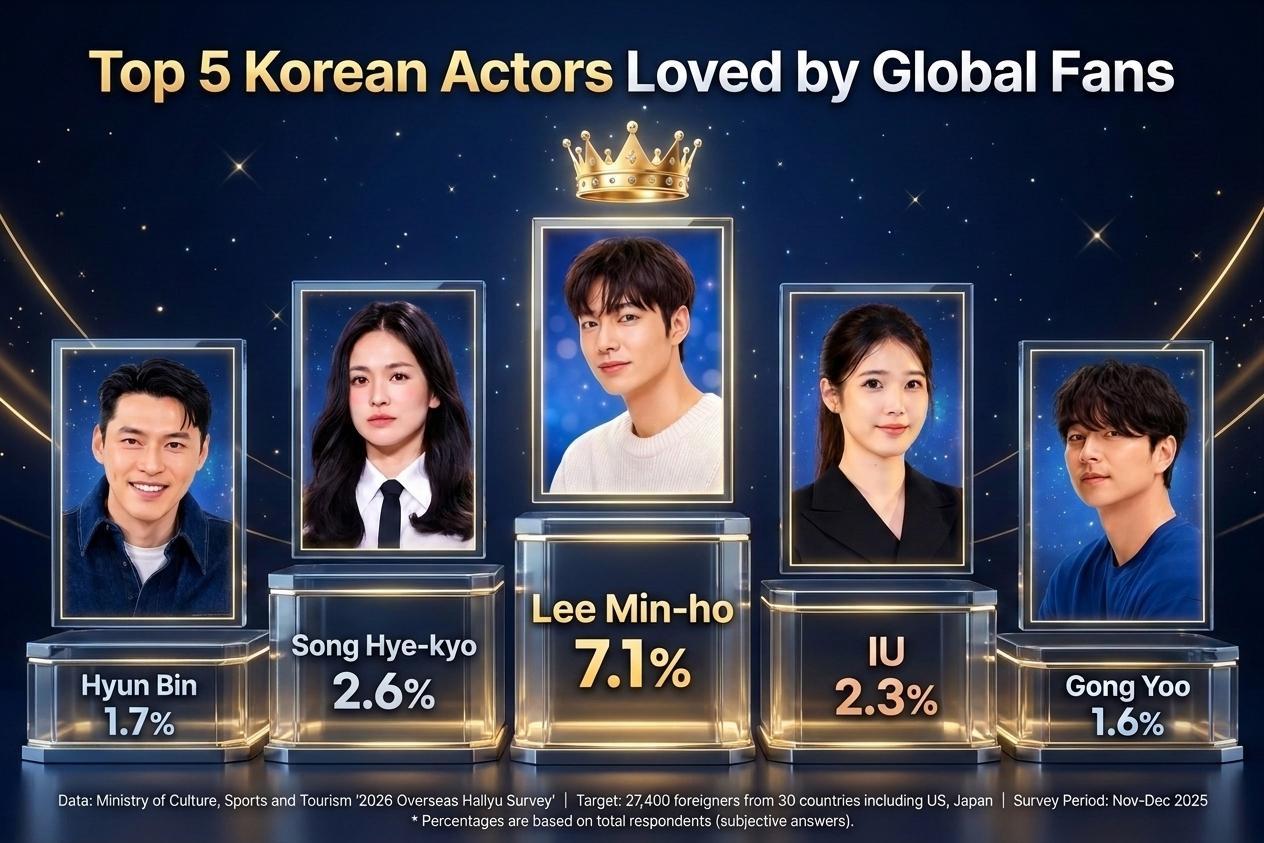
Lee Min-ho has again been named the favorite Korean actor among international fans of the Korean Wave, extending a long-running lead overseas despite weaker recent results at home.
According to the 2026 Overseas Hallyu Survey released by the Ministry of Culture, Sports and Tourism, respondents chose Lee as their favorite actor for the 13th consecutive year. The survey polled 27,400 international viewers of Korean content across 30 countries and used open-ended questions.
Lee was named by 7.1 percent of respondents, more than double the share for second-ranked Song Hye-kyo, who received 2.6 percent. Singer-actress IU followed in third place with 2.3 percent. The results showed that, among global consumers of Korean content, Lee continues to be strongly identified as one of Korea's leading screen stars.
His influence also extended beyond the actor category. In the survey's ranking of influential Korean Wave figures, Lee placed second overall behind K-pop supergroup BTS. In the Asia-Pacific region, however, Lee ranked first with 6.1 percent, narrowly ahead of BTS at 5.8 percent.
Overseas appeal contrasts with domestic setbacks
Lee's sustained global popularity contrasts with the underwhelming domestic performance of his recent projects. The survey was conducted from November to December 2025, a year in which he appeared in the drama "When the Stars Gossip" in January and February and the film "Omniscient Reader" in July. Both productions fell short of expectations in Korea.
"When the Stars Gossip" drew particular attention because it was Korea's first space drama and reportedly cost 50 billion won ($33.8 million) to produce. But its storyline, centered on childbirth in space, did not connect with many viewers, and ratings remained in the 1 percent to 2 percent range. The result raised questions about Lee's domestic appeal and why his overseas influence continues to grow as a representative face of the Korean Wave.
Researchers and industry officials say Lee functions as an entry point into Korean popular culture for many international audiences. They cite a first-exposure effect: his signature dramas "Boys Over Flowers" (2009) and "The Heirs" (2013), though released more than a decade ago, remain common starting points for viewers discovering Korean dramas. The phenomenon reflects how the Korean Wave, or Hallyu, has evolved since the late 1990s from a regional cultural export into a global industry spanning music, film, television and beauty, with the Korean government actively supporting overseas cultural promotion through agencies including the Ministry of Culture, Sports and Tourism and KOFICE.
Lee Hyun-ji, head of the Cultural Exchange Research Center at the Korea Foundation for International Cultural Exchange (KOFICE), said many overseas fans first encountered the Korean Wave through those two dramas.
"That initial experience appears to significantly influence their subsequent perception of Korean culture," she said.
While actor Bae Yong-joon introduced older Japanese audiences to Korean content through "Winter Sonata" (2002), Lee broadened the audience base to viewers from their teens through their 30s.
Influence across Asia
Indian director Ra. Karthik made the Netflix film "Made in Korea" (2026) after being introduced to Korean dramas through his family. In a written interview with the Hankook Ilbo, he said his wife liked Lee so much that they regularly watched his dramas over breakfast.
"Watching her explore Korean food, lifestyle and people inspired my project" the director said.
Han Song-i, a North Korean deflector and broadcaster who fled to South Korea in 2013, said Lee's romantic lines in "The Heirs" strengthened her desire for freedom. She jokingly added that she came to South Korea just to see him, illustrating the strong first impression he left on viewers who encountered K-dramas in North Korea at the time.
The "first love" effect of the Korean Wave
The "first love of the Korean Wave" effect has translated into long-term loyalty. Lee has ranked as the favorite Korean actor for 13 straight years. While younger stars in Korea are often replaced quickly depending on the popularity of current hit shows, the Korean Wave figures remembered by international fans tend to change less frequently.
Although Lee has had relatively few recent projects, he continues to draw online attention overseas. KOFICE's Hallyu Big Data Dashboard recorded 269 online mentions of Lee over a recent one-month period, placing him 19th among tracked keywords.
Hong Min-jung, a researcher at data analytics consultancy Ars Praxia, said Lee remains a subject of discussion among international fans.
"They (international fans) have been comparing Lee to Gen Z stars like Cha Eun-woo or anticipating a reunion project with Park Shin-hye, his romantic co-star in 'The Heirs,'" she said.
His loyal global fan base also helps explain why Apple TV+ cast him in a leading role in its original series "Pachinko," which reportedly had a production budget of 100 billion won.
An official from a domestic drama production company said streaming platforms remain eager to cast Lee to attract subscribers, prioritizing his international audience regardless of his domestic standing. Lee's career shows that domestic commercial results and overseas influence do not always move together. The divergence underscores how global streaming platforms including Netflix, Amazon Prime Video and Apple TV+ have increasingly invested in Korean originals since the breakout success of "Squid Game" (2021), changing how Korean content is financed, cast and distributed for worldwide audiences.
Streaming platforms reshape overseas Korean content
Lee's case illustrates how long a first encounter with the Korean Wave can remain with overseas fans, while global streaming platforms are also changing the types of Korean content watched abroad.
Netflix drama "When Life Gives You Tangerines" (2025) ranked second among the most popular Korean dramas, behind "Squid Game." It was the first time in five years that a family drama entered the top three.
Set in 1960s Jeju, "When Life Gives You Tangerines" connects one family's life story with Korea's modern history. Instead of focusing on high-intensity action or provocative thriller elements, global viewers paid attention to subjects such as the different social worlds of Korean in-laws and the 1997-98 Asian financial crisis.
An analysis of 761 English-language Reddit posts of at least 100 characters related to the drama showed strong engagement with those themes. Posts about the Korean family totaled 197, while posts about modern history totaled 85, together accounting for approximately 37 percent of the discussion.
This article from the Hankook Ilbo, the sister publication of The Korea Times, is translated by a generative AI system and edited by The Korea Times.

