How Lagos Life turned a viral city simulation into a $170,000 advertising business
Key Takeaways
- •Creator Shalom Rayhamen built the first version of Lagos Life in eight hours, and the game claimed more than $170,000 in earned and contracted revenue between October 1 and 9, 2026.
- •Lagos Life is free to play and earns money by selling advertising on virtual billboards in recreated Nigerian cities, with each slot priced at ₦250,000 ($188) per week.
- •TechCabal counted 244 advertisements across 40 virtual billboards on October 9, worth about ₦61 million ($45,870) for a single week, while total placements including the Lagos Lagoon reached roughly 959.
- •About 90,000 players were online on the morning of October 9, and Vatar, the company behind the game, raised a $500,000 angel round to support growth.
- •Disclosed running costs of roughly $6,500 monthly—about $2,000 for AWS hosting and $4,000 for Cloudflare protection—mean the business depends on repeat advertiser bookings to sustain itself.
Between October 1 and 9, 2026, Lagos Life, a browser-based simulation game modelled on Nigerian city life, went from an overnight project to a business claiming more than $170,000 in earned and contracted revenue—a mix of money already collected and bookings committed for future weeks. Its creator, Shalom Rayhamen, built the first version in eight hours. Inside the game, players develop virtual lives—taking jobs, building relationships, and passing landmarks they recognise from real life.
Keeping millions of players online now costs thousands of dollars each month, while virtual billboards and advertising plots have become a genuine source of income for the game.
Lagos Life is free to play, but businesses pay to reach its audience. On the morning of Friday, October 9, TechCabal counted 244 advertisements across 40 virtual billboards in Lagos, Port Harcourt, and Abuja—three real-world Nigerian cities reproduced inside the game.
At the disclosed rate of ₦250,000 ($188) per advertisement per week, those placements equal ₦61 million ($45,870) in advertising for a single seven-day period. Some advertisers have booked additional weeks, pushing the total booking value higher, and more billboard advertisements have likely gone up since TechCabal's count.
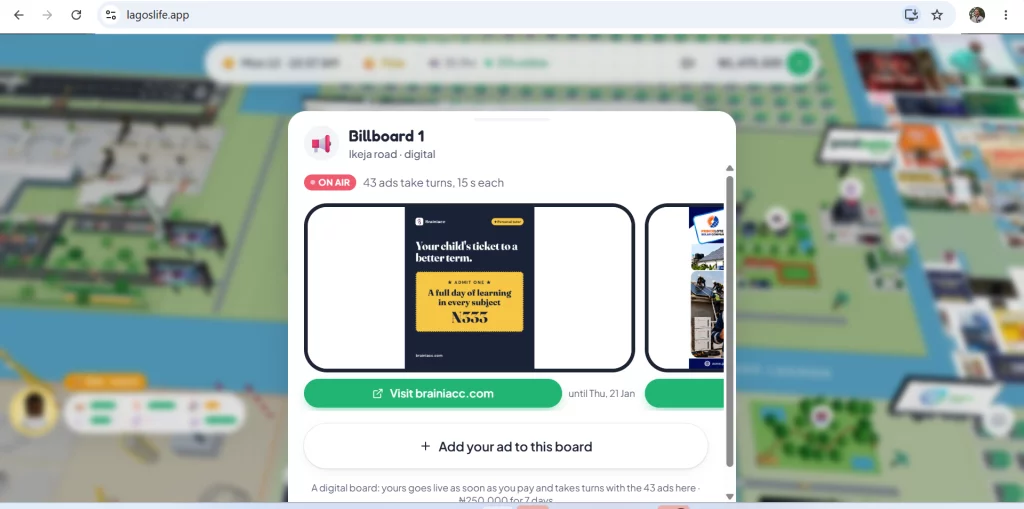
One virtual billboard alone carries 43 advertisements, worth ₦10.75 million ($8,083) for one week at the same rate.
The Nigerian life-simulation game has found a paying market within days of launching. Part of its earning power comes from selling the same space to several advertisers at once. Players encounter those businesses through rotating ads, or they can tap a billboard to browse its listings.
Keeping that income flowing, however, will depend on whether advertisers win customers, whether players keep returning, and whether the cost of expanding the game stays below the money it brings in.
What ₦250,000 actually buys
Monetisation is a persistent headache for many game makers. In September 2025—roughly a year before Lagos Life launched—Yemi Johnson, co-founder of Hyper, a Nigerian company that builds casual games, told TechCabal that building a game and delivering a great gameplay experience would always clash with how studios make money.
“If developers spend $0.5 to acquire a gamer, then they need to show you >$0.5 worth of ads. At a CPM [cost per mille] of $10 per thousand views, it means they need to show you 50 ads just to break even,” Johnson said.
Video games typically monetise in three ways: offering free access funded by advertising, charging upfront to unlock gameplay, or combining both. Some also sell in-game currencies that users purchase with real money.
Lagos Life has chosen the free-to-play model—running entirely in a browser, with no download or upfront purchase required to enter. Its simulation-style world-building lets it monetise quickly by selling advertising space in real-world places players recognise, including roadside billboards, airports, and the Lagos Lagoon. Businesses pay to become part of the world players spend time in.
Sustaining that loop depends on repeat bookings covering running costs and pushing the game toward break-even. Keeping advertisers paying means giving them enough visibility to justify another ₦250,000 ($188) when their seven days expire.
On the morning of Friday, October 9, Lagos Life was running 244 ads across 40 virtual billboards, with each advertiser paying at least ₦250,000 ($188) per week.
Take Billboard 1, the signpost on the game's Ikeja Road, which displays advertisements from 43 brands—the most in the game. Each advertisement stays on screen for 15 seconds before the next appears. Cycling through all 43 takes 10 minutes and 45 seconds before the first advertisement returns.
Assuming equal, continuous rotation, each brand receives about 2.33% of the billboard's screen time. Across seven days, that adds up to roughly 3 hours and 54 minutes. Under this rotating model, an advertiser paying ₦250,000 ($188) for the week is paying about ₦1,066 ($0.80) for each minute their advertisement is displayed.
How much attention does a shared billboard buy?
In Lagos Life, advertisers pay for a place on a virtual billboard. But when dozens of brands share one screen, how much attention does each actually get?
Whether advertisers renew depends on how many players see each advertisement and the business it brings them. Selling more slots on the same billboard increases Lagos Life's revenue but reduces each advertiser's share of the screen.
Players do not have to wait through the rotation; they can tap a billboard and scroll through its advertisers, especially on mobile devices, where TechCabal tested the feature.
On October 5, Rayhamen reported on X that the game had generated $46,900 in revenue, mostly from advertising. Billboard advertising has grown since that first wave, and her team has expanded the opportunities for advertisers by opening up more spaces across the game's three cities.
About 90,000 players were actively online on the morning of Friday, October 9, giving Lagos Life a sizeable audience to sell access to.
The ₦250,000 eyeball test
Lagos Life had about 90,000 players online at one point. But how many might encounter a single advertisement on a crowded virtual billboard? TechCabal modelled the question with the following assumptions.
Source: TechCabal's October 2026 reporting on Lagos Life. Reference figures: approximately 90,000 concurrent players, 43 ads on Billboard 1, 15-second slots, and a ₦250,000 seven-day billboard booking.
Methodology: Passing players = online players × assumed traffic share. Encounter probability = min(1, (viewing seconds + 15) / (advertisers × 15)). Modelled exposure opportunities = passing players × probability. Scenario CPM = ₦250,000 × 1,000 / exposure opportunities.
Limitations: This is an illustrative single-pass model, actual weekly reach or verified CPM. Any temporal overlap counts, however brief. Actual attention, repeat visits, manual billboard browsing, and conversions are not measured.
Those players were spread across different locations. An advertiser's audience depends on how many pass its billboard while its ad is showing, and how long they remain within view. A player passing Billboard 1 for a few seconds could miss an advertisement that appears only once every 10 minutes and 45 seconds.
New billboards could allow Lagos Life to sell more ads without making brands share crowded screens. Their value, however, depends on attracting player traffic. Opening more advertising spaces does not automatically create more viewers.
Evidence of how many players actually see each placement, and how many visit or buy from the business afterwards, would give advertisers a stronger reason to renew.
Lagos Life has also expanded advertising to its virtual Lagos Lagoon, which carries about 715 ads, bringing the total to about 959 placements roughly a week after launch, according to TechCabal's checks. The game has also erected more than 20 additional billboards at its virtual airports and popular landmarks, including Jabi Lake Mall in Abuja, Nigeria's capital city.
How many bookings pay the bills
Rayhamen told The African Engineer that Lagos Life had about $6,500 in running costs and that she had received $10,000 in AWS credits. The biggest bills are Amazon Web Services (AWS), which hosts the game, at roughly $2,000 monthly, and Cloudflare, which helps protect it from bots and attacks, at about $4,000 monthly.
At that rate, the AWS credits could cover five months of eligible hosting charges, although higher usage would use them up sooner.
Keeping the game running also means fixing problems and building features that keep players interested. Rayhamen uses Claude Code for this work. Though she already had a subscription before launching Lagos Life, Claude Code costs between $215 and $2,580, depending on the plan.
Rayhamen also uses an AI agent to collect player complaints and requests through X's developer service, she told The African Engineer. X (formerly Twitter) charges $0.005 for each standard post retrieved. Reading 10,000 posts in a month would cost about $50; increasing that to 50,000 posts would cost $250. The AI used to sort those posts could add another bill, depending on the service and how much it processes.
The game's website address is another, smaller expense. The domain, lagoslife.app, was registered on October 3, after the game initially launched on an Eliy Sites subdomain. At Cloudflare's current introductory rate, the address could have cost about $8.20 to register, with renewal at $14.20 annually.
TechCabal's checks of other city-based addresses, including phlife.app, portharcourtlife.app, onitshalife.app, beninlife.app, owerrilife.app, abeokutalife.app, and kadunalife.app, found consistent pricing for standard .app registrations.
The browser game frenzy is also creating another business: people are buying city-based domain names, such as kanolife.app, to resell. This could push up domain costs for developers who want to build similar simulation games around other cities, particularly if the addresses they want are already owned.
Buying an address, however, is a small part of building another virtual city. The larger expenses are the people creating it, the systems keeping it online, and the marketing needed to bring players in.
Purely as an estimate, Lagos Life's monthly expenses could reach about $10,000 in a higher-spending scenario, with a five-year domain registration adding roughly $65 upfront.
Set against the game's known advertising income, a lean operation could work with an illustrative budget of $10,000 monthly. The disclosed hosting and protection bills would take $6,000, leaving $4,000 for a small amount of paid help, marketing, AI tools, and other routine expenses. This assumes the founders continue doing much of the work themselves.
A middle case allows more room to hire and grow. Doubling the infrastructure allowance to $12,000, setting aside $8,000 for people and another $5,000 for marketing, tools, and administration would bring monthly spending to $25,000.
A faster expansion could take that budget to $50,000: $20,000 for infrastructure, $18,000 for people, and $12,000 for marketing and other running expenses. These are budgets for testing how the business could grow, not figures from the accounts of Vatar, the incorporated company building Lagos Life.
Now consider what one advertisement contributes. At an illustrative exchange rate of ₦1,329.91 per dollar, a ₦250,000 ($188) weekly booking brings in about $188. Setting aside an assumed 5% for collection costs and refunds leaves roughly $179 to pay the bills.
The $10,000 operation would need 56 seven-day bookings in a 30-day month to cover its running costs before tax. The $25,000 operation would need 140 bookings, while the $50,000 operation would need 280.
A simpler way to picture this is the number of ads that must remain paid for throughout the month. The three budgets would require roughly 14, 33, or 66, respectively, to remain continuously occupied, with each booking renewed or replaced at the end of its week.
Even the highest figure is only about a quarter of the 244 advertisements TechCabal counted. Keeping 61 slots paid for throughout a 30-day month would bring in roughly $46,700 after the assumed deductions, almost enough to cover the faster-expansion budget.
The opportunity is substantial, but it depends on repeat sales. Several weeks paid upfront give Lagos Life cash immediately, while committing it to displaying those advertisements later.
Vatar's $500,000 angel round—early-stage funding from individual investors—gives it time to build that repeat business. Assuming the full amount remains available and no revenue comes in, it would cover about 50 months at $10,000 monthly spending, 20 months at $25,000, or 10 months at $50,000. These estimates assume spending stays unchanged.
Rayhamen's reported $10,000 AWS credit could cover five months of eligible hosting costs, based on the $2,000 monthly bill she disclosed. But higher usage would exhaust the credit sooner.
Advertising income would reduce how much of the investment the company spends each month. Once repeat bookings cover running costs, the funding can support further expansion. Until then, every new hire and marketing campaign needs to bring the game closer to earning enough to pay for itself.
Making a bigger world pay
Lagos Life has already added about 21 more virtual billboards at airports and other premium landmarks. Advertising on the airport signposts, about 10 of them, costs ₦500,000 ($376) per slot for seven days. Whether those premium slots fill—and whether their buyers come back for a second week—will be an early read on demand above the ₦250,000 tier.
TechCabal's estimates do not account for potential bookings on those billboards or the Lagos Lagoon slots, where varying booking prices make revenue harder to estimate without disclosures.
Rayhamen uses Claude Code and Three.js, a tool for creating 3D environments, to build the game's virtual world. Adding cities gives Lagos Life more places to sell advertising, but also means more work creating locations, fixing problems, and supporting players. Each new city needs to attract enough activity to justify those costs.
Keeping that advertising income flowing means keeping gamers engaged. Familiar landmarks, virtual jobs, and relationships give players lives to develop, and some are earning real money. A therapist said on X that he had secured paid work through virtual sessions in the game, while some players are reselling advertising slots on the virtual lagoon, potentially at a markup.
More cities can extend those stories and earning opportunities, adding real financial incentives for people to play.
The financial return, however, depends on players coming back often enough to make advertisers renew their bookings. Lagos Life can keep building billboards, but getting businesses to pay for them repeatedly will depend on the life happening around them.
Exchange rate: ₦1,329.9/$1

