Kuaishou Is Listed on edgeX: Short Video, E-Commerce, AI, and the KUAISHOU Trading Thesis
Key Takeaways
- •Kuaishou Technology is now tradable on edgeX through the KUAISHOU/USDC perpetual, enabling 24/7 derivative exposure to the Hong Kong-listed stock outside traditional exchange sessions.
- •Founded in 2011 and publicly listed in February 2021, Kuaishou operates China's second-largest short-video platform by daily active users, with over 600 million monthly active users domestically.
- •The platform generates revenue through advertising, live-streaming virtual gifting, e-commerce transactions, and online marketing services built around its recommendation-driven content ecosystem.
- •The KUAISHOU/USDC perpetual is a derivative contract that does not confer ownership rights, dividends, or voting privileges associated with the underlying Hong Kong-listed shares.
- •Kuaishou has invested in AI capabilities including large language models and its Kling video-generation tool, but investors are focused on whether these investments produce measurable operating leverage rather than escalating infrastructure costs.
Quick Answer
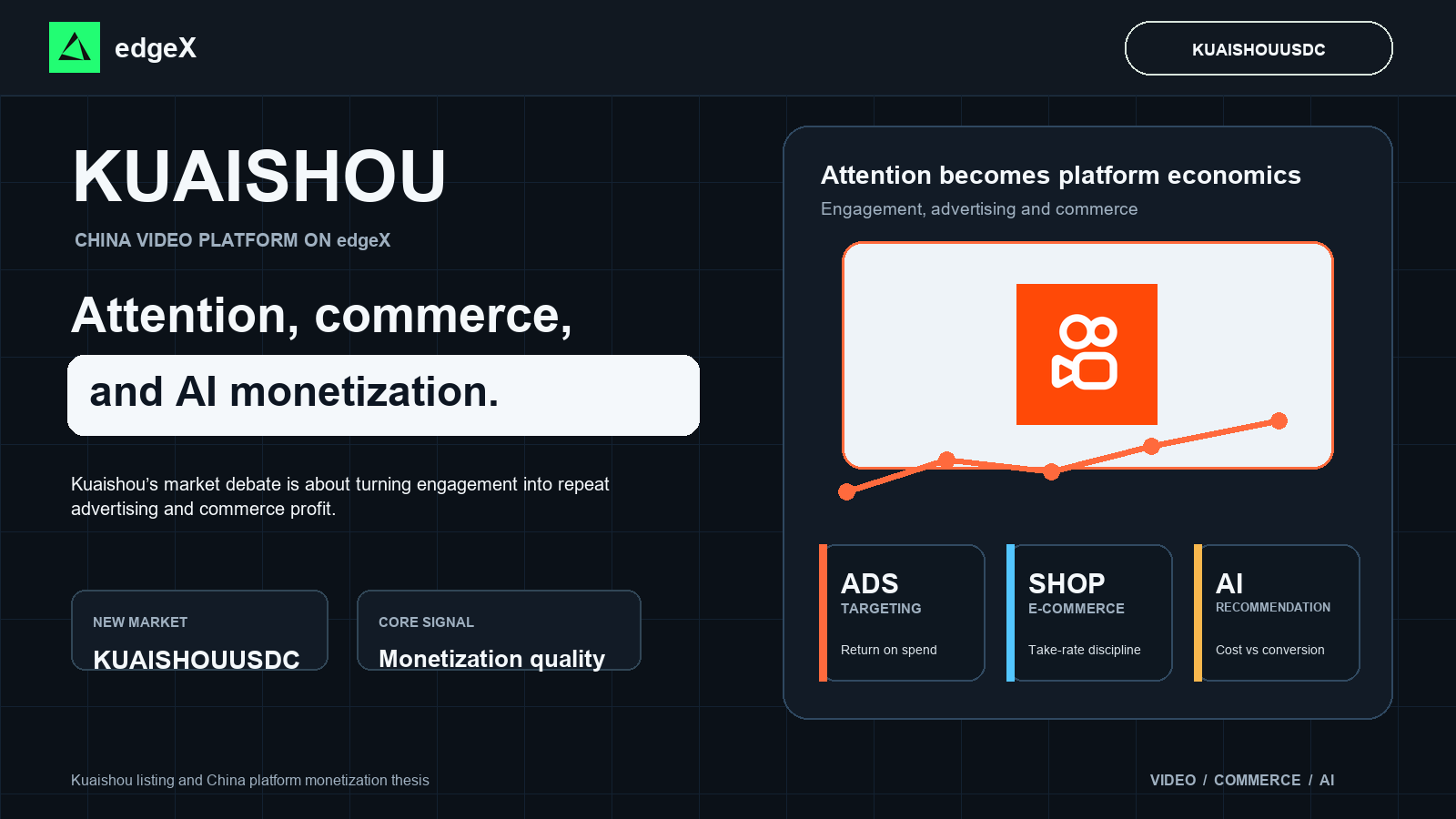
KUAISHOU refers to Kuaishou Technology, a Hong Kong-listed short-video, live-streaming and commerce platform. edgeX lists a KUAISHOU/USDC perpetual for continuous derivative exposure. The stock thesis depends on monetization quality: engagement, advertising demand, e-commerce take rate, creator economics, AI cost discipline and Chinese platform policy.
Trade the KUAISHOU/USDC perpetual on edgeX.
https://x.com/edgeX_exchange/status/2087429533532336251
Kuaishou Arrives on edgeX as China Internet Platforms Reprice Growth
edgeX has listed KUAISHOU, adding Kuaishou Technology to its V2 TradFi perpetual markets. Kuaishou operates a short-video and live-streaming ecosystem whose economics combine user attention, advertising, virtual gifting, e-commerce and local services. That mix makes the company sensitive to both consumer activity and the quality of its recommendation engine.
The listing arrives at an interesting point for Chinese internet equities. Investors want evidence that advertising and commerce can keep expanding, while they also watch regulation, competition, content costs and the changing economics of platform traffic. Kuaishou has real scale, but scale alone does not guarantee that every additional user or transaction produces attractive profit.
What Is Kuaishou?
Kuaishou is a technology platform organized around short video and live streaming. Its community is built on user-generated content, creator interaction and recommendation. Commercial activity then forms around that attention through advertising, live-streaming services, online marketing and e-commerce.
How the platform makes money
Advertising monetizes traffic and commercial intent. Live streaming lets viewers support creators through virtual gifts. E-commerce allows merchants and creators to reach users and complete transactions inside the ecosystem. The business therefore depends on a chain: users create attention, recommendations allocate that attention, creators and merchants supply content and products, and advertisers pay for measurable results.
The KUAISHOU Market Debate
| Driver | Bullish signal | Risk signal |
|---|---|---|
| User engagement | Stable daily activity and longer sessions | Traffic growth slows or content costs rise |
| Advertising | Better targeting and advertiser return | Weak macro demand or pricing pressure |
| E-commerce | Higher order quality and merchant retention | Subsidies compress take rates and margins |
| AI investment | Recommendation and productivity improve | Compute costs rise faster than monetization |
| Regulation | Clearer operating environment | New content, data or platform restrictions |
The bullish view is that Kuaishou can turn a large community into a more efficient commercial engine. Bears focus on a different risk: competition for attention keeps rising, merchants demand incentives, and platform growth becomes expensive. In practice, the market is likely to reward profit quality, not just headline user numbers.
Why AI Matters to Kuaishou
AI can improve recommendations, advertising matching, content tools and customer-service workflows. Better recommendation can raise engagement and conversion without requiring proportional traffic growth. Generative tools can also help creators produce content and merchants manage campaigns.
But AI is not automatically a margin story. Training and inference require infrastructure, and platform companies must decide whether efficiency gains are reinvested into product quality, creator incentives or lower advertising prices. Investors should look for measurable monetization and operating leverage rather than treating every AI announcement as a new revenue stream.
What Could Move the Stock Narrative?
The most useful evidence comes from advertising growth, e-commerce quality, operating margin, user engagement and management's explanation of AI spending. A strong quarter with rising profit can support the stock, but a weak macro backdrop may still reduce advertiser demand. Conversely, modest revenue growth can be well received if Kuaishou shows disciplined costs and better conversion.
China internet stocks also respond to policy signals and index flows. A regulatory headline can change the valuation framework quickly, while competition from Douyin, Tencent Video, Xiaohongshu and other platforms can affect user acquisition and merchant economics. The KUAISHOU perpetual gives traders access outside Hong Kong hours, which increases responsiveness and risk at the same time.
Risks for KUAISHOU Traders
Platform risk includes content governance, privacy, data security and restrictions on commercial practices. Competitive risk comes from rival platforms with greater traffic, deeper subsidies or stronger ecosystems. Financial risk comes from advertising cycles, merchant incentives, creator payouts and AI infrastructure costs.
The derivative adds market-structure risk. A perpetual is not the Hong Kong-listed share, and it does not provide dividends or shareholder rights. Funding, liquidation, spread, index timing and currency considerations can all affect the result. A trader should define risk in the contract, not only in the company thesis.
Trade KUAISHOU Perpetuals on edgeX
The KUAISHOUUSDC perpetual on edgeX gives eligible traders around-the-clock derivative exposure to the Kuaishou market. Verify current leverage, funding, fees, index methodology, liquidity and regional availability on the live market page before trading.
The Bottom Line
Kuaishou is a scaled community platform trying to turn attention into higher-quality advertising and commerce economics while using AI to improve the system. The opportunity is strongest when engagement, monetization and profit improve together. The risk is that competition, regulation or spending requirements absorb those gains. edgeX makes the market continuously accessible, but readers still need to separate user scale from durable shareholder economics.
Kuaishou’s Moat Begins With Community Behavior
Short-video platforms compete for time, but Kuaishou's economics depend on what users do after they arrive. Creator relationships, social interaction and recommendation quality influence whether attention becomes advertising impressions, live-streaming revenue or purchases.
This makes engagement quality more informative than a single user count. Investors should look at frequency, retention, time spent and commercial conversion. Traffic bought through incentives can raise activity without creating durable value, while a loyal community can support monetization with less acquisition spending.
Advertising tests the recommendation engine
Advertisers pay when the platform can find users likely to act. Better models can improve targeting and measurement, raising return on ad spend. The risk is cyclical: small businesses and consumer brands reduce budgets when demand weakens. Kuaishou must then balance price, ad load and user experience.
E-commerce adds another test. Gross merchandise value can rise through subsidies, but sustainable economics require merchant retention, repeat buyers and reasonable take rates. Investors should distinguish transaction volume from the profit that remains after incentives and fulfillment support.
Creators Are Suppliers, Customers and Competitors
Creators supply the content that keeps users engaged, but they can move between platforms. Kuaishou must offer traffic, tools and monetization while keeping its own costs disciplined. If creator payouts rise faster than commercial revenue, growth becomes less valuable.
AI can lower friction without removing content risk
Generative tools can help creators edit video, produce marketing assets and interact with audiences. Recommendation models can improve discovery. Those gains do not remove moderation, copyright, misinformation or synthetic-content risk. Better creation tools can increase both useful output and governance costs.
Management’s AI strategy should therefore be judged through retention, conversion and margin. Compute spending is justified when it creates measurable revenue or efficiency. It is less persuasive when every competitor is spending simply to maintain parity.
A Scenario Framework for KUAISHOU
In a bullish scenario, engagement remains resilient, advertising demand improves and e-commerce grows with less subsidy. AI raises conversion and productivity, allowing revenue and operating profit to advance together. The market may reward the platform with a higher-quality growth multiple.
In a base scenario, traffic is stable but monetization is mixed. Advertising improves while commerce competition intensifies, or cost discipline offsets modest revenue growth. The stock remains sensitive to each quarterly change in margin and guidance.
In a bearish scenario, users migrate, advertisers cut budgets or regulation raises operating costs. Kuaishou spends more on traffic and creators to defend activity, weakening profit. A platform can remain culturally relevant while becoming less attractive financially.
Reading a 24/7 KUAISHOU Market
Kuaishou shares trade in Hong Kong and are affected by local market hours, the Hong Kong dollar framework and mainland policy news. The edgeX perpetual may move while the underlying market is closed. That move can reflect genuine new information or speculative anticipation of the next open.
Before trading, check whether the news changes Kuaishou's operations or merely the valuation of Chinese internet stocks as a group. A policy headline can move the sector without affecting near-term advertising. A competitor promotion can matter more if it changes merchant incentives or user acquisition cost.
Funding and liquidity deserve the same attention as the company thesis. Continuous access is useful, but overnight gaps and thin periods can make leveraged exposure fragile. Position size should leave room for the underlying Hong Kong session to disagree with the perpetual market's initial reaction.
Monetization quality is the real question
A stronger Kuaishou story is not just more traffic; it is traffic that converts with less subsidy and lower friction. That means advertisers buy more efficiently, creators earn more without forcing the platform to overpay, and commerce grows with a healthier take rate. When those pieces align, the business begins to look less like a pure attention play and more like a diversified monetization platform.
Investors should also watch whether AI reduces operating drag. Better recommendation, moderation and creator tools can lift efficiency, but they can also become an arms race if rivals spend just as aggressively. The question is not whether Kuaishou uses AI. It is whether AI improves unit economics faster than it raises infrastructure and compliance costs.
The same discipline applies to live streaming. Revenue can rise when users spend more, but the platform must share part of that activity with creators and manage the cost of maintaining a healthy ecosystem. A better result is not simply a higher gross transaction figure. It is stronger contribution after creator incentives, payment costs, traffic acquisition and content governance. Those measures help distinguish durable monetization from a temporary burst of spending.
Kuaishou's international and domestic businesses may also deserve separate scrutiny. Different markets have different advertising demand, content rules and payment behavior. Blended growth can conceal a weaker core or an expensive expansion effort. Investors should ask which segment is producing incremental profit and whether management is allocating AI and traffic investment toward the highest-return opportunities.
A one-time jump in daily active users is useful, but it is not enough. The better signal is repeat monetization: Kuaishou turning attention into advertising, commerce and creator revenue again and again without relying on heavier subsidies. That is what separates a temporary traffic spike from a platform business that can deserve a stronger valuation.
What Would Make the KUAISHOU Setup Stronger
The strongest Kuaishou setup would show that the platform is monetizing attention with less friction. That means advertising demand improves, e-commerce conversion rises, creator incentives remain controlled and AI tools raise efficiency rather than simply adding cost. The company does not need every business line to accelerate at once. It needs evidence that user behavior is becoming more commercially valuable.
The warning sign is growth bought with subsidies
Traffic and transaction volume can look strong when a platform spends aggressively. The harder question is whether users, merchants and creators remain after incentives normalize. If growth requires rising subsidies, higher creator payouts or heavier traffic acquisition, the stock may struggle even when headline engagement is healthy. For KUAISHOU traders, the better signal is repeat monetization that improves without a matching rise in platform spending.
Trade KUAISHOU/USDC Perpetuals on edgeX
TradFi access no longer has to stop when traditional exchanges close. edgeX gives traders around-the-clock access to selected stock and exchange-traded-product perpetuals through a self-custodial venue. Users retain control of their assets and authorize fund movements themselves, while the platform is built for fast execution and transparent on-chain settlement.
24/7 Access to Listed TradFi Markets
The newly listed KUAISHOU/USDC perpetual lets traders express a long or short view on the referenced market without waiting for the next traditional-session open. A perpetual is a derivative, not ownership of the underlying security. Traders should check the live contract page for current leverage, funding, fees, liquidity, index methodology, contract specifications and regional availability.
Self-Custody and Market Infrastructure
edgeX combines decentralized settlement with an order-book trading experience. The platform describes institutional-grade liquidity, high-speed matching, self-custody and no KYC onboarding. Product availability and performance claims can change, so traders should verify current terms directly on edgeX before trading.
Leverage Changes the Risk Profile
Leverage can magnify both gains and losses. Funding payments, liquidation, spread, slippage, reference-price differences and market gaps can all affect results. A view can be directionally correct and still lose money if position size or timing is poorly managed.
Frequently Asked Questions
How does Kuaishou make money beyond short-video traffic?
Kuaishou monetizes attention through advertising, live-streaming services, e-commerce and related platform tools. The quality of that monetization matters more than traffic alone.
Why does engagement quality matter more than user count?
A large audience is valuable only if users return, interact and convert. Advertisers and merchants care about measurable action, not just headline activity.
How can AI improve or hurt Kuaishou economics?
AI can improve recommendations, creator tools, moderation and ad targeting. It can also raise compute and compliance costs if spending becomes defensive rather than profit-enhancing.
What should traders watch before using the KUAISHOU/USDC perpetual?
Watch advertising demand, e-commerce subsidy intensity, creator payouts, policy signals, Hong Kong market gaps and edgeX funding, depth and contract terms.
Does the edgeX perpetual represent ownership of the underlying?
No. It is a derivative contract. It does not provide voting rights, dividends, or a claim on the underlying issuer's assets.
What should traders verify before opening a position?
Check the live edgeX market page for current funding, fees, leverage, liquidity, index methodology, contract specifications, and regional availability.

