Kraken Pro Rolls Out Unified Wallet in the EEA, Linking Spot Holdings to Futures Risk
Key Takeaways
- •Kraken Pro launched its Unified Wallet for eligible European Economic Area clients on October 16, 2026, and the feature remains inactive until the user manually enables it in account settings.
- •Once activated, the wallet combines spot, margin, Earn, and futures balances into a single shared collateral pool, meaning a losing futures position can access funds across all eligible products.
- •USDT and DAI carry a 100% collateral haircut for EEA Unified Wallet users, so these stablecoins provide no collateral value within the shared pool.
- •Cross margin serves as the default mode when the feature is enabled, with isolated margin restricted to linear Multi-Collateral futures contracts.
- •The EEA rollout supports more than 40 cryptocurrencies plus USD, EUR, and gold as collateral, while bridging spot services regulated by the Central Bank of Ireland and derivatives regulated by CySEC under licence no. 342/17.
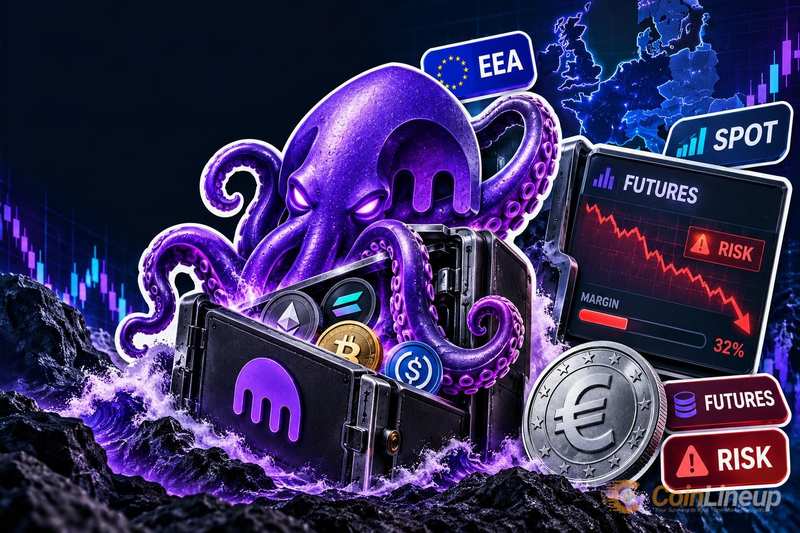
Kraken Pro has rolled out its Unified Wallet feature to eligible clients in the European Economic Area, launching on October 16, 2026, and the change carries a risk many users may not immediately notice: once activated, spot holdings can be drawn on to cover losses from futures trading.
The feature is off by default and requires a manual switch in account settings. But the moment a user enables it, all eligible balances — including spot, margin, Earn, and futures funds — are pooled into a single shared collateral, according to Kraken's official announcement.
Under separate wallets, a futures loss stays within the futures wallet. Under the Unified Wallet, there is no such wall. Kraken's own documentation states that a losing position can draw on a customer's entire eligible balance.
How the Unified Wallet Links Spot Funds to Futures Outcomes
A unified wallet, in simple terms, is a single account balance that backs all trading activity at once. Think of it as combining a savings account and a margin trading account into one pot, so that losses in one area can pull directly from funds set aside in another. Pooled-margin account structures are common across major crypto trading platforms: they are designed for capital efficiency, letting one balance support multiple products at once instead of sitting idle in separate silos. The same design that enables capital efficiency is also what spreads risk across products.
Cross margin is the default mode when the Unified Wallet is enabled. That means any open futures position has access to the full pool of eligible funds as collateral, not just a portion the user designates. Isolated margin, which limits risk to a specific amount per trade, is only available for linear Multi-Collateral futures contracts under this structure.
The official Unified Wallet guide goes further, noting that unrealized profit and loss from spot margin, futures, and options positions can be reused as margin across products. That means a paper loss in one product can reduce buying power in another, even before a position is closed.
Returning to separate wallets is not a simple undo. Users must first close all open derivatives positions and active orders. Balances then remain in the Main wallet and must be transferred manually before new derivatives trading can begin.
Stablecoin Users Face an Additional Surprise
EEA users who hold USDT or DAI as what they assume is a stable, safe store of value inside their account should be aware of a notable detail. Kraken assigns both USDT and DAI a 100% collateral haircut for EEA Unified Wallet users, meaning those assets contribute zero collateral value to the shared pool.
A stablecoin holder who enables the Unified Wallet and then opens a futures position may find they have less margin backing than expected. If the futures position moves against them, the loss will pull from other eligible assets, since USDT and DAI are not counted toward the collateral buffer.
Who Is Eligible and What the EEA Rollout Covers
The feature is available to eligible Kraken Pro clients in the European Economic Area. Eligibility depends on jurisdiction, account status, and which products are available in a given user's region, and not every Kraken account qualifies automatically.
Kraken says more than 40 cryptocurrencies, alongside USD, EUR, and XAU (gold), can serve as collateral in the EEA rollout.
From a regulatory standpoint, Kraken notes that spot services are provided by Payward Europe Solutions Limited, regulated by the Central Bank of Ireland. Derivatives are handled by Payward Europe Digital Solutions (CY) Limited, regulated by CySEC under licence no. 342/17. Kraken also states that staking and Earn products are not regulated financial products and may not carry the same regulatory protections as other services.
This cross-entity structure is worth understanding. When the Unified Wallet pools balances from spot and derivatives activity, it effectively bridges two separately regulated services. That is not necessarily a problem, but it means the risk profile of enabling the feature is more layered than a simple toggle might suggest. Kraken's growing presence in European financial infrastructure, including parent company Payward's acquisition of the European bank Saldo Bank, adds context to why the exchange is deepening its regulated product offerings in the region.
What EEA Kraken Pro Users Should Review
For EEA-based Kraken Pro users, the first step is checking whether the Unified Wallet is enabled in account settings. If it was not deliberately activated, it should be off, but it is worth confirming, especially for those who use both spot and futures products on the platform.
Users who have enabled the feature and want to understand their full exposure should review the collateral and margin disclosures inside their account. Knowing which assets are haircut, and by how much, directly affects how much genuine buffer sits between an open position and the rest of a user's funds. Because those valuations are maintained in Kraken's published support documentation, any change to the haircut schedule or the list of eligible collateral assets would directly change the effective buffer, which makes those disclosures worth periodic review rather than a one-time read. Anyone uncertain about how the feature affects their specific account should contact Kraken support directly for confirmation, rather than relying on general guidance.
The Crypto Fear and Greed Index currently sits at 59, in Greed territory, which historically correlates with higher leverage usage across the market. That makes understanding actual margin exposure more important, not less.
Bitcoin, one of the assets eligible as Unified Wallet collateral, is trading around $81,971 with a 24-hour gain of roughly 1.5%, giving it a market capitalization of approximately $1.65 trillion. In a rising market, pooled collateral can appear comfortable. The structural risk becomes most visible when prices move sharply in the wrong direction and a futures loss starts drawing on assets a user considered separate from their derivatives activity.
The practical takeaway: the Unified Wallet is an opt-in feature, and that opt-in has real consequences. EEA users who trade futures on Kraken Pro should read the collateral terms carefully before activating it, and those who already have it on should verify exactly which assets are backing their open positions.
Disclaimer: This article is for informational purposes only and does not constitute financial or investment advice. Cryptocurrency and digital asset markets carry significant risk. Always do your own research before making decisions.
Source: CoinLineup

