KOSPI Falls 10.8% as SK Hynix and Samsung Lead Selloff
Key Takeaways
- •The KOSPI Composite Index fell 10.8% on July 28 amid a broad selloff in semiconductor stocks.
- •SK Hynix and Samsung Electronics, which together account for about half of the index, fell 14.4% and 13.6% respectively on the day.
- •Korea Exchange briefly halted program selling and then suspended all stock trading for 20 minutes after the index crossed the -5% and -8% levels.
- •The KOSPI has declined 34% from its June 22, 2026 peak and is back near its April 15 level.
- •The weakness in South Korea also pressured other markets, with Japan’s Nikkei 225 falling nearly 4% and the U.S. SOX index down 21% from its peak.
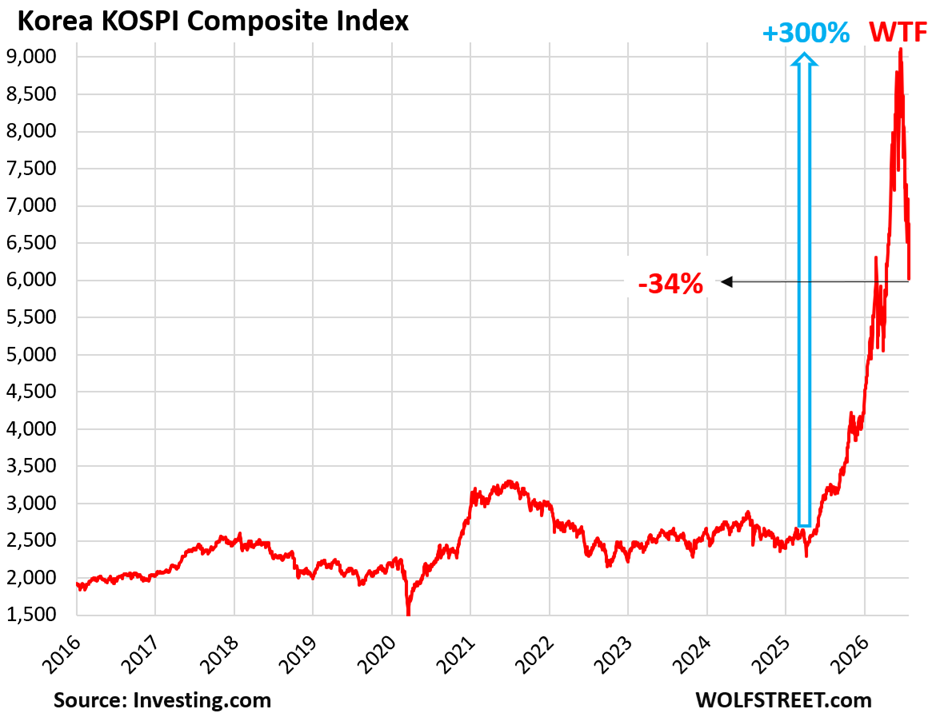
The South Korean KOSPI Composite Index fell 10.8% on July 28, as shares of Korea’s two major chipmakers, SK Hynix and Samsung, which together make up about half of the index, dropped even more amid a broad selloff in semiconductor stocks.
Since its peak on June 22, 2026, the KOSPI has declined 34% in just 25 trading days, with the slide interrupted only by sharp relief rallies.
In morning trading local time, as the index broke below the -5% level amid margin calls, forced selling, short-selling, and desperation, Korea Exchange activated a sell-side sidecar, temporarily halting program selling for five minutes. The move did little to stabilize the market.
When the KOSPI fell through the -8% level, Korea Exchange triggered a first-stage circuit breaker, suspending all trading across the entire stock market for 20 minutes. That also failed to halt the decline, and shares continued to fall. The episode underscores how quickly stress can spread in a market where a handful of large names carry outsized index weight.
The KOSPI had surged 300% from April 2025 to June 2026 in what the article described as a remarkable display of consensual hallucination, overtaking cryptocurrencies as favorite get-rich-quick gambling tokens, or whatever.
Even after the recent drop, the index is back only to where it stood on April 15 this year. In other words, about nine weeks of gains have been erased.
To reverse an entire year of gains, the KOSPI would have to fall a total of 71% from the June peak. The Nasdaq fell 78% during the U.S. dot-com bust over 2.5 years, showing that such a decline is possible.
The two large Korean chipmakers, which together account for about half of the KOSPI, moved lower in near lockstep in Korean trading:
- SK Hynix: down 14.4% on the day and down 48% from the June peak.
- Samsung Electronics: down 13.6% on the day and down 41% from the June peak.
Because those companies dominate the index, their moves matter far beyond the semiconductor sector itself: they can overwhelm broader market sentiment, help determine whether intraday selloff controls are triggered, and influence how investors read the health of Korea’s equity market overall.
Market participants are now waiting to see whether dip buyers will step in and trigger another rally.
The weakness in the KOSPI also pulled down another strong market, the Nikkei 225 Index, which fell nearly 4% on the day.
In the United States, the semiconductor selloff has lagged the one in South Korea, but it has still been significant. The PHLX Semiconductor Index [SOX] has fallen 21% from its peak on June 21, after a huge run-up. That makes the Korean moves a useful reference point for watching whether the pressure remains concentrated in a few heavyweight chip names or broadens further across global technology shares.