Kospi Falls 10.8% as China’s Chipmaking Advances Roil Tech Shares
Key Takeaways
- •South Korea’s Kospi fell 10.8% to 6,023.66, marking one of its steepest single-session declines in recent memory.
- •Samsung Electronics dropped 13.4% and SK Hynix fell 14.7% as chip shares led the selloff.
- •The decline followed a report that China had begun large-scale manufacturing of domestically engineered DUV lithography systems.
- •CXMT, a Chinese memory chip producer, fell 4% on Tuesday after briefly surging 466% in its Shanghai debut on Monday.
- •Regional markets also weakened, with Japan’s Nikkei 225 down 4% and Taiwan’s Taiex off 4.7%, while Hong Kong’s Hang Seng rose 0.3%.
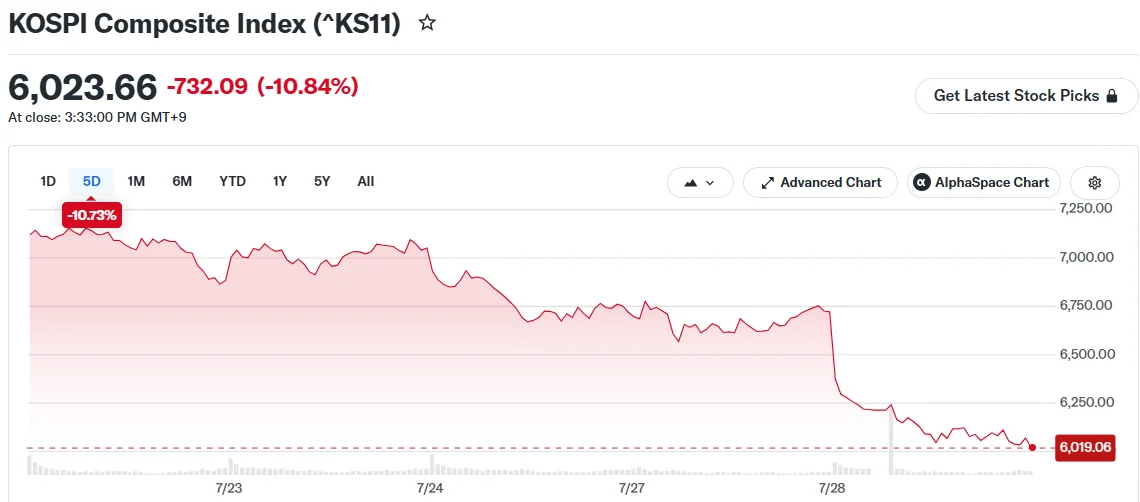
Asian equity markets were shaken on Tuesday as concerns over China’s semiconductor progress rippled through technology stocks.
The Kospi index fell 10.8% to 6,023.66, its weakest close in months. Circuit breakers were triggered several times during the session as the sharp decline set off automatic trading pauses, underscoring how concentrated the selloff was in South Korea’s heavyweight chip names.
Major Chipmakers Slide
Samsung Electronics dropped 13.4%, while SK Hynix plunged 14.7% amid heavy selling pressure. SK Hynix had recently completed its Wall Street listing, with shares priced at $149 in the initial public offering. By Monday’s close, the U.S.-traded securities had already fallen to $143, below the debut price.
The selloff followed a report from technology news outlet The Information, which said China had begun large-scale manufacturing of domestically engineered deep ultraviolet, or DUV, lithography systems. These machines are used to etch intricate circuit designs onto semiconductor wafers.
The report raised concerns that Chinese chipmakers may be closing the technology gap with global industry leaders faster than investors had expected. That matters because South Korean and Taiwanese firms are central suppliers in the memory and foundry supply chains, so shifts in perceived competition can quickly affect trading across the region.
Investor anxiety was further amplified by CXMT, a Chinese memory chip producer, which debuted on the Shanghai stock exchange on Monday and briefly surged 466%. The company raised at least $8.6 billion in the offering. On Tuesday, however, the stock fell 4%.
Morningstar analysts said the market appeared “spooked” by China’s semiconductor progress. Equity analyst Jing Jie Yu described the selloff as “largely a knee-jerk reaction and overdone,” adding that the dominant position of established global chipmakers is unlikely to face major disruption.
Wider Asian Markets Move Lower
The selling spread across regional markets. Japan’s Nikkei 225 fell 4% to 62,364.92, while Taiwan’s Taiex lost 4.7%, with TSMC shares down 3%.
Hong Kong’s Hang Seng index bucked the regional trend, rising 0.3%. Shanghai’s Composite index declined 1.2%.
In the United States on Monday, semiconductor stocks also came under pressure. Nvidia fell 5%, Advanced Micro Devices declined 5.2%, and Micron Technology lost 2.3%.
Oil prices also weakened by more than 2% as signs emerged that diplomatic tensions between the United States and Iran were easing. Brent crude fell to $84.07 a barrel, while U.S. benchmark crude dropped to $80.99.
The S&P 500 ended Monday little changed, the Dow Jones Industrial Average gained 0.5%, and the Nasdaq slipped 0.2%.
Market participants said part of the selling reflected profit-taking after a strong run in artificial intelligence-related stocks. Questions about whether the AI sector can justify current valuations have been building for months, and Tuesday’s move showed how quickly semiconductor names can be hit when policy, competition and valuation concerns converge.
Tuesday’s drop in the Kospi was one of the index’s steepest single-session percentage declines in recent memory.

