Tech and Crypto Leaders Criticize Jensen Huang’s Nvidia Exit as Shares Plunge
Key Takeaways
- •Jensen Huang stepped down after 33 years leading Nvidia, and CFO Colette Kress has taken over as interim CEO while the board seeks a permanent successor internally and externally.
- •The resignation followed reports of two extramarital affairs, including one with a businesswoman reportedly assessed by U.S. intelligence as a Chinese asset, though no evidence has established that Huang knowingly provided information to a foreign government.
- •Nvidia shares dropped 14% at Thursday's opening bell, more than $500 billion was erased from U.S. stocks within a single minute, and the company slipped from first to third among the world's most valuable companies.
- •Prominent figures including CZ Zhao, Tim Sweeney, and Erik Voorhees publicly opposed the departure, and some developers expressed concern that Nvidia under new leadership could become less supportive of open-weight AI models.
- •Nvidia's independent investigation into the security allegations continues, its roughly $12.9 billion acquisition of Hugging Face remains pending regulatory clearance, and its next earnings report is scheduled for November 17.
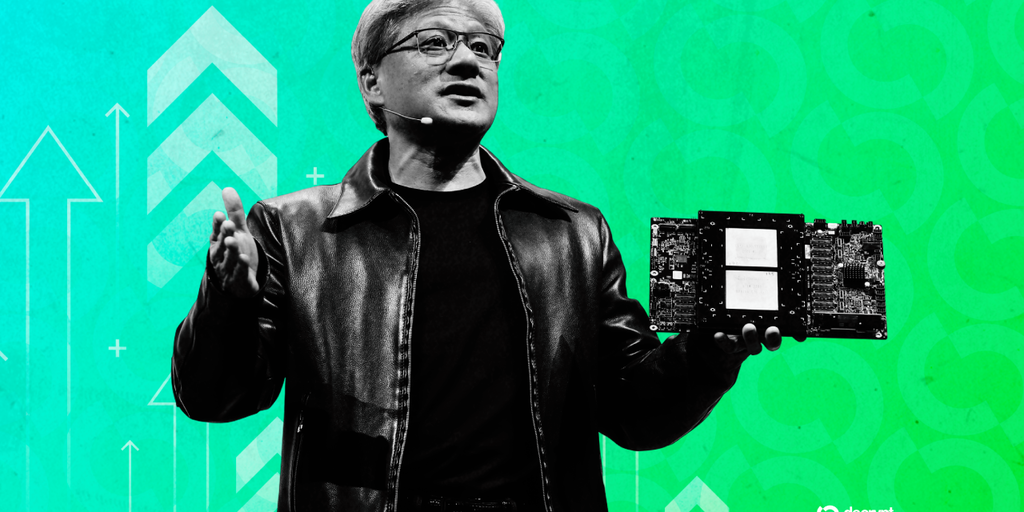
Nvidia co-founder Jensen Huang has resigned as the company’s president, CEO and board member after 33 years, prompting criticism from prominent figures in crypto, artificial intelligence and technology. The company named longtime chief financial officer Colette Kress interim CEO while its board searches for a permanent successor.
Nvidia announced the leadership change on Thursday. The decision followed reports of two extramarital affairs, including one involving a businesswoman whom U.S. intelligence reportedly suspected of having ties to China, as well as concerns about a reported relationship with an Nvidia employee. Huang acknowledged being unfaithful to his wife in a message to employees on Sunday.
In a statement from Nvidia’s board, the company said it had no reason to believe that its secrets or national security had been compromised. An independent investigation remains underway. The allegations involving foreign intelligence have not established that Huang knowingly provided information to a foreign government.
Even without evidence of a leak, however, the scandal was sufficient for the board to remove Huang, according to the account of events surrounding his resignation.
The market reacted sharply. Nvidia shares fell 14% at Thursday’s opening bell, while more than $500 billion was wiped from U.S. stocks in a single minute. Nvidia, previously the world’s most valuable company, has now fallen to third place by that measure. Because Nvidia sits at the center of U.S. AI infrastructure, its share price is closely watched across the technology industry.
The company was already facing pressure before the scandal. Huang’s departure also raised a succession question for a business closely identified with its founder: Who can replace him? Huang co-founded Nvidia and ran it for 33 years, a founder-led tenure few major American technology companies have matched.
Crypto figures call the decision a mistake
Changpeng “CZ” Zhao, the Binance co-founder and one of the most influential executives in crypto, said the decision was a mistake.
“It’s a mistake for Nvidia to let Jensen resign,” Zhao wrote on X: https://x.com/cz_binance/status/2120888881717612576?ref_src=twsrc%5Etfw
Bitcoin entrepreneur and former Kraken executive Dan Held also opposed the resignation, writing, “He shouldn't have resigned.” He argued that Huang’s personal problems should be considered separately from the company he built. Held’s post is available on X: https://x.com/danheld/status/2120890536575775223.
Erik Voorhees, the founder of ShapeShift and the privacy-focused AI platform Venice, took a more confrontational position. “The entire coup against Jensen Huang can be halted by asking a single question,” he wrote. “What evidence is there that Alice Huang is actually a Chinese spy? The answer, unsurprisingly, is absolutely zero.” His post is available on X: https://x.com/ErikVoorhees/status/2120756355028205728.
U.S. intelligence officials reportedly assessed Alice Huang as a Chinese intelligence asset. Nvidia has said it has no reason to believe that any secrets were compromised, while Singaporean authorities said they lacked sufficient evidence to establish that she had committed a crime. As of the time of publication, no law enforcement agency had presented hard evidence against Alice Huang.
Anthony Pompliano, a Bitcoin investor and commentator, shifted the discussion from Nvidia’s boardroom to the future of AI models.
“Do not get distracted by the headlines,” Pompliano wrote. “Open-source AI is essential to the freedom of billions of people in the future.” His post is available on X: https://x.com/APompliano/status/2120845035767837165?ref_src=twsrc%5Etfw.
The reaction was connected to a broader conspiracy theory circulating in open-source AI communities. The theory holds that Huang’s removal was intended to damage open-source development because Nvidia has been one of the movement’s leading corporate voices, while companies that keep their models closed view open-source systems as a threat. There is no established evidence supporting that claim.
Voorhees also raised a practical question: “Is there a decentralized Hugging Face yet?” The post referred to one of Huang’s stated commitments and reflected a crypto-oriented concern about relying on a single platform. His view is that a decentralized alternative could reduce the risk of a bottleneck controlled by one company.
That concern is particularly relevant to Voorhees because Venice AI is built around private access to open models. He previously told Decrypt that “open-source decentralization” was an antidote to excessive control over AI. His earlier post is available on X: https://x.com/ErikVoorhees/status/2120707384071143510.
Developers worry about the future of open-weight AI
Some developers viewed Huang’s departure as a threat to downloadable AI models whose underlying parameters, or weights, can be run outside the companies that created them. Their concern is that Nvidia under a new leader could become less willing to challenge companies that keep their most advanced systems behind proprietary services.
Jun Song, an open-source AI advocate and hardware entrepreneur, alleged that OpenAI and Anthropic had spent millions lobbying the U.S. Congress to restrict open weights. Song pointed to the “Pace the Frontier” campaign and argued that Huang had responded by creating the Open Secure AI Alliance.
“OpenAI and Anthropic have spent millions lobbying the US Congress to ban open weights. When they formed the "Pace the Frontier" group to push for strict limits on open models, Jensen stepped up right away. He created the Open Secure Alliance to fight back. Look at the list of…” Song wrote on X: https://x.com/jun_song/status/2120896574058291408. The post also included the URL
In July, Nvidia joined Microsoft, IBM, Hugging Face and dozens of other organizations to launch the Open Secure AI Alliance, which works on open AI security tools and standards. Nvidia also backed a letter opposing broad restrictions on open weights. The alliance was covered by Decrypt at https://decrypt.co/374401/nvidia-microsoft-ibm-open-secure-ai-alliance-cybersecurity..
The broader conspiracy theory requires substantially more evidence. The “Pacing the Frontier” initiative consists of a statement from employees at several AI companies seeking tools to slow dangerous frontier development. It is not proof of a joint corporate campaign to ban all open-weight models or remove Huang. OpenAI later signed the letter supporting open weights, while Anthropic CEO Dario Amodei said explicitly that his company had never advocated such a ban. Anthropic’s position is described at
Social media posts illustrated the anxiety surrounding the debate. One commenter replied to Song that they were now “counting on Huawei and Deepseek for the very survival of the OSS community.”
“I can't believe now I am counting on Huawei and Deepseek for the very survival of the OSS community. What a loss...” wrote Look4Newways on X: https://x.com/sflk2026/status/2120897425401643393. Huawei and Deepseek are two major Chinese companies known for their open-source developments.
The debate also has a significant commercial backdrop. Nvidia agreed in September to acquire the open-source AI repository Hugging Face for roughly $12.9 billion, subject to regulatory clearance. The deal is expected to close in the first half of 2027. Nvidia’s announcement is available at
The proposed transaction would place both the hardware used to build AI systems and the largest hub for distributing open models under the influence of one company. That prospect has intensified concerns about concentration in the AI ecosystem.
Tech leaders condemn the exit
Epic Games founder and CEO Tim Sweeney was among the most prominent technology executives to criticize Huang’s departure.
“A sad day for NVIDIA, developers, America, and all humanity,” Sweeney wrote. He praised Huang for continuing to drive innovation as Nvidia grew into an enormous company.
“A sad day for NVIDIA, developers, America, and all humanity. Jensen founded and ran one of the few companies to reach a massive scale while driving massive continued innovation and ubiquity, while others fell into the trap of ever-increasing extraction. Sweeney wrote on X: https://x.com/TimSweeneyEpic/status/2120887322312921465.
Perplexity AI co-founder and CEO Aravind Srinivas took a more personal approach, writing, “Thank you Jensen Huang for 33 years of bold leadership.” Srinivas also credited Huang’s generosity toward other founders, including himself, with helping shape the future of American AI. His post is available at https://x.com/AravSrinivas/status/2120891190333607989.
Peter Steinberger, creator of the open-source OpenClaw agent and now an employee of OpenAI, said the decision appeared rushed.
“If that Spy’s goal was to destabilize one of the most successful American companies, they achieved their goal. Ousting Jensen feels rushed and not right,” Steinberger wrote on X: https://x.com/steipete/status/2120903527803564397?ref_src=twsrc%5Etfw.
Financial commentator The Kobeissi Letter had urged Nvidia’s board to consult shareholders before taking action. The account argued that there was no obvious replacement and cited research on the costs of removing successful CEOs. After the announcement, it described the resignation as “the most costly mistake of the AI Revolution.”
Former DWS executive and corporate-governance critic Desiree Fixler invoked directors’ fiduciary duty. She said the board should protect shareholders rather than indulge what she called a media frenzy. Her post is available at https://x.com/desireefixler/status/2120805335422099955.
Most reactions were supportive of Huang and separated his personal affairs from his business record. The corporate-espionage allegations did not appear to change that view among many technology enthusiasts.
Bitcoin and privacy advocate Neil Woodfine described Huang as a founder who had taken Nvidia from its beginnings to the top of the industry, promoted free and local AI, and was then displaced by a managerial establishment that believed it could do better.
“This Jensen Huang thing is so ugly. Guy takes a company from zero to absolute pinnacle, through blood, sweat, and tears, a pure founder’s founder, great products, makes so many people rich beyond their imaginations, champions open free local AI, and then the incumbent modern…” Woodfine wrote on X: https://x.com/nwoodfine/status/2120792593886027943?ref_src=twsrc%5Etfw.
Not everyone believed the security questions could be dismissed. North Dakota Republican Sen. Kevin Cramer had called for Huang’s departure, warning about the risk of blackmail and saying Nvidia’s internal investigation was insufficient. Concern in Washington has largely centered on the possibility of compromising pressure against the head of a company central to U.S. AI infrastructure.
President Donald Trump has remained supportive of Huang. “He’s definitely suffering,” Trump told the press. “I think he’ll be in good shape.”
Speculation about Huang’s next job spread as quickly as criticism of his departure. When an X user asked Elon Musk to hire Huang, Musk replied, “That would be an honor.” The exchange is available at https://x.com/elonmusk/status/2120688743111971293.
Nvidia has said that its board is seeking a permanent CEO from inside and outside the company, with Kress running the business in the interim. Alongside the leadership search, the independent investigation into the security allegations remains underway, and the proposed $12.9 billion acquisition of Hugging Face is still awaiting regulatory clearance. The company’s next scheduled earnings report is November 17, which will be the first major financial update investors receive after Huang’s departure.

