Japan July Producer Price Index Rises 7.2% Year-on-Year, Below Market Expectations
Key Takeaways
- •Japan’s producer price index increased 7.2% from a year earlier in July 2026, below the expected 7.4% rise.
- •The annual increase was faster than the revised 7.1% reading recorded in June.
- •Producer prices rose 0.1% month on month, versus forecasts for a 0.6% gain and a 0.4% rise in the prior month.
- •Persistent wholesale price pressure may strengthen views that the Bank of Japan could raise interest rates at its September policy meeting.
- •The Corporate Goods Price Index is watched closely because it can signal future consumer price inflation when companies pass higher input costs on to buyers.
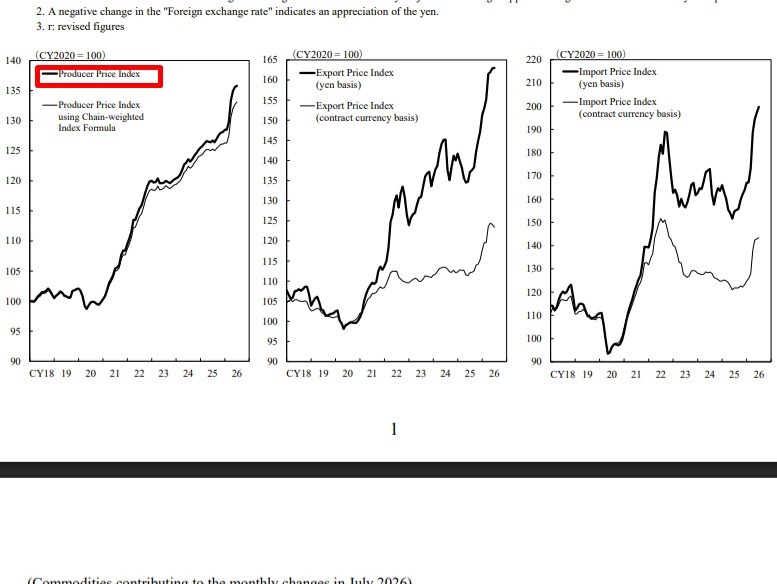
Japan's Producer Price Index (PPI), also known as the Corporate Goods Price Index (CGPI), rose 7.2% year-on-year in July 2026, according to data released by the Bank of Japan. The figure came in below market expectations of a 7.4% increase but accelerated from the prior month's revised reading of 7.1%.
On a month-on-month basis, prices increased 0.1%, significantly undershooting the forecast of 0.6% growth and decelerating from the previous month's 0.4% gain.
The elevated producer price readings are likely to reinforce expectations that the Bank of Japan may consider a further interest rate hike at its September policy meeting. Persistently high input costs for Japanese corporations continue to signal underlying inflationary pressure in the world's fourth-largest economy, where policymakers spent decades combatting deflation before a sustained shift toward price growth emerged. The BOJ began dismantling its ultra-loose monetary policy framework in 2024, ending years of negative interest rates, and wholesale price trends that remain sticky above the central bank's 2% inflation target keep the case for further normalization intact.
The Corporate Goods Price Index measures the price changes of goods traded among companies in Japan and is closely monitored by the Bank of Japan as a leading indicator of consumer price inflation, since companies facing sustained rises in raw material and energy input costs tend to pass those costs downstream to consumers over time.
Source: ForexLive
